49 works in this view — arrow keys or swipe to move between them.
Dance in Art
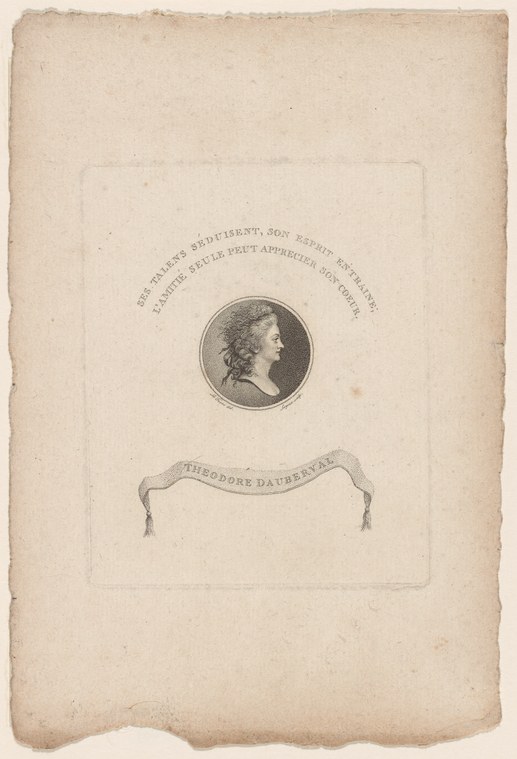
Theodore Dauberval. Ses talens seduisent, son esprit entraine; l'amitié seu le peut apprecier son coeur
Unknown artist
- Collection:
- Prints depicting dance
- Source:
- New York Public Library
- Rights:
- Public domain — free to use, share and adapt.
- Recorded as:
- Public Domain
Dauberval family connections are central to the history of French ballet and pantomime in the late 18th century. This portrait, though purely commemorative, preserves a record of a secondary but connected figure and gives material evidence of how members of the dance world were remembered and valued in their own time.
What you are looking at
This is a formal portrait engraving of a man shown in profile within a circular frame, set against a plain background. The sitter wears his hair long and styled in the fashion of the late 18th century, with a composed, dignified expression. Below the circular portrait sits an ornamental cartouche or nameplate bearing text that identifies the subject. The entire composition is executed in the restrained neoclassical style typical of commemorative portraiture from this period, with careful attention to the refined modeling of the face and the elegant simplicity of the presentation. The work appears designed as a formal record of the subject's identity and status rather than as a dynamic narrative scene.
The dancing
A single male figure is shown in strict profile, facing left. His body is not depicted below the shoulders, so no dance posture or gesture is visible. The head is finely modeled with particular attention to the planes of the face, the nose, and the distinctive hairstyle. There is no movement suggested, no arm position, no weight shift—this is a portrait of the head and neck only, composed for formal commemoration.
The dance depicted
The image does not depict dance or any active movement. Theodore Dauberval was a notable figure in late 18th-century French dance—the son of the choreographer Jean Dauberval, who created *La Fille Mal Gardée*—but this engraving is a commemorative portrait, not a representation of dance in performance or practice. The inscription in French reads roughly: 'His talents seduce, his spirit carries forward; only friendship can appreciate his heart.' This is a testament to his character and gifts rather than evidence of choreographic or performance work.
How it was made
This is an engraving, identifiable by the fine parallel hatching lines and the precise tonal modeling characteristic of 18th-century intaglio printmaking. The circular format and neoclassical restraint suggest it may be part of a series of commemorative portraits, possibly for a book of notable figures or as a collector's print. Engravings allowed for wide circulation and multiple impressions, making this an accessible format for preserving the likeness and memory of a notable person in the dance world.
About this work
This is a formal commemorative engraving of Theodore Dauberval, a figure connected to important developments in late 18th-century dance through his family. Though the image itself contains no dance content—it is purely a portrait—it appears in a collection dedicated to dance imagery because Dauberval's name and lineage are significant to dance history. The inscription celebrates his personal qualities rather than his professional achievements, suggesting this was created as a memorial to character and taste rather than as documentation of choreography or performance.
The work represents the broader 18th-century practice of preserving the likenesses of notable individuals in the performing arts through formal, dignified portraiture. As such it belongs in a dance archive not for what it shows but for whom it commemorates and how that commemoration was valued and circulated within the dance world of its time.
How to look at it
Examine the profile of the face and the sculptural quality of the modeling—the engraver has captured a specific individual with precision and subtlety. Notice the long, styled hair characteristic of the 1780s–1790s period. Read the inscription below to understand that this is memorial rather than documentary; the words matter as much as the image. The circular frame and formal composition situate the portrait within a tradition of honoring notable people through classical presentation.
The artist
The artist is not recorded in the catalogue. The style and execution suggest a competent neoclassical engraver working in France in the late 1700s, likely producing commemorative portraits for a cultivated audience that valued both the performing arts and the classical aesthetic of the period.
The period
This engraving dates to the late 18th century, an era when the French performing arts were experiencing significant innovation. Jean Dauberval's *La Fille Mal Gardée* (1789) had recently revolutionized ballet by introducing naturalistic movement and comic pantomime; his son Theodore was moving within this transformed landscape. Portraiture during this period had shifted toward neoclassical restraint and psychological dignity, reflecting Enlightenment ideals about individual merit and character. Engraved portraits were a primary means of preserving and circulating images of notable figures before photography, and the careful, formal nature of this work reflects the respect accorded to accomplished professionals.
Where it lives
The work is held in the New York Public Library's collection of prints depicting dance. It is catalogued as an engraving of unknown date and unknown artist, though the inscription and style place it firmly in the late 18th century.
Questions about this work
Does this engraving show Dauberval dancing?
No. This is a formal portrait—a head in profile—not a depiction of movement or performance. Dauberval is commemorated here as a person of taste and character, not documented as a dancer or choreographer in action. It belongs in a dance collection because of Dauberval's historical importance to dance, not because it shows dance itself.
Who was Theodore Dauberval?
He was the son of Jean Dauberval, the celebrated choreographer who created *La Fille Mal Gardée* (1789), one of the first ballets to introduce naturalism and comic pantomime on stage. Though Theodore himself is less well documented than his father, his name suggests he moved within the important French dance circles of the late 18th century.
What does the inscription say?
The French text translates approximately to: 'His talents seduce, his spirit carries forward; only friendship can appreciate his heart.' It is a personal tribute to his character and gifts rather than a description of his professional work.
Why is a portrait without dancing in a dance collection?
This collection preserves prints that document the world of dance and dancers across time, including portraiture of notable figures. The image is valuable precisely because it shows how people connected to the dance world were remembered and honored in their own era, and because Dauberval's family was central to the history of French ballet.
More dance artwork





