49 works in this view — arrow keys or swipe to move between them.
Dance in Art
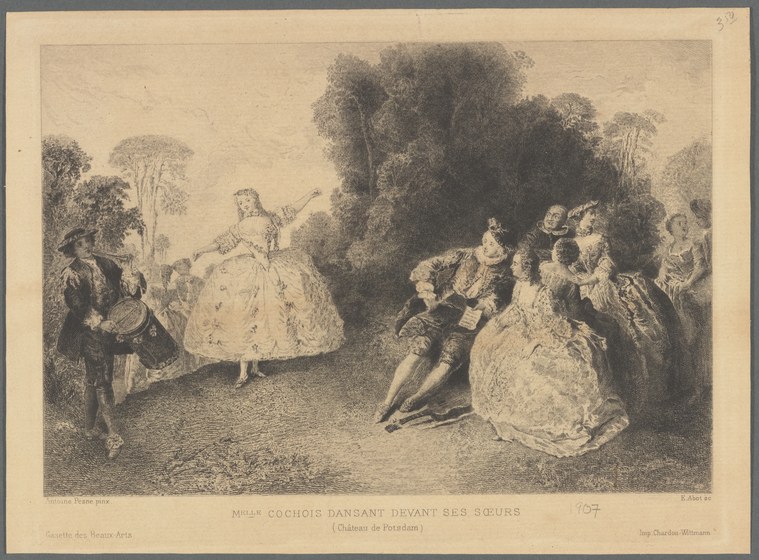
Melle Cochois dansant devant ses soeurs (Château de Potsdam)
Unknown artist
- Collection:
- Prints depicting dance
- Source:
- New York Public Library
- Rights:
- Public domain — free to use, share and adapt.
- Recorded as:
- Public Domain
The work shows dance not as performance art but as social practice and family entertainment, revealing how young women of the aristocracy displayed accomplishment through their bodies. It also demonstrates the reach of lithography in circulating images of fashionable manners and dances to aspiring middle-class audiences across Europe.
What you are looking at
A young woman in an elaborately gathered white ball gown dances before a group of spectators in a garden setting, the composition suggesting a formal court entertainment or aristocratic gathering. She stands nearly centre, her skirts billowing around her, one arm raised and the other extended, captured mid-movement. Behind and to either side stand numerous figures in period dress — men in dark coats and breeches, women in full skirts — arranged as an informal audience. The background suggests an outdoor pavilion or garden room with tall trees and architectural elements barely suggested in the soft, atmospheric technique. The whole scene is rendered in fine tonal gradation with pencil or chalk, creating a luminous quality typical of Romantic-era social scenes.
The dancing
The central dancer's body is upright with a slight forward tilt, her weight appearing to shift between feet, arms held at different heights in a pose suggestive of movement rather than static balance. Her raised arm extends openly, the other gesturing downward, conveying lightness and buoyancy. The surrounding figures are passive spectators — standing, some leaning toward the dancer in attitudes of attention — creating a clear hierarchy of active and observing bodies. No partner is visible; this is a solo performance for an audience.
The dance depicted
This appears to be a Romantic-era ballroom dance, most likely a waltz or galop given the soloist's billowing skirts and the formal garden setting. The title references 'Mlle Cochois dancing before her sisters' at the Potsdam castle, suggesting a private aristocratic performance rather than a public theatrical event. The dance style is social ballroom in an intimate setting, but the figure's isolated, admiring audience and the artist's emphasis on her figure and movement suggest this is a moment of display or performance — a young woman showcasing her accomplishment or grace for family and guests. Without visible partnering, this may represent the solo flourishes or separations that occurred within social dances of the period.
How it was made
This is a lithographic print, identifiable from the characteristic crayon-drawn or chalk-applied tones, the soft atmospheric effects, and the way the composition sits on a cream-coloured ground. The medium allowed rapid distribution of fashionable social scenes to a broad middle- and upper-class audience interested in contemporary manners, costume, and domestic life. The soft handling of light and the romantic, slightly theatrical staging suggest this was marketed to viewers who consumed prints as records of refined behaviour and aspiration, rather than documentary evidence. The technique permits the atmospheric blur of the background while maintaining clarity in the foreground figures.
About this work
This is a lithographic print of a social dance moment from the Romantic period, showing a young woman performing a solo dance before an aristocratic audience in a garden room at Potsdam. The image captures not the technical execution of the dance itself but the social and visual pleasure of the moment — the admiring audience, the elegant costume, the graceful bearing — making it a record of how dance functioned in private aristocratic life. It belongs in a dance gallery both as documentation of ballroom practice and as evidence of how Romantic visual culture staged dance as a marker of refinement, youth, and feminine accomplishment.
How to look at it
Observe the dancer's isolated position and upright, open posture — this is a moment of display, not the closed partnership of couple dances. Notice how the artist has rendered her skirts in full volume, frozen mid-swing, to convey motion without depicting footwork. The surrounding figures, rendered more summarily, establish the social context and the fact that this is a performance for witnesses. The soft atmospheric background and the careful gradations of tone give the scene a dreamlike, slightly theatrical quality, suggesting the artist (or the fashion-print tradition) saw this moment as aspirational rather than mundane.
The period
The Potsdam setting and the costume — the high-waisted, full-skirted gown and the Romantic-era spectators' dress — place this in the 1820s–1840s, the height of the waltz and galop craze in aristocratic Europe. This was the era when social dance became a primary vehicle for courtship, social display, and the performance of refined femininity. Lithography had recently become widely available as a medium for distributing scenes of contemporary life and fashion, making prints like this both documents and fashion aspirations.
Where it lives
The work is held in the New York Public Library's collection of prints depicting dance, a 19th-century social-genre collection. It is catalogued by subject rather than artist, reflecting both the commercial nature of the print and the era's classification of such works by theme rather than creator.
Dance in this work
Questions about this work
Who was Mlle Cochois?
The catalogue record provides no biographical information beyond the title. She is identified only as a young woman dancing at Potsdam castle, likely a member of an aristocratic family. The fact that she is named suggests some social prominence or that this print was commissioned or circulated within her social circle as a record of a particular occasion.
Is she dancing alone or with a partner?
No partner is visible in the composition. This may represent a solo turn or variation within a couple dance (common in waltzes and galops of the period), or a solo exhibition dance performed for the gathered audience. The absence of a partner and the frontal presentation suggest this is intentionally a display of the individual dancer's grace and accomplishment.
What dance is this?
The ballroom setting, the full billowing skirt, the upright posture, and the Romantic-era costume and audience suggest a waltz, galop, or similar social dance of the 1820s–1840s. The lithographic print tradition does not document technical detail, so the specific steps cannot be determined from the image alone.
Why is this a lithograph and not a painting?
Lithography was the primary medium for circulating fashionable images of social life to a broad European audience in the 19th century. This print was likely produced in multiple impressions and sold to wealthy middle-class and aristocratic consumers interested in contemporary costume, manners, and style — making it both a document and a fashion aspiration.
More dance artwork





