49 works in this view — arrow keys or swipe to move between them.
Dance in Art
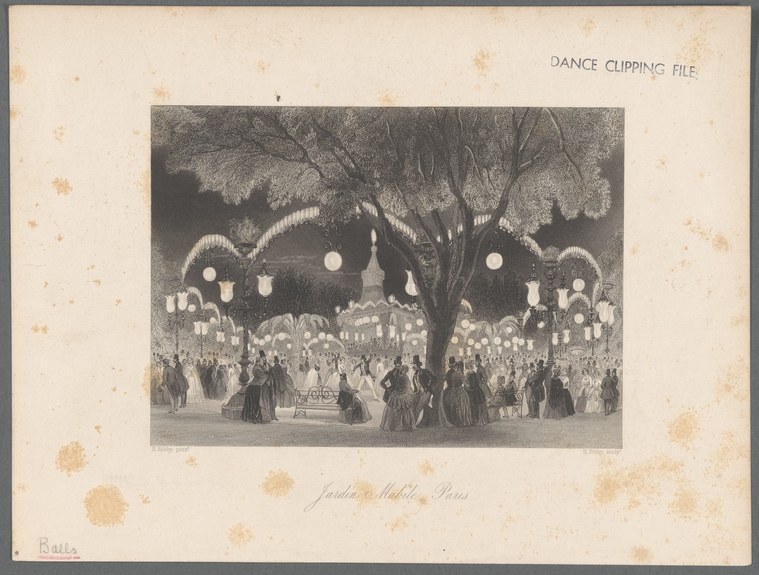
Jardin Mabille, Paris
Unknown artist
- Collection:
- Prints depicting dance
- Source:
- New York Public Library
- Rights:
- Public domain — free to use, share and adapt.
- Recorded as:
- Public Domain
Jardin Mabille was where the cancan emerged as a public scandal and cultural phenomenon. This engraving is primary-source documentation of the space, the crowds, and the atmosphere in which working-class women's transgressive dancing became a defining image of modern Paris. For historians of social dance and gender in the 19th century, such venue imagery is rare and valuable.
What you are looking at
A crowded nighttime outdoor dance venue, likely the famous Jardin Mabille in Paris, captured in a romanticized engraved or lithographed style. The scene is dominated by a large tree in the center, its canopy rendered in delicate detail, beneath which dozens of figures in period dress mill about. Gas lamps or early electric lights are suspended in arcs above the crowd, creating a festive atmosphere. The background shows a cityscape with church spires and distinctive Parisian architecture. Hundreds of small figures populate the space, many in pairs suggesting couples dancing or promenading. The composition uses the tree as both a compositional anchor and a symbol of the garden itself. The rendering is detailed yet atmospheric, with careful attention to the play of light from the suspended lamps across the crowd below.
The dancing
Most figures appear to be in casual social postures rather than formal dance holds. Some couples seem to be in close proximity, suggesting dancing or intimate promenade, but the distance and scale of the engraving make precise hold analysis impossible. The figures wear period dress—women in full skirts, men in frock coats and hats—consistent with mid-to-late 19th-century fashion. The crowds are dense and mobile rather than arranged in rigid formations, suggesting spontaneous social dancing rather than choreographed ensemble work.
The dance depicted
This depicts social ballroom and garden dancing, likely the cancan or quadrille-style entertainment that Jardin Mabille was famous for in the 1840s–1870s. The Jardin Mabille was one of Paris's most notorious pleasure gardens, where working-class and middle-class Parisians danced in the open air, and where the cancan famously emerged as a transgressive women's dance. The engraving captures the venue's character as a space of public, mixed-gender social dancing under gaslight—a significant shift from aristocratic ballroom culture. The scale and informality of the scene distinguish it from theatrical or court dance.
How it was made
This is a wood engraving or steel engraving, created using fine parallel lines (hatching) to build tone and form. The technique allowed for mass reproduction in newspapers, journals, and books, making images of Parisian leisure accessible to a broad readership across Europe. The detail and delicacy of the linework, particularly in the tree foliage and the suspended lamps, suggests skilled mid-to-late 19th-century commercial engraving. The medium implied an intended audience of educated middle-class readers interested in contemporary Parisian culture and urban life.
About this work
This engraving documents Jardin Mabille, one of 19th-century Paris's most famous public dance venues and a crucible for new social dance forms. The work captures the democratic character of mid-century Parisian nightlife—a space where social boundaries were negotiated through dance, music, and public display under electric light. For dance historians, the image is important as evidence of how social dance was commercialized, performed, and circulated in the urban public sphere. For art historians, it exemplifies the engagement of printmaking with modern leisure culture and the city itself.
How to look at it
Attend to the density and informality of the crowd—this is not a hierarchical ballroom but a mass gathering. Note the distribution of light from above, which was a novel feature of 19th-century public entertainment and something engravers worked hard to render. Observe the figures' dress: the women's full skirts, which would have been essential to the visual and physical vocabulary of cancan dancing. The choice to depict the scene at night, under artificial light, emphasizes the modernity and transgressive pleasure of the venue.
The period
The Jardin Mabille opened in 1840 and was at its height of fame in the 1850s–1870s. It opened precisely as industrial urbanization was reshaping Paris and creating new publics for commercial leisure. The venue coincided with the emergence of the cancan as a distinctive women's dance form—fast, energetic, performed in groups, with visible legs and petticoats, shocking to bourgeois morality. Engraved images of the Jardin circulated widely in European illustrated newspapers and journals, making the venue and its dances internationally famous and infamous. The garden was one of several new public dance venues (including the Bal Mabille, the Closerie des Lilas, and others) that democratized access to dance and marked the transition from aristocratic ballroom to urban commercial dance culture.
Where it lives
The work is held in NYPL's prints collection documenting dance. It is catalogued as part of a series of clipping-file materials about Parisian entertainment venues, suggesting it may have been gathered as documentary evidence of a specific cultural moment rather than preserved as fine art.
Dance in this work
Questions about this work
What was Jardin Mabille?
Jardin Mabille was a public open-air dance garden that opened in Paris in 1840 and became one of Europe's most famous venues for social dancing, music, and entertainment. It was known for its festive atmosphere, gas lighting, and as the birthplace of the cancan. The venue attracted a mixed crowd of working-class and middle-class Parisians and became internationally notorious as a symbol of modern urban pleasure and moral transgression.
What dance was performed at Jardin Mabille?
The primary dance associated with the Jardin was the cancan—a fast, energetic group dance performed mainly by women, characterized by high kicks, petticoat displays, and rapid footwork. Quadrilles and other ballroom dances were also danced there. The cancan was shocking to Victorian morality and became an emblem of Parisian modernity and female transgression.
Why would an engraving of a dance venue be made?
Engravings of leisure venues were mass-produced for illustrated newspapers, journals, and books throughout the 19th century. They allowed readers across Europe to visualize contemporary Parisian life and culture. Such images served as both documentary evidence and entertainment, feeding public fascination with the city's nightlife and new forms of public social dancing.
What does the lighting tell us about 19th-century dance?
The suspended gas lamps visible in the engraving mark this as a modern venue with access to new technology. Gaslight enabled evening and night dancing on a large scale, transforming social dancing from an afternoon or evening activity in private ballrooms to a public spectacle. This technological shift was crucial to the emergence of commercial dance culture and mass entertainment.
More dance artwork





