49 works in this view — arrow keys or swipe to move between them.
Dance in Art
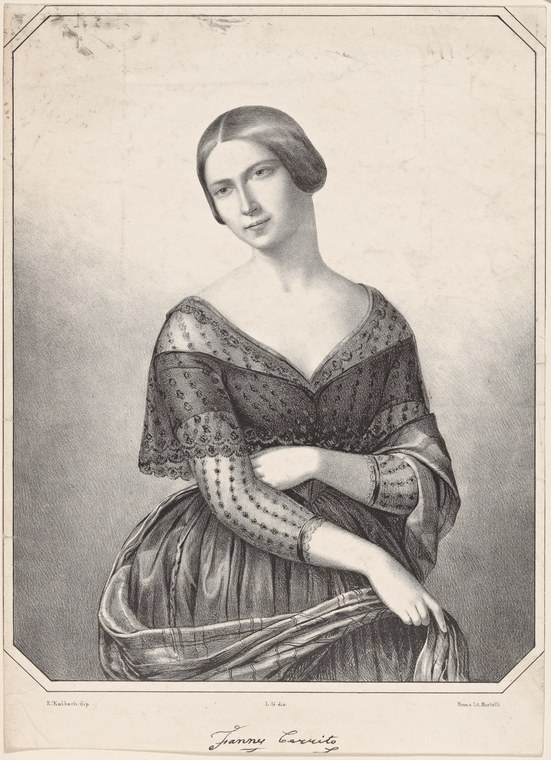
Fanny Cerrito [facsimile signature]
Unknown artist
- Collection:
- Prints depicting dance
- Source:
- New York Public Library
- Rights:
- Public domain — free to use, share and adapt.
- Recorded as:
- Public Domain
Fanny Cerrito was a virtuosa of the first rank whose career spanned four decades and who championed new technical standards for female dancers, including unprecedented skill in pointe work and jumps. This portrait, circulated as a print, illustrates how 19th-century dancers built and maintained their fame through mass-produced imagery, making them visible as celebrities in the emerging culture of visual publicity.
What you are looking at
A three-quarter-length portrait of a woman in mid-19th-century dress, shown against a plain background. She wears a dark, richly decorated dress with a deep V-neckline and sheer patterned sleeves that drape off the shoulders. The bodice is fitted and ornate, with embroidered or beaded detailing visible across the chest and arms. Her skirt, rendered in lighter tones with fine cross-hatching, suggests the full volume and gathered fabric typical of 1840s–1850s fashion. She turns slightly to the left, her head tilted with a composed, frontal gaze. Her dark hair is pulled back smoothly. The work employs fine tonal gradation across the figure, with particular attention to the translucent quality of the sleeve fabric and the play of light across skin and textile. The background remains neutral, keeping focus on the sitter and her costume.
The dancing
The figure stands in a relaxed, upright posture with her weight evenly distributed. Her left arm rests naturally at her side, while her right arm is bent and drawn across her body, the hand positioned near her waist or lap in a pose of modest repose. The shoulders are drawn back and remain level. There is no sense of active movement or dance position; this is a posed portrait of stillness and formal presentation. The body is shown in isolation, not in relation to other figures or a partner.
The dance depicted
This is not a depiction of dance. The figure is stationary and formally posed for portraiture. While the subject was Fanny Cerrito, one of the great prima ballerinas of the Romantic era (1817–1909), known for her technique and dramatic roles in ballets such as *La Sylphide* and *Ondine*, this image shows her in street dress or semi-formal attire, not in character or performance costume. The work is a portrait of the dancer as a person, not a documentation of her dancing.
How it was made
This is a steel engraving or similar print medium, identifiable by the fine parallel hatching lines used to build tone and the characteristic sharp, precise linework throughout. The technique required skilled plate-work to render the delicate gradations of the fabric, the subtle modeling of the face, and the intricate patterning of the dress. Steel engraving was the dominant method for producing multiple impressions of high-quality portraiture in the mid-19th century, making this a work intended for wide circulation—likely as a standalone print or for inclusion in illustrated journals, celebrity albums, or promotional materials. The artist's name does not appear to be recorded on the plate or in the catalogue.
About this work
This is a mid-19th-century steel engraving of Fanny Cerrito, a celebrated Romantic-era ballerina, shown in formal dress rather than in performance or dance costume. The print documents the subject as a public figure and personality rather than as a dancer in motion. It belongs in a dance gallery because Cerrito was a towering figure in the history of ballet and because the image participated in the mass circulation of celebrity portraiture that made her fame visible and accessible to audiences far beyond those who could attend her performances. The work reveals how dancers of the period were also marketed and consumed as personalities and fashion icons.
How to look at it
Look at the dress in detail: the ornate beadwork or embroidery on the bodice, the sheer patterned fabric of the sleeves, the volume and gathered quality of the skirt. These luxurious materials and styles signal Cerrito's status as a wealthy and celebrated performer. Notice how the engraver has used fine hatching to suggest the translucency and weight of different fabrics—a technical achievement of the medium. The portrait is composed in three-quarter view, a standard convention for celebrity portraiture that allows the viewer to see both the face and the full costume. The pose—relaxed, dignified, without affectation—presents the sitter as a polished public figure rather than as a character or performer.
The artist
The engraver is not recorded. Based on the signature facsimile at the foot of the print and the professional quality of the work, this was produced by a commercial engraving house serving the portrait and celebrity market of the 1840s–1860s. Such prints were typically made from paintings or drawings by portrait artists, with the engraver's name often subordinated to or omitted from the published impression.
The period
This print dates to the height of the Romantic ballet period, when dancers like Cerrito, Marie Taglioni, and Carlotta Grisi achieved unprecedented celebrity and commanded substantial fees for performances across Europe and beyond. The 1840s and 1850s saw a boom in the production and circulation of theatrical celebrity prints—steel engravings of dancers, singers, and actors that fed a mass market for images of famous performers. These prints were cheaper and more reproducible than lithographs, making them ideal for wide distribution through print shops, journals, and personal collections. The fashion industry and dance world were closely intertwined, and dancers' costumes—both stage and street wear—became objects of aesthetic and commercial interest in their own right.
Where it lives
This is a print from the New York Public Library's collection of dance-related prints. It is a wood-engraved or steel-engraved portrait print, a format that was widely produced and distributed in the 19th century, making it a relatively common type of object but one that documents the visual culture of celebrity and performance of the period.
Questions about this work
Was Fanny Cerrito a real dancer?
Yes. Fanny Cerrito (1817–1909) was one of the greatest ballerinas of the Romantic era, celebrated for her technical virtuosity, dramatic presence, and innovation in pointe work and jumps. She performed across Europe and beyond, creating and dancing in major roles in ballets including *La Sylphide*, *Ondine*, and *Gemma*, and she was one of the four stars featured in the famous *Pas de Quatre* of 1845. She retired from the stage in 1854 and later became a teacher and choreographer.
Is this what she wore when she danced?
No. This is a formal street or semi-formal dress, likely from the 1840s–1850s. When performing, Cerrito would have worn stage costumes specific to each role—long, full Romantic tutus with fitted bodices, pointe shoes, and character-specific accessories. This portrait documents her as a fashionable public figure and celebrity, not as a performer on stage.
Why is this in a dance gallery if she is not dancing?
Because the image is a primary document of 19th-century dance culture and celebrity. It shows how dancers were marketed, represented, and consumed as public figures. Such prints were important tools for building and sustaining a dancer's fame and reached audiences far beyond those who could attend performances. The image also reveals the intersection of fashion, celebrity, and the theater in the period.
Who made this print?
The catalogue record does not identify the artist. The work is a steel or wood engraving signed with Cerrito's facsimile signature, a standard practice for portrait prints. It was likely created by a commercial engraving house from a drawing or painting, and the engraver's name may have been omitted or is now lost.
More dance artwork





