49 works in this view — arrow keys or swipe to move between them.
Dance in Art
Marie Taglioni
Unknown artist
- Collection:
- Prints depicting dance
- Source:
- New York Public Library
- Rights:
- Public domain — free to use, share and adapt.
- Recorded as:
- Public Domain
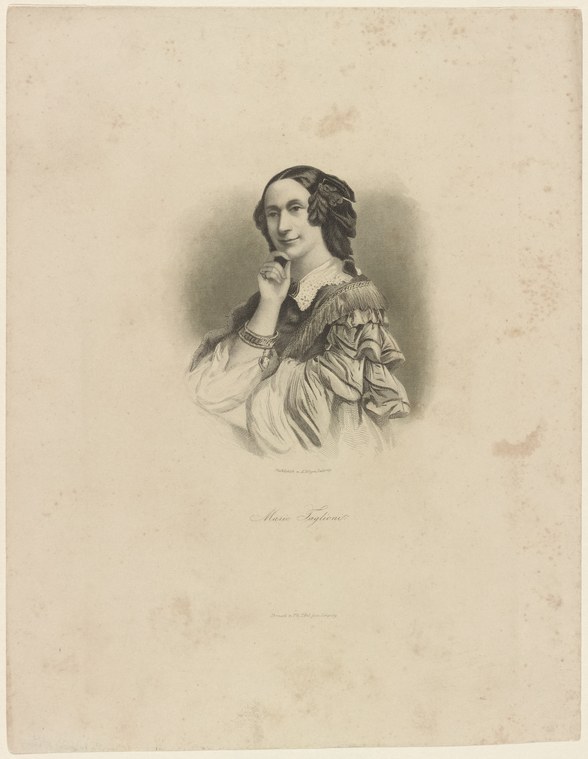
Taglioni was the defining figure of Romantic ballet and the most famous dancer of her generation; this portrait documents her public image and the costume that became iconic of Romantic ballet aesthetic. The work demonstrates how dance history was also a history of celebrity culture and visual reproduction—the portrait itself became a form through which audiences knew and consumed the dancer.
What you are looking at
A three-quarter-length portrait of a young woman, shown from roughly the waist up, gazing thoughtfully to the left with her right hand raised to her chin in a pose of contemplation or reverie. She wears a white cotton or linen dress with puffed sleeves gathered at the forearms, typical of early 19th-century theatrical costume. Her dark hair is bound up with what appears to be a decorative band or wreath. The figure is rendered in fine line engraving against a plain background with subtle tonal shading that creates volume and depth. The composition is intimate and portrait-like rather than narrative—there is no stage setting, no dance partner, no indication of movement. The work appears to be a formal celebrity portrait of the kind used for publicity or reproduction in periodicals.
The dancing
The pose is static and presentational, not a captured moment of dance. The raised hand and turned head suggest an introspective moment—a classical rhetorical gesture of thought or sorrow rather than an active position in any dance form. The body is upright, the shoulders relaxed and square. There is no indication of turnout, en dehors positioning, or any technical apparatus of ballet. The weight appears evenly distributed; the figure is not captured mid-step or mid-turn. This is a portrait pose, not a dance study.
The dance depicted
This is not a depiction of dance in action. The image is a portrait of Marie Taglioni, the celebrated Romantic-era ballerina, but it shows her at rest in a studio or sitting context, not performing. The theatrical dress—the white muslin gown—references her stage costume and fame, but the pose itself is that of formal nineteenth-century celebrity portraiture. If the work documents anything about dance, it is the costume and public image of one of the most famous dancers of the Romantic ballet era, not the technique or performance of dance itself.
How it was made
This is a line engraving, likely steel-engraved, executed with fine parallel lines to create tonal modulation and dimensional form. The technique allows for mass reproduction and was the standard medium for celebrity and theatrical portraiture in the early-to-mid nineteenth century. The quality of the engraving—precise and refined—suggests a skilled practitioner working from a drawing or painting. Engravings of this kind were issued as individual prints or bound into theatrical annuals, magazines, and souvenir collections, making them affordable and widely circulated among literate audiences. The plain background and formal composition place it in the tradition of reproductive engravings made for the print market.
About this work
This is an engraved portrait of Marie Taglioni, one of the most celebrated dancers of the Romantic era, executed sometime in the nineteenth century (exact date unknown). Rather than depicting her in performance or in a posed ballet position, it presents her as a public figure and object of admiration—a theatrical celebrity in her signature white muslin costume, caught in a moment of pensive grace. The work belongs to the broader tradition of theatre portraiture and fan culture that surrounded Romantic ballet, in which the dancer's image became a commodity separate from the dance itself. It is a work about the dancer's cultural fame and the aesthetics of Romantic femininity rather than about dance technique or choreography.
How to look at it
The portrait should be read as a work of celebrity imaging rather than dance documentation. Attend to the costume—the white gathered skirt and puffed sleeves—which became the visual shorthand for Romantic ballet. The contemplative pose and idealized beauty are conventions of nineteenth-century theatrical portraiture meant to elevate the dancer into the realm of art and refinement. The fineness of the engraving itself signals prestige and reproducibility; this was a work circulated widely to satisfy public demand for images of the famous performer.
The artist
The artist is not recorded. The engraving is professional and accomplished, suggesting a skilled theatrical portraitist or reproductive engraver working within the commercial print trade. Portraits of celebrated performers were a major commercial genre in nineteenth-century Europe, and such works were produced by both known and anonymous engravers for periodicals, annuals, and print portfolios.
The period
This portrait dates from the height or aftermath of the Romantic ballet era (roughly 1830s–1860s). Marie Taglioni became famous in the 1830s for her ethereal, weightless style and for appearing en pointe in productions such as La Sylphide (1832). Her image became synonymous with Romantic ballet's ideals of otherworldly femininity and delicate grace. The white muslin dress shown here—inspired by classical drapery—became the canonical costume of Romantic ballet and was copied by countless dancers. Engravings and lithographs of Taglioni and her rivals flooded the market during this period, satisfying an enormous appetite for images of the theatrical muse.
Where it lives
The print is held by the New York Public Library in its prints collection devoted to dance imagery. It is one of many such engravings and lithographs of celebrated nineteenth-century dancers, part of the visual archive of theatre culture.
Questions about this work
Is this Taglioni dancing?
No. This is a portrait made for publicity or collection, not a record of a performance or technique. Taglioni is shown at rest in her signature stage costume, struck in a pose of theatrical refinement. It documents her as a celebrity rather than her as a dancer in motion.
What is the white dress?
It is the Romantic ballet costume—a white muslin gown with gathered skirt and short puffed sleeves—that became the canonical dress of the Romantic era after Taglioni performed in it. The costume signaled ideals of classical grace, ethereality, and otherworldly beauty central to Romantic ballet aesthetics.
When was this made?
The date is unknown. It was almost certainly made during or shortly after Taglioni's performing career, which spanned from the early 1830s through the 1850s. The style of engraving and costume are consistent with that period.
Why is she posed this way?
The pose of contemplation with hand to cheek is a classical rhetorical gesture signifying thought, melancholy, or introspection. It was a convention of nineteenth-century theatrical portraiture used to suggest refinement, sensibility, and artistic depth—qualities audiences associated with the idealized Romantic heroine.
More dance artwork





