49 works in this view — arrow keys or swipe to move between them.
Dance in Art
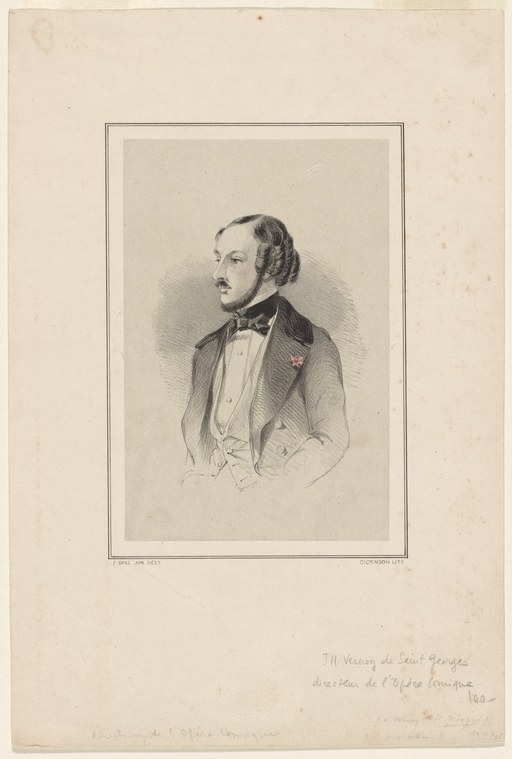
Jules Henri Vernoy de Saint-Georges, directeur de l'Opéra Comique
Unknown artist
- Collection:
- Prints depicting dance
- Source:
- New York Public Library
- Rights:
- Public domain — free to use, share and adapt.
- Recorded as:
- Public Domain
Saint-Georges's directorship of the Opéra Comique during a crucial period in 19th-century French dance makes him a key figure in institutional history. This portrait is one of few images that documents the individual behind major production and programming decisions that affected the careers of dancers and the commission of new works. For historians of dance administration and the economics of theatrical production, identifying the human face of such authority is essential.
What you are looking at
A three-quarter length portrait of a bearded man in formal 19th-century dress, shown in profile facing left. He wears a dark coat with a velvet or satin collar, a white dress shirt with visible buttons, and a bow tie. His hair is dark and swept back from his forehead in the style of the 1850s–60s. The figure is rendered in fine stippled engraving against a pale ground, with careful attention to the texture of fabric and the modeling of the face. The composition is intimate and dignified, framed by a thin ruled border, with notations in cursive script below the image suggesting this is a documented portrait, likely from a print series.
The dancing
The subject is depicted in a static, frontal pose typical of 19th-century portraiture—shoulders squared, gaze directed downward and to the left, hand visible at the waist with fingers relaxed. There is no suggestion of movement or dance gesture. The posture is one of formal repose, neither animated nor theatrical. This is a portrait of a person, not a depiction of dance practice or performance.
The dance depicted
The image does not depict dance. It is a portrait of Jules Henri Vernoy de Saint-Georges, identified in the inscription as director of the Opéra Comique. While the subject's professional role was central to the production and governance of theatrical dance in Paris during the mid-19th century, the portrait itself shows no dancer, no movement, and no dance content. The work documents its subject in his administrative capacity.
How it was made
This is a fine-line engraving or steel engraving, recognizable by its precise parallel hatching, controlled tonal gradation, and the delicate stippled texture used to model the face and hair. The technique was standard for mid-19th-century portrait reproduction and allowed for wide circulation through printing and publishing. The ruled border and notational space below indicate this was part of a documented series, likely a collected gallery of notable figures in French cultural life. The precision and high finish suggest a commercial or institutional origin.
About this work
This is a portrait engraving of Jules Henri Vernoy de Saint-Georges, director of the Opéra Comique in Paris. Although the subject's professional authority over one of France's leading dance institutions makes him significant to dance history, the portrait itself is a study in administrative formality rather than a document of dance. It belongs in this collection as evidence of the apparatus of theatrical dance production—the bureaucratic structures, personalities, and decision-making that shaped what was performed, commissioned, and preserved on the operatic stage during a period of major innovation in ballet and opera comique.
How to look at it
Attend to the formal conventions of the engraved portrait: the three-quarter pose, the controlled reveal of the subject's character through facial expression and posture, and the absence of any context or activity beyond the figure itself. This is not a narrative scene but an assertion of identity through physical presence and professional dignity. The inscription beneath confirms that the subject's name and title were considered sufficient context—he is shown as he wished to be known, without background or action.
The artist
The artist is not recorded in the catalogue. The quality and finish of the engraving suggest a skilled professional working in the mid-19th-century Parisian print trade, possibly for a publisher or gallery producing portraits of cultural figures. The style is consistent with the work of commercial engravers of the period who specialized in reproductive portraiture for institutional and private collectors.
The period
The 1850s–60s saw the consolidation of the Opéra Comique as a major venue for theatrical dance in Paris, distinct from but rivaling the Académie Royale de Musique (Opéra). Directors of these institutions wielded significant power over repertory, casting, and the commissioning of new ballets. The production of engraved portraits of such figures reflected the prestige of administrative roles and the cultural importance of theatrical institutions. This portrait dates from a period when portraiture of non-royal public figures was becoming more common and democratized through print media.
Where it lives
The work is held in the New York Public Library's collection of prints depicting dance. The existence of notational space and an inscription below the image suggests it was part of a systematic gallery or collection of portraits, possibly a published series. The presence in a dance-focused collection indicates that curators recognized Saint-Georges's professional significance to theatrical dance history, even though the portrait itself contains no dance imagery.
Questions about this work
Who was Jules Henri Vernoy de Saint-Georges?
He was a prominent French administrator who served as director of the Opéra Comique in Paris during the mid-19th century. In that role, he oversaw the commissioning, casting, and production of operas, operettas, and ballets, and exercised considerable influence over the development of French theatrical dance. He was a key figure in the institutional structures that supported professional dance.
Why is a portrait in a dance collection if it shows no dancing?
Because institutions and the people who run them are as much a part of dance history as the dancers themselves. Directors, impresarios, and choreographers made decisions that shaped which works were created, which dancers were employed, and what styles were encouraged. This portrait documents one such influential figure in his institutional capacity.
What is the engraving technique?
This is a steel or fine-line engraving, a reproductive printmaking method that uses precise parallel lines and stippling to build tone and model form. It was the dominant technique for quality portrait reproduction in the mid-19th century and allowed prints to be made in large numbers and distributed widely through commercial and institutional networks.
More dance artwork





