49 works in this view — arrow keys or swipe to move between them.
Dance in Art
Wallachia
Unknown artist
- Collection:
- Prints depicting dance
- Source:
- New York Public Library
- Rights:
- Public domain — free to use, share and adapt.
- Recorded as:
- Public Domain
This work documents the intersection of folk tradition and Romantic theatrical culture in the early 19th century, showing how European audiences encountered non-Western dance through the filter of elite artistic presentation. It preserves specific details of Wallachian dress and movement vocabulary at a historical moment when regional folk practice was being absorbed into ballroom and theatrical contexts. For historians of dance ethnography and costume, it offers concrete visual evidence of how Southeastern European traditions were perceived, aestheticized, and circulated in European visual culture.
What you are looking at
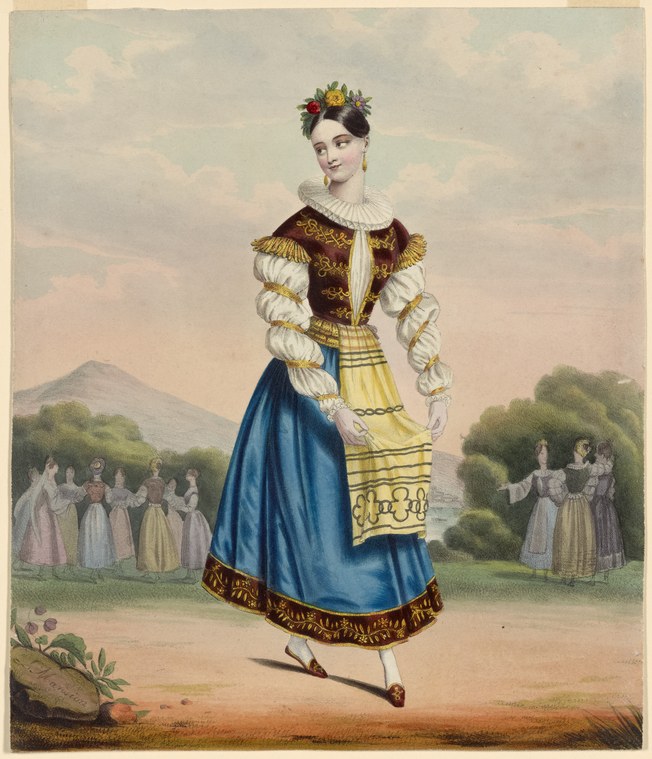
A woman in elaborate early 19th-century dress stands alone in the center of the composition, gazing slightly upward. She wears a brown velvet corseted bodice with gold embroidered trim, paired with a striking blue silk skirt decorated with a gold-patterned hem band. Her sleeves are notably voluminous, constructed from white gathered fabric that extends from shoulder to wrist, creating a distinctive silhouette. A white lace collar frames her neck, and she wears a small floral crown adorned with what appears to be roses and foliage. The background shows a pastoral landscape with two groups of women in pale gowns gathered in the middle distance, flanking rocky outcrops with vegetation. The figure's pose suggests movement—her weight appears shifted, one leg extended as if mid-step, and her carriage conveys a sense of graceful elevation or lightness. The engraving technique renders fine detail in the drapery and shadows, with hand-coloring applied to create the rich jewel tones of the costume.
The dancing
The solitary dancer is positioned in a classical contrapposto stance with her body upright and her weight seemingly transferred forward onto one leg, while the other appears to extend behind or beneath her in a light step. Her arms hang naturally at her sides. Her gaze is directed upward and outward, away from the viewer, suggesting an inward or transcendent focus rather than engagement with an audience. The gathering of women in the background, though small and indistinct, implies this is a formal or ceremonial moment rather than intimate social dancing. The overall frame is elegant and contained; there is no sense of vigorous movement or partnering.
The dance depicted
This appears to be a portrait of a Wallachian folk dancer or a European artistic interpretation of Wallachian dance tradition, given the catalogue title and the specificity of the costume. The dress is consistent with early 19th-century Wallachian or Southeastern European folk wear, though the engraving's aesthetic conventions may have stylized it. The pose and carriage suggest a solo, formally presented dance rather than participatory group dancing. The upward gaze and elevated bearing are characteristic of Romantic-era theatrical presentation, particularly the convention of the idealized, almost ethereal female dancer figure popular in ballet and folk-inspired theatrical pieces of the 1830s–1850s. Without visible footwork or clearer evidence of specific choreography, the precise dance form cannot be securely identified, but the presentation strongly suggests a theatrical or ballroom context rather than vernacular folk practice.
How it was made
This is a hand-colored engraving or possibly a lithograph, recognizable from the fine linear work defining the drapery, features, and costume detail, combined with selective hand-coloring in watercolor or gouache. The technique allowed for mass production and circulation across Europe as a relatively affordable luxury print, suitable for framing in domestic or institutional collections. The refinement of the engraving and the care taken in rendering textile surfaces and ornament suggest a mid- to high-end print market, likely produced for educated urban audiences interested in ethnographic or theatrical costume subjects. The hand-coloring was likely applied by workshop assistants following a printed key, a common practice that made each impression slightly individual.
About this work
This is a formal portrait engraving of a woman in Wallachian traditional dress, presented in a theatrical and idealized manner consistent with early 19th-century European art. The work sits at the intersection of ethnographic costume documentation and Romantic ballet aesthetics, a period when European artists and producers were increasingly fascinated by folk traditions from the Ottoman-influenced regions of Southeastern Europe. The solitary figure, the pastoral background, and the ethereal quality of the rendering suggest this may be a record of a specific performer or a composite idealization of Wallachian femininity and dance as understood by Western European audiences. Whether depicting an actual dancer or a costume fantasy, the print circulated knowledge of Wallachian culture in visual form.
How to look at it
Observe the careful rendering of the costume: the weight of the velvet bodice, the airiness of the gathered sleeves, the precise gold embroidery. Notice how the artist has positioned the figure to suggest both solidity (the corseted torso, the firm stance) and lightness (the upward gaze, the sense of the body mid-step). The pastoral setting with distant female figures suggests a ceremonial or fête context rather than domestic sociability. The hand-coloring emphasizes the richness of the materials—blue silk, gold thread, white linen—suggesting this was a valuable or precious representation, not a cheap print.
The period
This engraving dates to the early–mid 19th century, a period of intense European fascination with folk culture and distant lands, driven by Romanticism and colonial expansion. Wallachian and other Southeastern European traditions were newly accessible to Western audiences following the Greek War of Independence and shifts in Ottoman control. The same period saw the rise of ballet héroïque and ethnographic ballet, in which Western choreographers created theatrical dances based on folk traditions—often highly filtered and Romanticized. The idealized female figure gazing upward was a standard convention of Romantic ballet imagery, seen in prints of dancers in works like La Sylphide (1832) and Giselle (1841). This engraving likely served both as ethnographic documentation and as fashionable interior decoration for educated European households.
Where it lives
The work is held in the New York Public Library's collection of prints depicting dance. Its provenance beyond that holding is not recorded in the catalogue.
Dance in this work
Questions about this work
Is this a real person or a generic figure?
The catalogue provides no identification. The work may document a specific performer, a composite type, or a costume fantasy created for theatrical or commercial purposes. Without inscription or further documentation, it cannot be determined whether the figure is a portrait or an idealized representation of 'Wallachian Woman' as understood by Western European audiences.
What does the costume tell us about Wallachian dance?
The engraving records specific elements—the embroidered velvet bodice, the voluminous gathered sleeves, the patterned skirt hem, the floral crown—that are consistent with early 19th-century Wallachian dress. However, the theatrical presentation and European aesthetic conventions may have stylized or altered details. This is valuable as visual documentation but should be cross-referenced with other sources on Wallachian material culture.
Why does she look so ethereal?
The upward gaze, the lightness of the pose, and the elevated positioning are all conventions of Romantic ballet imagery from the 1830s–1850s. European artists frequently rendered folk dancers in this idealized manner, emphasizing grace, otherworldliness, and feminine delicacy—aesthetic values of the period rather than accurate documentation of actual folk performance style.
More dance artwork





