49 works in this view — arrow keys or swipe to move between them.
Dance in Art
La prima ballerina Signora Antonietta [sic] Bella
Unknown artist
- Collection:
- Prints depicting dance
- Source:
- New York Public Library
- Rights:
- Public domain — free to use, share and adapt.
- Recorded as:
- Public Domain
This work documents the intersection of dance celebrity, theatrical publishing, and popular visual culture in nineteenth-century Italy. It shows how information about notable dancers reached a wide audience through periodical illustration rather than through photographs or paintings of performance, and how a dancer's reputation was constructed through narrative and social positioning rather than through direct images of dancing. For historians of dance media and publicity, the work is essential evidence of how dancers were made famous and how their image circulated.
What you are looking at
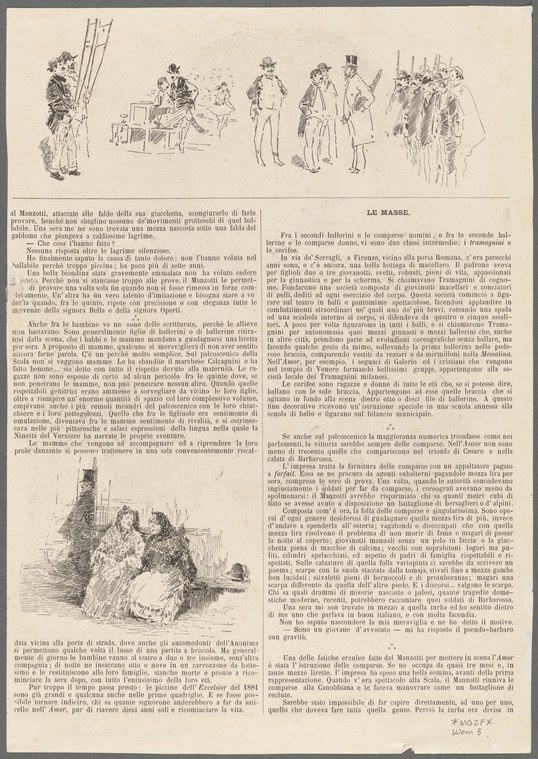
This is a page from a nineteenth-century Italian publication, combining engraved illustration with letterpress text. At the top, a frieze of figures presents various scenes of social life and theatrical performance. A woman in a long dress stands at the left near a curtain or drape; center-left shows figures seated around furniture in what appears to be a parlor scene; to the right stands a formally dressed man in a coat and hat; further right are several figures in military or formal dress, and at far right a cluster of figures in bonnets and cloaks. The lower half of the page is text in Italian, with a small engraved vignette set into the margin showing an interior scene. The engraved style is typical of mid-to-late nineteenth-century illustration—fine line work, careful cross-hatching for tone, and the characteristic appearance of steel-engraving. The title at the top reads "LE MARBE" (likely "LE MARCHE" or a regional variant). The page has aged to a cream or tan color with some foxing.
The dancing
The figures are small and rendered schematically rather than with anatomical precision. The woman at left stands in a conventional S-curve posture with one arm raised, typical of period fashion drawing. The seated figures show no active dancing posture—they are positioned as in conversation or observation. The formally dressed men stand in static, frontal or three-quarter poses. There is no evidence of a dance hold, leap, or dynamic weight shift in any figure. The composition is designed to illustrate social types and settings rather than choreographic action.
The dance depicted
This page does not appear to depict dance in any formal sense. The title references "La prima ballerina Signora Antonietta Bella" (The prima ballerina Signora Antonietta Bella), which suggests the page concerns a notable dancer of the period, but the illustrations and accompanying text treat social and theatrical scenes in general rather than a specific dance performance. The frieze of figures may include theatrical performers, but no figure is shown in active dance movement, and no dance hold, posture, or technique is evident. The work appears to be documentary or narrative illustration accompanying a written account, possibly biographical or theatrical reportage.
How it was made
This is a steel or copper engraving, printed from a single plate and bound into a publication with letterpress text. The technique is characteristic of mid-nineteenth-century commercial book illustration—fine parallel lines (hatching) create tone and shadow, allowing the image to be reproduced sharply and repeatedly. The marriage of engraving with letterpress suggests a periodical or serialized publication, likely reaching a educated middle-class audience interested in theatrical news and social observation. The small scale and page integration indicate this was not a fine art print but a practical tool for narrative communication.
About this work
This page comes from a nineteenth-century Italian periodical or serial publication documenting theatrical and social life. The title suggests it concerns a celebrated prima ballerina of the era, Antonietta Bella, but the image itself is illustrative and documentary rather than a portrait of dance in action. The engraved composition presents a frieze of social and theatrical types—observing an interior scene whose meaning and significance are conveyed primarily by the accompanying Italian text. The work belongs in a dance gallery as evidence of how dance culture, celebrity, and theatrical life were communicated and visualized in the popular press of the Romantic era, even when the image itself does not foreground active dance movement. It reveals what audiences saw when they encountered information about dancers: not usually images of dancing itself, but rather social and biographical narrative.
How to look at it
Read this page as a document of publishing practice and celebrity construction rather than as a representation of dance itself. Note how the engraver has arranged multiple social and theatrical scenes in a frieze format, allowing comparison and narrative continuity. The small vignette set into the text margin shows how illustration was embedded into the page as a whole, guiding the reader's eye and reinforcing the text. Observe that none of the figures is shown in active movement or dance posture—instead, the image conveys information through social positioning, dress, and setting. This is typical of how dance was visualized in the popular press: the dancer was famous, the dancer's life was newsworthy, but the dance itself remained largely invisible or summarized through conventional theatrical posture.
The artist
The artist is not recorded. The engraving is typical of mid-nineteenth-century Italian commercial book and periodical illustration, likely executed by a staff engraver or journeyman practitioner working for a publishing house in a major Italian city. The level of technical finish and the publication format suggest a professional workshop producing work for a regular periodical or serial publication.
The period
The nineteenth century saw the rise of the Romantic ballet in Europe, with celebrated prima ballerinas becoming public figures and celebrities. Alongside this, periodical and newspaper publishing expanded rapidly, creating new demand for illustration and reportage on theatrical life. Steel engraving made possible the cheap, durable reproduction of images, and the marriage of engraving with letterpress text created the modern illustrated publication. By the mid-nineteenth century, information about dancers and theatrical performances was being actively circulated through the popular press. However, technical limitations meant that published images of dance often showed social contexts and celebrity rather than the dance itself—the moment of performance or rehearsal was difficult to capture and expensive to reproduce, so illustrators focused on narrative, biography, and the theatrical world around the dancer.
Where it lives
The work comes from the New York Public Library's prints collection depicting dance, part of a larger archive of theatrical and entertainment illustration. It is a page from a bound or serialized publication, not a separate print, indicating it was part of a systematic information system for a reading public.
Questions about this work
Is there any actual dancing shown in this image?
No. Although the page is titled with reference to a prima ballerina, none of the figures depicted is shown in active dance movement. The page illustrates social and theatrical scenes in which dance is referenced or contextually implied, but no figure exhibits a dance posture, hold, or technique. This reflects a common practice in nineteenth-century periodical illustration, where dancers and theatrical life were documented through social narrative rather than through images of the dance itself.
Who was Antonietta Bella?
The catalogue record does not provide biographical details. The title suggests she was a celebrated opera singer or dancer in nineteenth-century Italy, notable enough to merit coverage in a theatrical periodical. Without access to the full text on this page or to additional records, we cannot establish her dates, companies, repertoire, or historical significance.
What is the text about?
The text is in Italian and appears to be a narrative account or article accompanying the illustrations. The exact subject matter cannot be determined from the image alone, but based on the title and the social scenes depicted, it likely concerns the life, career, or theatrical activities of the subject. The integration of engraved illustration with letterpress text is typical of mid-nineteenth-century periodical journalism.
More dance artwork





