49 works in this view — arrow keys or swipe to move between them.
Dance in Art
Orientalist images of dance in prints
Unknown artist
- Collection:
- Prints depicting dance
- Source:
- New York Public Library
- Rights:
- Public domain — free to use, share and adapt.
- Recorded as:
- Public Domain
This work exemplifies the orientalist visual culture through which Europeans fantasized about non-European dance practices in the eighteenth century, and shows how printmaking conventions shaped the perception and dissemination of dance imagery. For dancers and historians, it is a key example of how belly dance and harem performance entered European consciousness not through authentic documentation but through imaginative print series that blended costume study, architectural fantasy, and erotic display. Understanding such images is essential to recognizing how European dance history has historically appropriated, exoticized, and misrepresented non-Western movement practices.
What you are looking at
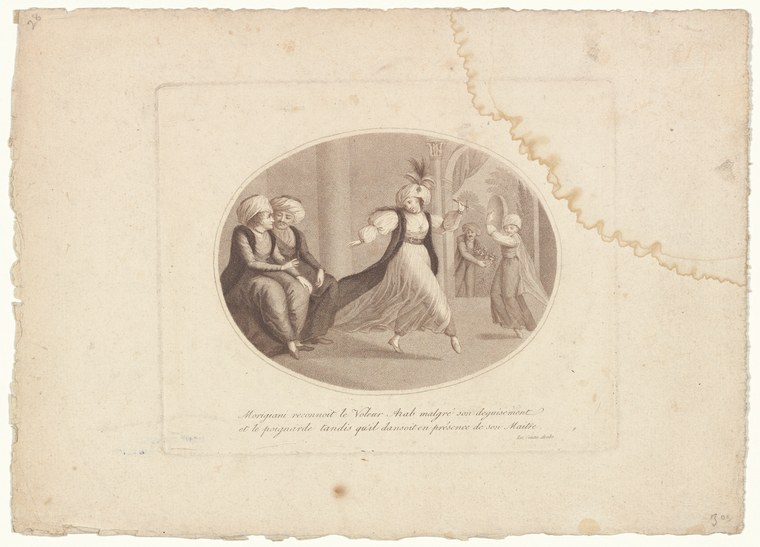
A neoclassical engraving in an oval frame depicts an orientalist dance scene set in an interior with draped walls and architectural details. A central female dancer in a flowing, diaphanous gown is caught mid-movement, her body arched and arms raised in an expressive gesture. She wears a tall feathered headdress and ankle bracelets. To her left, two seated female figures watch—one in darker dress, one partially obscured. To the right, two additional standing figures observe the performance from the shadows. The composition uses strong tonal contrasts between the brightly lit central dancer and the darker surrounding figures and architecture. The scene suggests a harem or palace interior, with the dancer performing for an elite, predominantly female audience. The engraving's fine cross-hatching creates depth and the illusion of luxurious fabrics.
The dancing
The principal dancer stands in a near-vertical torso position with significant spinal extension, her weight appearing to be on one leg while the other leg extends or is flexed beneath her. Both arms are raised, with elbows bent and hands positioned expressively at shoulder height or above. Her head tilts back, integrated with the overall curve of the body. The pose is static rather than in active locomotion—this is a moment of held extension and display rather than a step or traveling movement. The four secondary figures are arranged as a stationary audience, indicating this is a solo performance attended by witnesses.
The dance depicted
This depicts a solo feminine performance in an orientalist interior, consistent with European eighteenth-century imaginings of Near Eastern or North African belly dance and courtly dance practices. The dancer's arched back, arm position, and upright stance suggest a style emphasizing torso mobility and statuary poses rather than footwork or traveling steps. The costume elements—the feathered headdress, diaphanous gown, ankle bracelets, and the harem setting—are orientalist conventions of the period rather than documentary evidence. The engraving likely represents European fantasy about exotic dance rather than an observed practice, though it may draw on authentic costume and movement vocabularies filtered through the aesthetic preferences of its time and audience.
How it was made
This is an engraving, as evidenced by the fine parallel hatching lines used to build tone and shadow, the oval border frame typical of eighteenth-century print publication, and the monochromatic line-work. The technique allowed for mass reproduction and wide circulation among educated collectors and theater-goers. The refined execution and narrative sophistication suggest this was a relatively expensive print, likely part of a series or folio. The oval format and careful composition indicate an audience familiar with neoclassical aesthetics and likely with theater design and dance imagery.
About this work
This is an eighteenth-century engraved print depicting an orientalist fantasy of Near Eastern or North African dance as an elite, feminized interior performance. The work belongs to a substantial body of European visual culture that used exoticized dance imagery—particularly belly dance and harem fantasies—as a vehicle for eroticism, luxury, and orientalist fantasy. For a dance history audience, it documents how European print culture visualized non-European dance in this period, and how the conventions of neoclassical engraving (static poses, tonal restraint, narrative framing) shaped the representation of movement. The engraving is not documentary; it is a constructed image reflecting European aesthetic and erotic interests rather than observational practice.
How to look at it
Attend first to the stillness of the pose: the artist has chosen a moment of maximal extension and display, not transition or step. This reflects neoclassical taste for sculptural simplicity and the held gesture over motion. Notice the asymmetry of the dancer's torso and the arc of her spine—this exaggerates the potential for torso movement (characteristic of belly dance) into a single dramatic curve. The surrounding figures are witnesses and statues, not participants; this frames the dance as performance for an audience's gaze rather than as participatory or social. The orientalist costume elements—the headdress, the diaphanous gown, the setting—are visual codes marking this as 'exotic' and distant from European practice.
The period
The late eighteenth century saw an explosion of orientalist imagery in European visual culture, driven by colonial expansion, travel literature, and aristocratic fascination with the Near East and North Africa. Dance was a central focus of this fantasy: belly dance in particular entered European consciousness through prints, travel accounts, and theatrical performances. Neoclassical aesthetics dominated European visual culture at this time, favoring restrained line-work, allegorical narrative, and the frozen pose over dynamic action. Engravings of dance were popular luxury goods, sold individually or as part of series; they circulated among theater patrons, collectors, and educated elites who viewed them as windows into exotic courts and practices.
Where it lives
The work is held in the NYPL Prints collection as part of a broader body of orientalist dance imagery. The catalogue record identifies it only as a print depicting orientalist dance, without author, date, or title, suggesting it may be one of many similar works from the period or part of a series whose individual sheets were dispersed.
Dance in this work
Questions about this work
Is this a realistic picture of belly dance in the eighteenth century?
No. This is an orientalist fantasy created for European audiences. While it may incorporate authentic costume elements, the composition, the posed stillness, the harem setting, and the framing are all European aesthetic choices designed to appeal to European erotic and exoticist interests. The engraving shows us what Europeans wanted to imagine about non-European dance, not how the dance was actually performed.
Why is there so little movement in the pose?
Neoclassical aesthetics privileged the held pose, the sculptural moment, and clarity of line over dynamic action. Additionally, the engraving technique—which builds tone through parallel lines—makes fluid motion difficult to render. The frozen, arched position is easier to engrave and also more aligned with European aesthetic taste and the codes through which orientalism was visualized.
Who would have bought a print like this?
Theater patrons, wealthy collectors, and educated elites interested in dance, exoticist fantasy, and luxury goods. Such prints were circulated individually or as part of series and were expensive enough to indicate an audience with significant purchasing power and leisure for visual culture.
More dance artwork





