49 works in this view — arrow keys or swipe to move between them.
Dance in Art
Orientalist images of dance in prints
Unknown artist
- Collection:
- Prints depicting dance
- Source:
- New York Public Library
- Rights:
- Public domain — free to use, share and adapt.
- Recorded as:
- Public Domain
For historians of classical revival dance and for students of how choreographers and artists imagined the ancient body: this print documents what educated viewers of the period understood classical gesture and ritual to look like. The image influenced stage design, costume, and the formal vocabulary of classical mime and pantomime, which in turn shaped early modern dance. It is also important evidence of how the female body was positioned in neoclassical fantasy—supine, the object of male attention and expertise.
What you are looking at
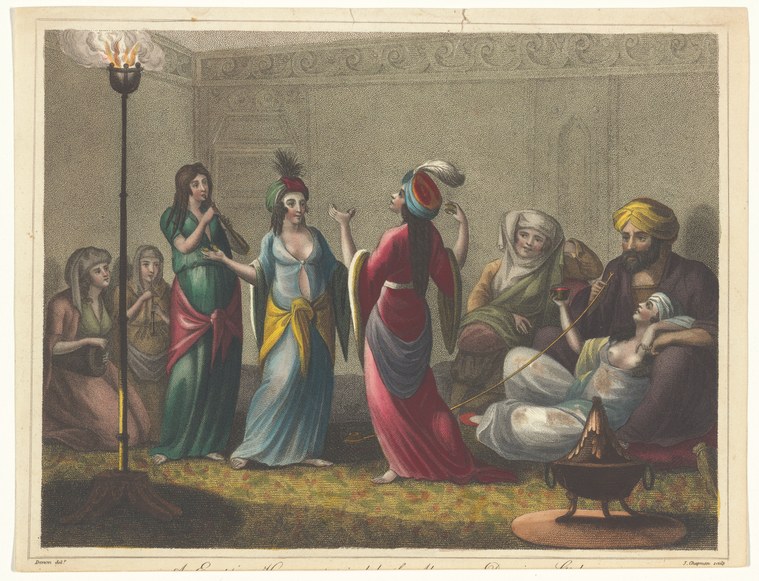
A classical interior illuminated by a tall torch with an ornamental capital holds a gathering of seven figures arranged in conversation and ritual action. The setting appears to be a temple or ceremonial chamber with a coffered ceiling and draped walls. In the foreground, a woman in white reclines on the ground; standing figures in Greek and Roman dress—women in flowing chitons and himations of white, green, and rust red, men in draped garments—gesture toward her in attitudes of concern or instruction. The composition follows classical principles of frieze-like arrangement, with the figures distributed across the picture plane at varying depths. The engraving employs subtle gradations of tone to suggest drapery and volume, and the scene has the formal, didactic quality of a neoclassical print illustrating a narrative from classical antiquity.
The dancing
The standing figures adopt the classical contrapposto and orator's pose: one woman at center touches her face in a gesture of emotion or thought; another extends an arm in address; a male figure with a beard and yellow headdress gestures downward toward the reclining woman. The woman on the ground is positioned in a supine or semi-recumbent pose, weight fully supported. The group forms a loose semicircle around her, their bodies angled toward the focal point. Arms are raised, extended, or curved in the vocabulary of classical mime and oratory—this is gesture-based communication rather than rhythmic movement.
The dance depicted
This does not depict dance in the modern sense. The scene appears to illustrate a moment from classical mythology or drama—possibly an oracle's trance, a healing ritual, or a scene from a Greek or Roman play. The pose of the reclining woman and the ceremonial setting suggest ritual or spiritual experience rather than social or theatrical dance. The standing figures employ the gestural and postural language of classical rhetoric and pantomime, which are allied to but distinct from choreographed dance. The image belongs to the neoclassical interest in recreating the physiology and ethos of the classical world.
How it was made
This is a hand-colored engraving or aquatint, evidenced by the fine parallel line work visible in the drapery and background, the tonal subtlety of the wash, and the characteristic appearance of the copper-plate line. The verso notation "Roger 267" suggests a catalogue or inventory number. The technique allowed for precise anatomical representation and wide circulation; the hand coloring was applied after printing, indicating this was a luxury print intended for educated collectors and those with antiquarian or theatrical interests. Such prints served as visual primers on classical costume and behavior.
About this work
This is a neoclassical engraving depicting a scene from classical antiquity—a moment of ritual, trance, healing, or theatrical performance set in a temple interior. The work belongs to the late 18th or early 19th-century tradition of classical revival imagery that circulated through prints to educate audiences about Greek and Roman culture. While the work does not depict dance per se, it is deeply invested in the language of the classical body: formal posture, meaningful gesture, and the theatrical arrangement of figures in space. It represents a moment when the Western artistic tradition was attempting to recover and reinvent the visual and gestural vocabulary of the ancient world.
How to look at it
Observe the distribution of weight and the orientation of the body: the reclining woman is entirely passive and supported, while the standing figures are engaged in active interpretation and address. Notice the formal geometry of the composition—the torch as vertical axis, the figures arranged as a frieze—which creates order and solemnity rather than spontaneity. Attend to the hand gestures: raised palms, extended fingers, positions of address and emotional expression. This is the language of classical oratory and ancient mime, transmitted to the viewer through the bodies of the figures. The scene is frozen at a moment of high affect or revelation, not mid-movement.
The artist
Unknown. The catalogue number "Roger 267" may refer to the engraver, publisher, or a collection inventory; without access to the full provenance record, the artist cannot be identified with confidence. The style and technique are consistent with late 18th or early 19th-century European neoclassical printmaking, a period when such images were produced in significant quantity across France, England, and the German states.
The period
This work dates to the era of neoclassicism in European art (c. 1750–1820), when artists and choreographers were fascinated by the material and cultural remnants of Greece and Rome. Archaeology, published travel narratives, and translations of classical texts fueled a desire to visualize and recreate classical life. In dance, this impulse manifested in the ballet d'action, pantomime, and formalized classical mime—theatrical forms that relied heavily on gesticulation and symbolic posture rather than the pointe work that would come to define ballet later in the century. The engraving belongs to a body of prints that served as visual reference for actors, dancers, and designers attempting to authentically stage classical subjects.
Where it lives
The work is held in the Prints collection at the New York Public Library. The verso is marked "Roger 267," suggesting it was part of a systematic catalog or collection, likely in Europe before entering an American holding. As a hand-colored engraving, it circulated as a luxury object and visual document among educated collectors and those with interests in classical antiquity, theater, and the arts.
Questions about this work
Is this a scene from a specific Greek or Roman play?
The image does not bear an inscription identifying the source, and the catalogue record does not specify. The composition and subject—a woman in a state of trance or supplication surrounded by clasping, gesturing figures in classical dress—are consistent with oracle scenes, priestess rituals, or climactic moments from Greek drama. Without additional documentation, the specific source cannot be confirmed.
Why would this print matter to a dance historian?
It documents what the late 18th century understood classical bodily gesture and theatrical arrangement to mean. Choreographers of the period, including those working in ballet d'action and pantomime, drew on such images as visual authority for how the ancient body moved and communicated. The print is evidence of how artistic fantasy about the classical world shaped the formal vocabulary of early modern theatrical dance.
What is the figure on the ground doing?
She appears to be in a state of trance, supplication, or ritual ecstasy. Her body is supported, passive, and fully recumbent, while the standing figures around her attend, gesture, and respond. The positioning suggests she is the object of ritual action rather than its agent—a common trope in neoclassical fantasies of female bodies in religious or spiritual contexts.
More dance artwork





