49 works in this view — arrow keys or swipe to move between them.
Dance in Art
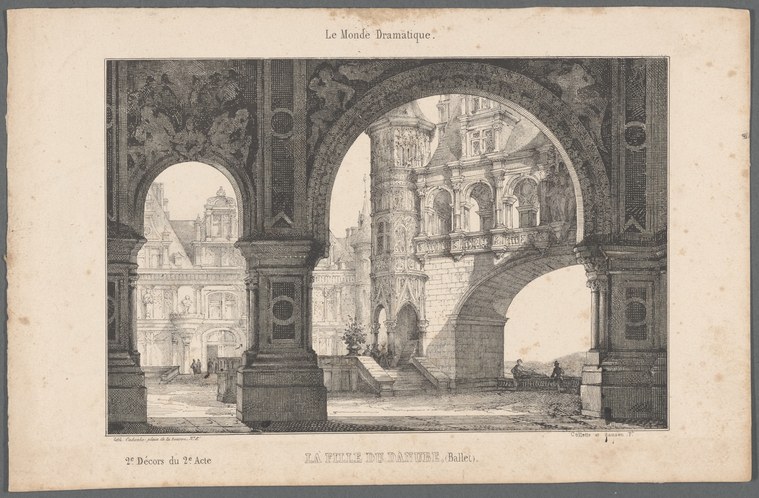
La fille du Danube. (Ballet): 2e. décors du 2e. acte
Unknown artist
- Collection:
- Prints depicting dance
- Source:
- New York Public Library
- Rights:
- Public domain — free to use, share and adapt.
- Recorded as:
- Public Domain
This image crystallises the aesthetic of Romantic ballet, in which exotic or supernatural settings were created through architectural illusion and perspective—a space in which dancers' bodies could enact the supernatural. For dance historians, it shows how the stage image of the period was conceived and circulated, and reveals the primacy of visual spectacle in Romantic choreography. For art historians, it exemplifies the persistence of Renaissance perspective as a tool for theatrical effect well into the nineteenth century.
What you are looking at
An architectural stage set rendered in linear perspective, dominated by monumental arcaded walls in classical style. Through a series of receding arches, the eye travels deep into the composition, where smaller figures inhabit a piazza in the middle distance. The print depicts a moment of theatrical illusion: the architectural volumes themselves form the subject, with human figures playing a subordinate role. The stonework is rendered in delicate cross-hatching, creating a sense of monumental depth and solidity. In the foreground, two figures in what appears to be classical drapery stand near the archway; others scatter across the central plaza. The composition exploits the Renaissance principle of stage design in which architecture frames and contains the action rather than merely housing it.
The dancing
The human figures are small and somewhat schematically rendered, subordinate to the architectural spectacle. Those visible in the foreground appear to stand in relaxed, informal attitudes; none are depicted in the codified positions or holds that characterise theatrical dance of the Romantic era. The drapery on the nearest figures suggests classical rather than contemporary costume. The dispersal of figures across the deep space suggests processional or courtly movement rather than choreographed partnered dance.
The dance depicted
This is not a dance image in the modern sense, but rather a stage design for a Romantic ballet, likely from the 1830s–1840s. *La fille du Danube* (The Daughter of the Danube) premiered in 1836 at the Opéra de Paris and was one of the celebrated Romantic ballets of the period. This engraving documents the second act scenery—a moment when stage design itself, derived from Renaissance principles of theatrical perspective, was considered as important as the dance performed within it. The image captures the aesthetic ambition of the era to create fantastical, deep architectural spaces as the domain of supernatural and exotic action.
How it was made
This is an engraving, recognisable from its line-based technique, precise linear perspective, and the characteristic cross-hatching used to model form and shadow. The inscription at the bottom—'2e décors du 2e acte' (second decoration of the second act)—and the credit line suggest this was a commercial theatrical publication, likely issued as a souvenir or documentation of the production. Engravings of stage sets were circulated to the educated public and served as both advertisement and record of the work. The technique's precision and legibility made it ideal for capturing architectural spectacle.
About this work
This engraving documents the stage architecture of the second act of *La fille du Danube*, a Romantic ballet first performed in 1836. Rather than depicting dancers in motion, it presents the set design itself—a classical arcaded plaza rendered in deep perspective. The print belongs to the tradition of theatrical ephemera through which nineteenth-century audiences encountered performances they could not always see in person, or by which they commemorated what they had witnessed. It demonstrates the central role that architectural fantasy played in Romantic ballet, where setting was inseparable from the work itself.
How to look at it
Attend to the recession of space: the artist uses the geometry of arches and arcades to pull the eye backward, so that the stage itself becomes an illusion of depth. This was the essential principle of Renaissance perspective, adapted here to the stage. The smallness of the human figures in the middle distance emphasises the scale of the architectural envelope. This is a record of a visual effect—how the dancer appeared within an architectural fantasy—rather than a picture of how dancers moved.
The artist
The artist is not recorded in the catalogue, but the work belongs to a substantial commercial practice of engraving Parisian theatrical designs for publication. Such prints were produced by specialist firms and typically credited to the stage designer rather than the engraver. This work is typical of the documentary style used in mid-nineteenth-century theatrical prints: precise, legible, and concerned more with architectural and spatial information than with dramatic narrative or movement.
The period
In the 1830s and 1840s, Romantic ballet flourished in Paris, and the Opéra was a centre of visual spectacle. The era was marked by a taste for exotic and supernatural subjects (*La Sylphide*, *Giselle*, *La Fille du Danube*) and by a corresponding investment in elaborate stage machinery and illusionistic sets. At the same time, lithography was becoming the dominant medium for theatrical publicity, so the persistence of engraving here may indicate either an earlier production date or a particular market. The classical architectural vocabulary—arches, arcades, perspective—remained the standard language for representing theatrical space, even as the content of the ballets themselves drew increasingly on medieval and supernatural themes.
Where it lives
This print is held in the Prints collection of the New York Public Library. It is a theatrical ephemeris—a documented souvenir of a production—and represents the material record through which nineteenth-century audiences engaged with performances they attended or about which they read.
Questions about this work
What ballet is this from?
*La fille du Danube* (The Daughter of the Danube) premiered in 1836 at the Opéra de Paris. It was a Romantic-era ballet with music by Adolphe Adam, choreography by Philippe Taglioni (father of the famous dancer Marie Taglioni), and libretto by Eugène Scribe. The ballet told the story of a water nymph who falls in love with a mortal, a plot typical of Romantic ballet subject matter.
Why is this a stage design and not a picture of dancers?
In Romantic ballet, the stage set was as much a protagonist as the dancers. The supernatural worlds in which these ballets were set—forests, castles, magical lakes—were created through elaborate illusions and perspective tricks. This engraving documents one such illusion: how the stage architect designed the space to convey architectural grandeur and depth.
Who created this engraving?
The artist's name is not recorded in the catalogue. It was most likely produced by a commercial engraving firm in Paris. Such prints were typically credited to the stage designer (whose name does not appear here either) rather than to the engraver, who was considered a skilled craftsman rather than an author.
How would audiences have seen this print?
These engravings were sold as theatrical souvenirs, collected in albums, and circulated among the educated public. They served both as advertisement for upcoming productions and as a record for those who had attended. In an era before photography, they were how people outside Paris learned what famous productions looked like, and how Parisians remembered what they had seen.
More dance artwork





