49 works in this view — arrow keys or swipe to move between them.
Dance in Art
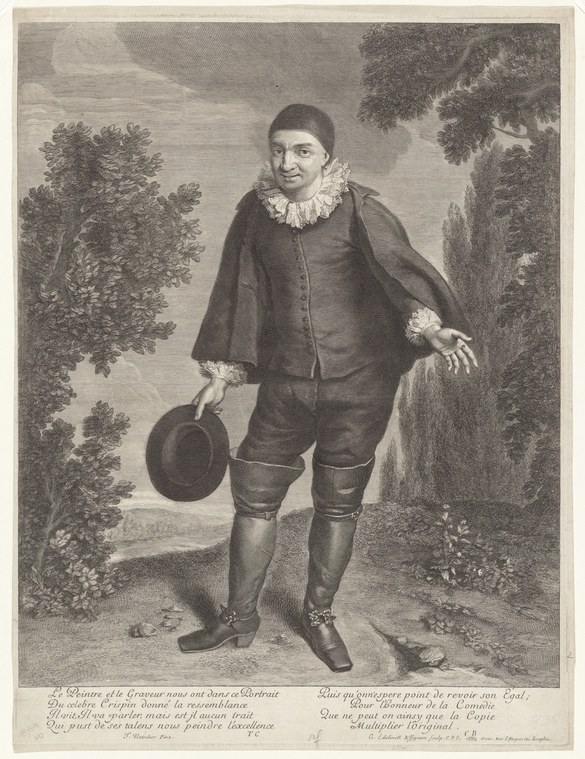
Le peintre et le graveur nous ont dans ce portrait du celebre Crispin donné la ressemblance
Unknown artist
- Collection:
- Prints depicting dance
- Source:
- New York Public Library
- Rights:
- Public domain — free to use, share and adapt.
- Recorded as:
- Public Domain
This work documents the visual culture of commedia dell'arte and the theatrical celebrity system of the Baroque period. It shows how a stock character could be individualized and celebrated through fine-art portraiture, occupying an ambiguous space between theater documentation and high-art print.
What you are looking at
A single male figure in Baroque court dress stands in a garden setting flanked by tall cypress trees, his body angled in a relaxed contrapposto pose. He wears a dark doublet with ornate lace collar and cuffs, a short dark cape draped casually over one shoulder, and fitted dark breeches ending at the knee with dark hose and shoes. His right hand holds a dark hat at his side; his left hand rests lightly against the cypress trunk beside him. His expression is animated and engaging, with a slight smile directed toward the viewer. The engraving technique creates fine hatching in the foliage and subtle modeling in the fabric, with the figure rendered against a luminous sky. Below the image runs a French inscription identifying this as a portrait of the celebrated Crispin, made by painter and engraver.
The dancing
The figure is alone, posed in a standing attitude rather than captured mid-movement. His weight rests on his back leg, the front leg extended in a relaxed bend, the classical contrapposto of courtly bearing rather than active dance. The arms are not in a closed hold or dance frame; they are used for casual props—one holding the hat, one touching the tree—suggesting character portrayal rather than the balletic or social dance postures of the period. The face is the focal point, clearly drawn and individually characterized rather than generalized.
The dance depicted
This engraving depicts Crispin, the famous commedia dell'arte servant character, not a dancer. Crispin was a stock theatrical type known for physical comedy, acrobatic business, and rapid-fire comic timing rather than formal dance training. While commedia dell'arte performances included lazzi (improvised comic routines) and movement sequences that could be highly physical, the pose and costume here emphasize the character's personality and theatrical status rather than demonstrating any specific dance form. The figure is in costume but frozen in a moment of character—a portrait of an actor in role rather than documentation of dance.
How it was made
This is an engraving, executed with fine parallel lines (hatching) to create tone and modeling throughout. The technique allows for precise delineation of the elaborate textile details—the lace collar, the cape's drape, the hose—and for the subtle play of light across the figure and landscape. Engravings of this type, with letterpress inscription, were widely distributed and collected; they served as theatrical publicity, actor celebrity, and art-market commodities all at once. The quality of execution suggests a professional hand and a commercial purpose.
About this work
This is a theatrical portrait engraving of Crispin, the commedia dell'arte servant character, presented as a standing figure in Baroque court dress within a stylized garden. The work belongs to a tradition of actor portraiture that documented the famous performers and stock characters of early modern theater, circulating both as theatrical documentation and as fine prints for the art market. While Crispin was associated with physical performance and rapid comedic business on stage, this particular image freezes him in a moment of courtly repose and characterful bearing rather than capturing him in the act of dance or even overt physical comedy. The inscription credits both painter and engraver for creating a likeness of this celebrated performer.
How to look at it
The viewer should attend to the distinction between movement and character: Crispin is shown not dancing or performing physical business, but posed in a relaxed attitude that suggests personality and wit rather than acrobatic skill. Notice the careful rendering of his face—individualized and expressive—and the attention to textile detail in the costume, which marks this as a portrait of a famous performer rather than a generic figure study. The garden setting and the graceful contrapposto pose elevate the theatrical servant to the dignity of a courtly subject, a visual claim to Crispin's celebrity and the prestige of the commedia tradition.
The period
Commedia dell'arte flourished across Europe from the 16th through 18th centuries, with Italian troupes touring and establishing reputations that made individual performers—and the characters they embodied—internationally famous. Crispin (or Crispino) was one of the most recognizable servant characters, defined by physical agility, verbal wit, and the ability to build comic momentum through improvisation. By the Baroque period, successful commedia performers were celebrated in portraiture, costume engravings, and theatrical publications that circulated among both theater-goers and collectors. This engraving reflects the growing status of commedia as an art form worthy of fine-print documentation and the emerging cult of theatrical celebrity.
Where it lives
The work is held in the New York Public Library's collection of prints depicting dance. The inscription and engraving style suggest a 17th or early 18th-century date, though the record does not specify date or artist.
Questions about this work
Is this actually a dance image?
Not strictly. While Crispin was a physical performer and commedia dell'arte involved bodily virtuosity, this particular engraving shows him standing still in costume and character rather than dancing or performing. It documents the theatrical celebrity and stock character tradition that overlapped with—but was distinct from—formal dance.
Who was Crispin?
Crispin (or Crispino) was a famous servant character in commedia dell'arte, the improvisational Italian theater tradition. He was known for comic agility, witty business, and physical dexterity. The character was so well-known and successful that individual performers who played Crispin became celebrities in their own right, commemorated in prints like this one.
What does the French inscription say?
The inscription identifies this as a portrait of the celebrated Crispin, made by a painter and engraver to capture his likeness. The text emphasizes the dual artistry involved—painting the image and engraving it for publication.
More dance artwork





