49 works in this view — arrow keys or swipe to move between them.
Dance in Art
Turandot
Unknown artist
- Collection:
- Prints depicting dance
- Source:
- New York Public Library
- Rights:
- Public domain — free to use, share and adapt.
- Recorded as:
- Public Domain
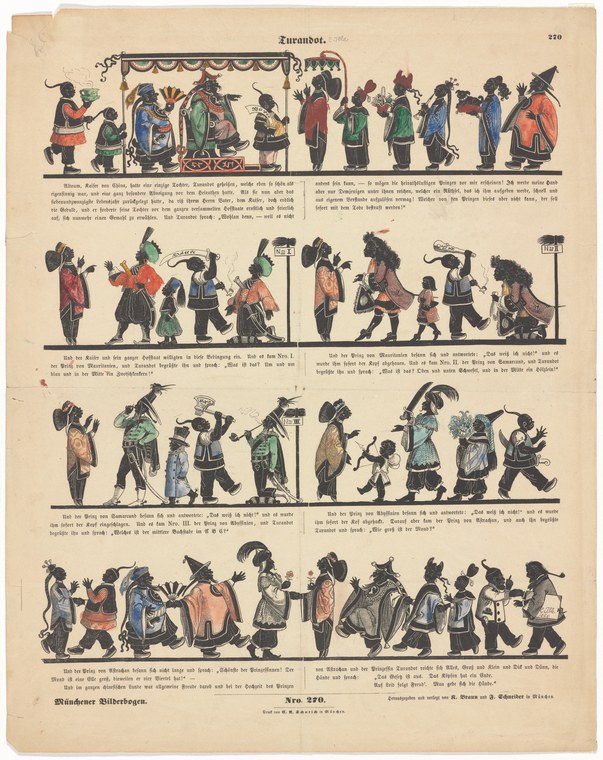
This engraving is a rare documentary record of how *Turandot*—a story that would later inspire Puccini's famous opera—was staged and performed, likely in German-speaking Europe in the 19th century. It shows how theatrical narrative and emotional expression were conveyed through gesture, costume, and pantomime before the rise of realistic acting, and how non-Western stories were adapted, visualized, and circulated through European print culture. For theater historians and those studying the visual culture of performance, it is primary evidence of stagecraft, costume, and the actor's expressive vocabulary of the era.
What you are looking at
This is a hand-colored engraving divided into four horizontal registers, each depicting a different scene from a theatrical or dramatic narrative. The figures wear East Asian costume—robes with long sleeves, traditional hats and headpieces—suggesting the work illustrates a story or opera, likely connected to the title *Turandot*. In the top register, a procession of richly dressed figures moves across the stage; some wear crimson and blue robes, others green and gold. The figures include what appear to be officials, attendants, and possibly nobility. The second, third, and fourth registers show more intimate groupings: figures in conversation, some gesturing expressively, others in postures of supplication or distress. The setting is bare except for a simple pole or standard in some scenes, suggesting a stylized theatrical space. The composition is crowded and animated, with overlapping figures and varied poses creating a sense of narrative movement and dramatic tension.
The dancing
The bodies are rendered in silhouette or bold outline, with expressive arm gestures that convey emotion and narrative intent rather than precise anatomical detail. Figures lean toward one another in conversation, bow deeply in deference, or stand with arms raised in gestures of grief or appeal. The poses suggest pantomime and stylized dramatic movement rather than balletic grace or ballroom hold. Groups cluster around central figures, and the varying heights and positions create visual rhythm and hierarchy within each scene. The movement quality is gestural and narratively driven rather than technically precise.
The dance depicted
This engraving does not depict dance in the ballroom or theatrical-ballet sense. Instead, it illustrates dramatic action and pantomime from a theatrical performance, most likely a staging of Puccini's *Turandot* or an earlier operatic or dramatic work with that title. The scenes show narrative moments—processions, confrontations, expressions of emotion—characteristic of operatic stagecraft. The figures' movements are those of actors and singers performing a story rather than dancers executing choreographed steps. The work documents theatrical convention and costume rather than dance technique.
How it was made
This is a hand-colored engraving, identifiable by the fine line work, the register divisions, and the evidence of hand coloring applied to a black-and-white printed base. The technique allowed for multiple copies to be distributed, suggesting a wide audience for theatrical documentation. The colored inks—crimsons, blues, greens, golds—were applied selectively to enhance the spectacle and distinguish characters by rank and role. The engraving preserves the layered, sequential narrative typical of 19th-century theatrical illustration, where key scenes are arranged vertically to tell a story.
About this work
This is a theatrical illustration documenting a stage production in East Asian costume and style, likely from the 19th century. It is one of a series of engravings recording performances or story-dramas, here capturing the narrative of *Turandot* through a sequence of key moments and emotional beats. The work sits at the intersection of theater history, operatic documentation, and engraving as a medium of mass cultural distribution. It belongs in a dance gallery not as a record of dance itself but as evidence of the theatrical and gestural conventions of the period, and the way narratives of courtship, power, and conflict were enacted on stage through expressive movement and costume.
How to look at it
Attend to the progression of scenes from top to bottom, which tells a story through sequential image—a narrative structure that predates cinema but served similar documentary purposes. Notice how the artist uses costume color and the repetition of key figures across scenes to guide the eye and establish character identity. Observe the gestural language: the deepness of bows, the reach of arms, the clustering of figures around a central point of dramatic action. These are conventions of theatrical pantomime and operatic staging, designed to convey plot and emotion to an audience watching from a distance in a crowded theater.
The period
The engraving dates from the 19th century, an era of intense interest in non-Western cultures, Oriental exoticism, and theatrical spectacle. *Turandot* had appeared in European literature and theater since the 18th century, most famously in Gozzi's 1762 play, which was widely adapted and staged across Europe. The hand-colored engraving was a primary medium for documenting and circulating theatrical images to a broad public, creating a visual record of performances for those who could not attend. The style and execution suggest publication by a German or Central European printer, consistent with the strong theatrical and operatic culture of that region.
Where it lives
The work is held in the New York Public Library's collection of prints depicting dance. It is catalogued as an engraving, undated, with artist unknown. The title *Turandot* appears at the top of the page, and the page is numbered 310, suggesting it is part of a larger bound or serialized publication.
Questions about this work
Is this dance?
Not in the sense of ballroom or ballet. This is theatrical pantomime and dramatic gesture—the expressive movement and gesture language of actors and singers on a stage. However, it documents the physical conventions and gestural vocabulary of 19th-century theater, which often overlapped with dance and are of interest to those studying movement and performance history.
What is the story of Turandot?
*Turandot* is the tale of a proud Chinese princess who sets deadly riddles for her suitors. The suitor who solves all three may marry her; those who fail are executed. A young prince eventually wins, but the story hinges on questions of love, pride, duty, and the princess's ultimate transformation. It has been adapted in European literature and theater since the 18th century and culminates in Puccini's 1926 opera.
Why are the costumes and setting so stylized?
This reflects 19th-century European theater practice: non-Western stories were often staged with exoticized but not strictly authentic costumes, designed to signal 'foreign' or 'Oriental' to the audience. The bare stage and simplified settings were also typical of theater of the era, with spectacle and meaning conveyed primarily through costume, gesture, and the actor's body.
How many scenes are shown?
Four principal scenes are stacked vertically, each showing a different moment in the narrative. This sequential, register-based composition is typical of theatrical illustration and narrative engraving of the 19th century, allowing multiple scenes and moments to be presented on a single page.
More dance artwork





