49 works in this view — arrow keys or swipe to move between them.
Dance in Art
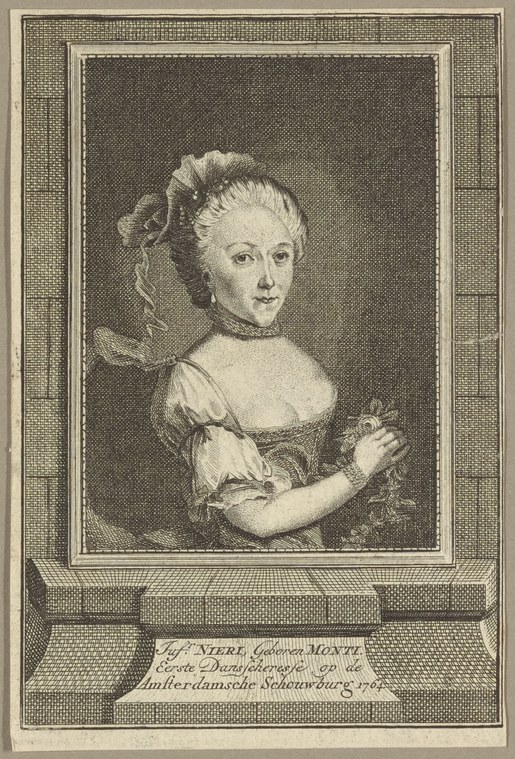
Portrait of Regina Monti
Unknown artist
- Collection:
- Prints depicting dance
- Source:
- New York Public Library
- Rights:
- Public domain — free to use, share and adapt.
- Recorded as:
- Public Domain
Portraits of named dancers from this period are relatively scarce and valuable evidence of individual careers, physical type, and the kind of celebrity status accorded to performers in the 18th century. This engraving also records the Dutch theatrical world, a less well-documented corner of European dance history than Paris or London.
What you are looking at
A three-quarter-length portrait of a young woman, shown from approximately waist up, turned slightly to her right and gazing back toward the viewer over her shoulder. She wears an elegant pale silk gown with short puffed sleeves and a low neckline, the fabric catching light to show its sheen and weight. Her hair is elaborately dressed, swept up and secured with what appears to be a decorative comb or ornament. Behind her head floats a fine gauze scarf or veil. She holds something small in her right hand—possibly a fan, flower, or decorative object—at chest height. The background is a plain dark tone that throws the figure forward. The work is rendered as an engraving with fine parallel hatching to model form and create tonal depth, characteristic of 18th-century reproductive prints. Below the portrait is an inscription identifying the subject and noting an Amsterdam publication date of 1768.
The dancing
The woman's posture is upright and composed, with her upper body slightly twisted to create the three-quarter view. Her shoulders are relaxed and squared; her arms are not raised or extended in an active dancing frame. The gentle backward glance and soft, composed expression suggest a moment of pause or rest rather than active motion. There is no visible partner, and nothing in her stance or bearing suggests she is in the middle of a dance step.
The dance depicted
This is a portrait rather than a scene of dance in progress. The identity of Regina Monti—identified in the inscription as a dancer from Amsterdam—tells us this depicts someone known for performance. However, the image itself shows a fashionable woman in court or theatrical dress at rest, not dancing. The elegance of her costume and the formality of the portrait suggest she was a professional performer of status, likely associated with the aristocratic theatrical world of the mid-18th century, but the work does not depict dancing itself.
How it was made
This is an engraving—a print made from an incised metal plate. The fine parallel lines used to model form, the delicate tonality, and the precise detail are all characteristic of skilled reproductive engraving of the 18th century. Engravings were the primary means of circulating images of performers and public figures before lithography; they were relatively expensive but far more widely distributed than paintings, making them the standard medium for theatrical celebrity portraiture. The quality and finish here suggest this was a commercial publication, likely sold to collectors interested in theatre and fashionable society.
About this work
This is a mid-18th-century engraved portrait of Regina Monti, identified as a dancer associated with Amsterdam in 1768. The work is a studio portrait in the refined manner of the period, showing a fashionably dressed young woman in a moment of repose rather than action. It belongs in a gallery of dance in art not because it depicts dancing, but because it documents the visual culture surrounding professional dancers—how they were presented to the public, how their status was marked through costume and composition, and what kind of visual record was kept of their work. For historians of theatre and dance, such portraits are primary documents of what performers looked like, how they were valued, and what visual conventions governed the representation of the theatrical body in the 18th century.
How to look at it
Look at the costume and grooming as evidence of status: this is expensive material, elaborately made, worn by someone who was a public attraction. Notice the turn of the head—the backward glance is a standard pose in portraiture of the period, suggesting awareness, grace, and a certain social ease. The absence of a dance pose is itself informative: this is not a record of movement, but a record of how a performer presented herself when not performing—how she dressed, how her body was trained to stand and sit, how she was meant to appear in polite society.
The artist
The engraver is not identified in the catalogue record. The inscription names only the subject and the place of publication. The competent handling of the medium suggests a trained reproductive engraver working in or for an Amsterdam publisher, but without further research the artist cannot be attributed.
The period
In the mid-18th century, engraved portraits of dancers and singers were a significant branch of printmaking, part of the broader visual culture of celebrity and theatre. Performers, especially those in court service or associated with fashionable urban centres, were public figures whose images were bought and sold. The costume and style here—the silks, the elaborate hair, the refined setting—belong to the world of aristocratic and court performance, before the Romantic ballet of the 19th century transformed both the body and the iconography of dance. The inscription in French ("Melle Niere, Celebre Danseuse") indicates the international circulation of such prints and the prestige of French as the language of fashion and performance.
Where it lives
The work is held in the New York Public Library's collection of prints depicting dance, catalogued as an unknown date and medium (both are here established as engraving and 1768 respectively from the inscription). It is a commercial print, one of presumably multiple impressions made from the same plate.
Questions about this work
Is Regina Monti shown here actually dancing?
No. This is a portrait taken at rest, a convention of celebrity portraiture in the 18th century. The woman is posed formally in her finest dress, not captured mid-step or gesture. Such portraits served to show the performer as a fashionable and elegant person, not to document how she moved on stage.
What does her costume tell us about her work?
The pale silk gown, the carefully styled hair, and the overall refinement suggest she was a dancer of some status, probably associated with court or aristocratic theatre rather than popular entertainment. This is the dress of someone trained in the formal traditions of theatrical performance, likely trained in ballet or court dance.
Why is this object in a dance collection if it doesn't show dancing?
Because it documents the visual history of dance and dancers. Portraits, costumes, prints, and programmes are all part of how we understand what dance meant in a given time and place. This engraving is evidence of how dancers were represented, valued, and remembered.
More dance artwork





