49 works in this view — arrow keys or swipe to move between them.
Dance in Art
Marie Taglioni
Unknown artist
- Collection:
- Prints depicting dance
- Source:
- New York Public Library
- Rights:
- Public domain — free to use, share and adapt.
- Recorded as:
- Public Domain
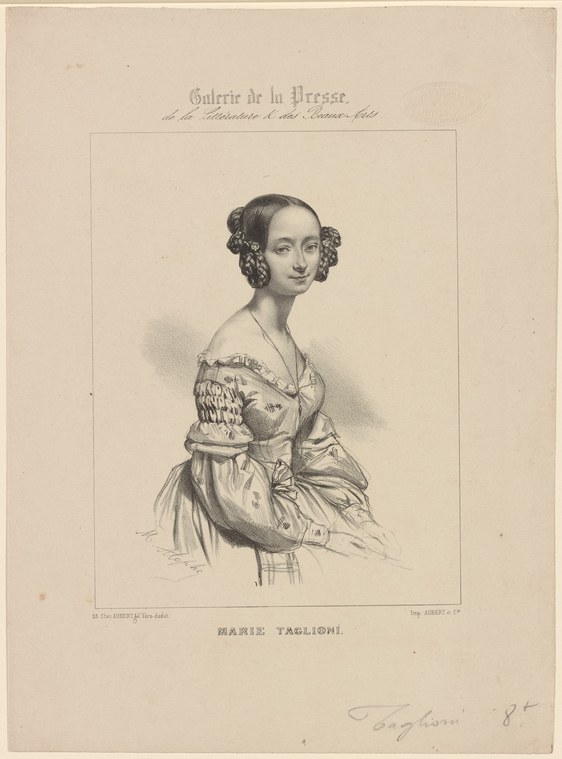
Marie Taglioni was the defining ballerina of the Romantic age and the first dancer to achieve true celebrity status beyond theatrical circles; this print is evidence of how her image was industrially reproduced and consumed. For historians of dance and visual culture, the engraving reveals the relationship between live performance, portraiture, and mass media in the nineteenth century—how the body of a famous dancer became a commodity and how her public identity was shaped by printed reproduction.
What you are looking at
A three-quarter-length portrait of a young woman in elegant dress, presented as if for presentation to society or the stage. She wears a white muslin gown with puffed sleeves gathered at the elbow, the bodice fitted and the skirt voluminous, gathered at the waist. Her dark hair is arranged in elaborate ringlets on either side of her head, a fashionable style of the 1830s–1840s. She is posed turning slightly, her body weight shifted, one arm held loosely, in an attitude of graceful repose rather than active movement. The setting is austere—a plain rectangular frame against a cream background—suggesting this is a formal portrait meant for circulation as a print. The title *Marie Taglioni* and the publication mark *Gal[erie] de la Presse* at the head indicate this is a published engraving from a contemporary gallery or periodical. Her expression is composed and direct, with the slight turn of the figure giving an impression of poised elegance.
The dancing
The figure is rendered in a single standing pose, weight distributed on both feet, with a subtle counterpose that suggests the body could shift into movement at any moment. The arm position is relaxed, the shoulders held level, the neck long and graceful. There is no active dance posture or visible foot position, but the overall frame conveys the physical discipline and upright carriage expected of a professional dancer. The artist has rendered the figure with careful attention to the proportions and bearing of a trained body.
The dance depicted
This is a portrait of Marie Taglioni, the Swedish-born ballerina who became the most celebrated dancer of the Romantic era. She was the daughter of the choreographer and dancer Philippe Taglioni and the star of ballets including *La Sylphide* (1832), which became her signature role. The portrait captures her as she was known to her contemporaries—not mid-performance but in the formal presentation style of the day, emphasizing her refined beauty and aristocratic bearing rather than her dancing. The dress here is fashionable street or presentation wear, not a stage costume, suggesting this print circulated among the general public as a celebrity portrait rather than as a record of choreography or technique.
How it was made
This is an engraving, a process by which an image was incised into a metal plate (likely steel or copper) and printed as a line-based image. The fine cross-hatching visible in the fabric and shadows, and the precise linear quality of the contours, are characteristic of steel engraving—a technique that allowed for large print runs and fine detail. The technique was commonly used for portrait engravings in the 1830s and 1840s, both for periodicals and as separate prints. The publication notation *Gal[erie] de la Presse* suggests this was part of a series or collection, likely printed in Paris, the center of print publishing and celebrity culture at the time.
About this work
This is a formal engraved portrait of Marie Taglioni, the dominant ballerina of the Romantic period, from the 1830s–1840s. It belongs to the tradition of celebrity portraiture that emerged around major theatrical figures in the early nineteenth century, capturing the sitter not as a character in a ballet but as an object of public fascination and admiration. The print circulated as a commodity—part of a published gallery—making Taglioni's image accessible to those who would never see her perform live. As a historical document, it shows how a dancer of the era was publicly represented: refined, elegant, idealized, and presented to a mass audience through the democratic medium of the printed engraving. The image was part of the machinery that made Taglioni not merely a performer but a cultural icon.
How to look at it
This is not a record of Taglioni dancing, but a formal portrait in the idiom of the age. The slight turn of the figure, the relaxed but controlled posture, and the careful arrangement of the drapery are all conventions of the fashionable portrait, designed to convey grace and refinement rather than action. The viewer should attend to the delicate rendering of the muslin and the soft modelling of the face and neck—techniques that emphasize the subject's beauty and vulnerability, central to the Romantic ideal. The engraver has chosen a moment of stillness and presentation, not choreography, reflecting how Taglioni was imagined by her public: as a being of perfect composure and elegance, rather than as an athlete or technician.
The artist
The artist is not identified in the catalogue record. The engraving bears a signature or mark (indicated as 'Imp. Lemoine N.D.C.' in the lower margin), which likely refers to the printer or publisher rather than the original artist. Many such portrait engravings were produced by skilled commercial engravers whose names were not always recorded or credited; the work was often after a drawing or painting by another hand. The publisher's mark *Gal[erie] de la Presse* suggests this was part of a commercial enterprise producing fashionable portraits for the press and the public.
The period
This portrait dates to the height of the Romantic movement in ballet (c. 1830–1850), when the art form was dominated by ethereal, otherworldly female figures—the *ballerina* as a creature of grace and fantasy rather than technical display. Marie Taglioni embodied this ideal; she was famous for her lightness, the illusion of effortlessness, and her ability to seem to float rather than leap. In the visual culture of the period, engravings like this one were among the primary ways the public encountered images of famous performers. Photography existed but was not yet fast or cheap enough to displace the engraving. Lithography was also in use but engraving remained the standard for fine-art reproduction and high-quality portrait printing. The 1830s–1840s saw an explosion of celebrity portraiture in print, partly driven by the rise of illustrated periodicals and the appetite of a growing urban audience for images of notable public figures.
Where it lives
The work is held in the New York Public Library's print collection *Prints depicting dance*. It is a published engraving from the *Galerie de la Presse* (Gallery of the Press), a series or periodical that collected portraits of notable public figures, including theatrical celebrities. The publication is likely French, dating to the 1830s–1840s.
Questions about this work
Is this a picture of Marie Taglioni dancing?
No. This is a formal portrait, not a record of performance. Taglioni is presented in fashionable dress, in a pose designed to convey grace and refinement rather than active dancing. It belongs to the tradition of celebrity portraiture, in which famous performers were represented for public consumption in a style similar to that used for society portraits.
What was Marie Taglioni famous for?
Taglioni (1804–1884) was the leading ballerina of the Romantic era and the star of *La Sylphide* (1832), the ballet that defined Romantic aesthetics. She was celebrated for her lightness, her ability to convey emotion through movement, and her ethereal stage presence. She was the first dancer to achieve widespread celebrity beyond theatrical circles, and her image, like this print, was widely reproduced and consumed.
What is a *Galerie de la Presse*?
A *Galerie de la Presse* (Gallery of the Press) was a series of published engravings, likely French, that collected portraits of notable public figures—politicians, artists, performers, and society figures. Such galleries were part of the emerging mass media of the early nineteenth century, making images of celebrities accessible to the urban public.
Why is this print in a collection of dance imagery if it doesn't show dancing?
Because it is a primary historical document about how dance and dancers were publicly represented in the nineteenth century. The image reveals the relationship between live performance, portraiture, and celebrity culture. It shows how a dancer's body and image were circulated and consumed by the public, and how Romantic ballet was imagined and celebrated.
More dance artwork





