49 works in this view — arrow keys or swipe to move between them.
Dance in Art
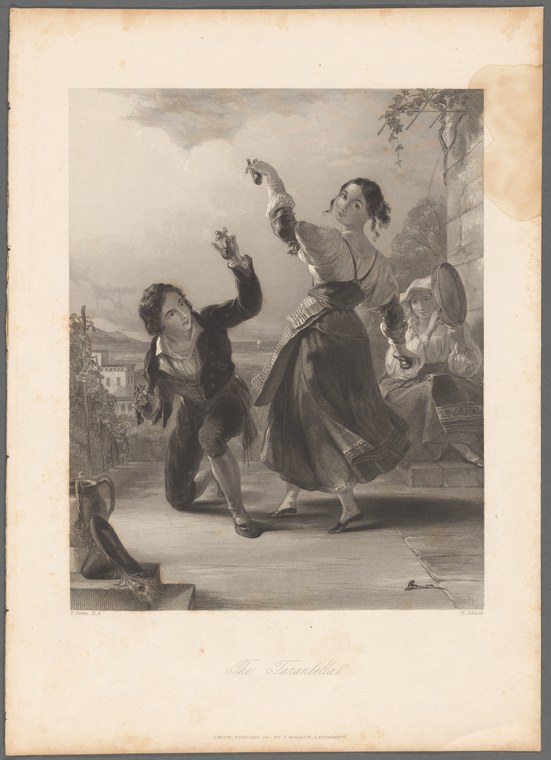
The tarantella
Unknown artist
- Collection:
- Prints depicting dance
- Source:
- New York Public Library
- Rights:
- Public domain — free to use, share and adapt.
- Recorded as:
- Public Domain
The tarantella held a powerful grip on 19th-century artistic imagination as a symbol of authentic, unrestrained emotional and bodily expression—often specifically female expression. This print documents how the dance was visualized and understood in elite European culture: not as a technical or social practice to be analyzed, but as a moment of theatrical intensity, watched and interpreted by others. It reveals the gap between the dance as lived and practiced and the dance as imagined and consumed by audiences who encountered it through art.
What you are looking at
A woman in a long dark dress and light shawl dances with vivid, expressive arm gestures while three other figures watch from the right side of the composition. The dancing woman's body is captured mid-movement, her arms raised and gesturing upward with animated energy, her face turned to follow the motion. She stands on a terrace or open platform with classical architecture—columns and buildings—visible in the misty background. A male figure to the left, dressed in dark coat and breeches, watches intently; two other figures (a woman in white and another observer) stand near doorways on the right. The lighting is soft and atmospheric, creating a romantic, theatrical mood typical of 19th-century narrative engravings. A dog sits in the foreground, adding a domestic note to what appears to be an intimate social gathering.
The dancing
The principal dancer's arms are raised in a gesture of exuberant, almost ecstatic movement—one arm extended high and outward, the other bent and raised, palms facing upward in a gesture of abandon or invocation. Her head is tilted back, her body in a slight contrapposto stance. The watching figures are static, arranged as an audience: the man in dark coat leans forward with evident engagement, the women stand more formally. The composition captures a moment of solo female expression before an intimate group, emphasizing the dancer's energy against the stillness of the observers.
The dance depicted
The title identifies this as a tarantella, the rapid, energetic Neapolitan couple dance that became a stock element of Romantic-era narrative art and literature. The raised arms and expressive gesture suit the tarantella's character of vivid, uninhibited movement. However, this scene shows solo female display rather than partner dancing, which suggests either a performative demonstration (as often occurred in social gatherings) or a romanticized, theatrical interpretation of the dance. The mood and framing—the woman's apparent emotional intensity, the rapt attention of the observers—places this squarely in the 19th-century tradition of depicting folk dances as expressions of passion and regional character.
How it was made
This is a steel or copper engraving, executed with fine cross-hatching and careful tonal gradation to create depth and atmosphere. The technique allows for precise rendering of fabric texture—the woman's dark dress and white shawl are distinguished through differential line density—and for the subtle modeling of faces and hands. The medium's association with book and periodical illustration suggests this was created for wide circulation, likely as part of a narrative or literary publication, which in turn explains the theatrical framing and the focus on emotional and social narrative over documentary accuracy.
About this work
This engraving depicts a tarantella, the rapid, socially charged Neapolitan dance that fascinated 19th-century artists and writers as an emblem of Mediterranean passion and folk authenticity. The work captures not a typical couple dance but a moment of solo female performance—a woman expressing the dance's characteristic energy and emotional intensity before an intimate audience. The romantic atmosphere, the careful attention to social dynamics (the watching figures as an engaged audience), and the theatrical composition all mark this as a literary or narrative engraving rather than documentary record. It belongs to a rich tradition of Romantic-era prints that used folk dance as a vehicle for exploring female expression, regional identity, and the social performance of emotion.
How to look at it
Note the moment the artist has chosen: not the rapid footwork (which would be difficult to render in a static medium) but the emotional peak—the upraised arms and tilted head that read as abandon and intensity. Observe how the composition frames the dancer as the focal point of attention: her body and gesture are the largest and most detailed elements, while the watching figures are secondary, their gazes directing the viewer's attention back to her. The terrace setting and classical architecture ground this in a specific Mediterranean or Italian fantasy; the soft lighting and romantic atmosphere mark this as an emotional rather than documentary image. This is how Romantic-era audiences wanted to imagine folk dance: beautiful, passionate, contained within polite society but transgressive in emotion.
The period
The tarantella became a fashionable subject in Romantic literature and art from the 1820s onward, popularized by Lord Byron, Alexandre Dumas, and others who associated it with Italian passion and freedom. The dance appeared frequently in opera (notably in Rossini's La donna del lago), in narrative paintings, and in engravings for literary publications. By the mid-19th century, when this print was likely made, the tarantella was established as a stock emblem: the vehicle through which artists could depict female emotional expression within a framework of cultural exoticism and moral guardedness (the dance is observed, not joined; it remains socially bounded even as it appears emotionally transgressive). The engraving format—precise, reproducible, and cheap—made such images widely available to middle-class audiences.
Where it lives
The work is held in the New York Public Library's collection of prints depicting dance, classified as a historical print work. The catalogue record provides no date, artist, publisher, or medium specification, but the style and technique are consistent with mid-to-late 19th-century reproductive engravings.
Dance in this work
Questions about this work
Was the tarantella always a solo dance?
No. The tarantella was traditionally a couple dance, often fast and improvisational, with partners facing and moving in circles. This print shows a solo performance or demonstration, which reflects how the dance was often presented in theatrical and social contexts for educated European audiences—as a display of individual expressiveness rather than a social partnered form.
Why does this print focus on the woman's arms and gestures?
In a static medium like engraving, the artist cannot show the rapid footwork that defines the tarantella. Instead, the raised arms and expressive gesture become the readable signs of the dance's energy and emotional character. This also reflects Romantic-era aesthetics: the dance becomes a vehicle for expressing interior emotion and romantic passion, qualities legible in the body and face rather than in technical footwork.
Who would have seen this print?
Engraved prints of this type were relatively inexpensive and widely circulated in 19th-century Europe and North America, most likely as book or periodical illustrations. Middle-class readers interested in literature, travel, and the arts would have encountered images like this; it both reflected and shaped educated audiences' understanding of Italian culture and folk dance as exotic and emotionally intense.
More dance artwork





