49 works in this view — arrow keys or swipe to move between them.
Dance in Art
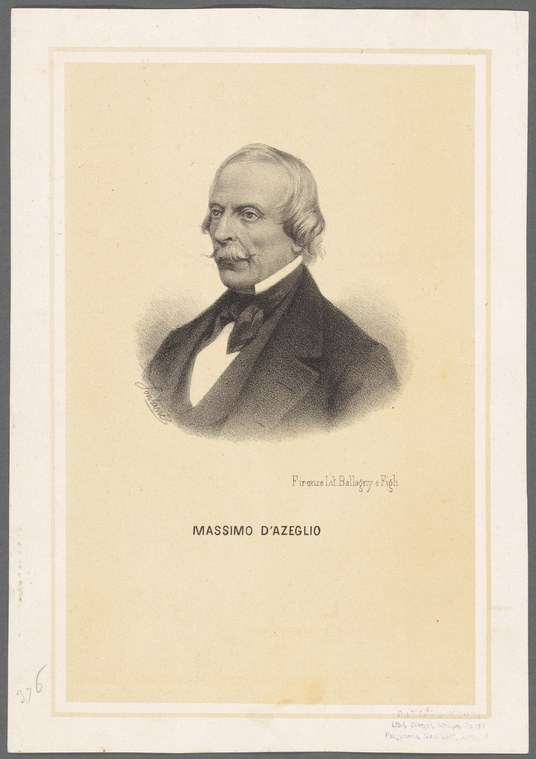
Massimo d'Azeglio
Unknown artist
- Collection:
- Prints depicting dance
- Source:
- New York Public Library
- Rights:
- Public domain — free to use, share and adapt.
- Recorded as:
- Public Domain
This catalogue entry highlights a significant cataloguing error: the work does not depict dance and should not appear in a collection organized around dance imagery. It serves as a useful example of how portrait materials can be miscategorized in historical collections.
What you are looking at
This is a portrait engraving of a single male figure, shown in three-quarter profile against a plain cream background. The man wears formal 19th-century dress: a dark coat with visible white shirt front and bow tie. His hair is receding, styled back, and he has a distinctive drooping mustache. The figure is rendered in fine stippled and line engraving technique, with careful attention to shadow and modeling of the face. The composition is bust-length, framed within a simple rectangular border. The name "MASSIMO D'AZEGLIO" appears below the portrait in capital letters. There is no suggestion of dance, movement, or any physical activity beyond the static pose of portraiture.
The dancing
A single standing male figure in formal dress, shown from the shoulders up in a conventional three-quarter pose. The body is still and upright; there is no dynamic posture, weight shift, or gesture that would indicate dance training or movement. The arms are not visible. This is a straightforward portrait format.
The dance depicted
This image does not depict dance. It is a formal portrait of an individual identified as Massimo d'Azeglio. There is no dance action, costume, or setting visible.
How it was made
This is a stipple and line engraving, a reproductive print technique common in the 19th century. The fine dotted texture visible in the face and the precise linear work in the hair and costume are characteristic of engraving. The technique allowed for accurate reproduction of the portrait across multiple impressions and broad circulation, suggesting this was a published portrait of a public figure.
About this work
This is a formal portrait engraving of Massimo d'Azeglio, a 19th-century Italian statesman and intellectual. The work has been catalogued in a collection of prints depicting dance, but the image itself contains no dance content whatsoever. It is a conventional bust-length portrait in engraved line and stipple, the kind used to commemorate public figures in the period.
How to look at it
The viewer should observe the careful rendering of facial features and the formal conventions of 19th-century portraiture: the three-quarter pose, the formal dress, and the neutral background designed to focus attention on the sitter's face and identity. The engraved technique itself—visible in the fine dots and precise lines—is part of what made this image reproducible and therefore politically and socially useful.
The artist
The engraver's name is not recorded in the catalogue. The style and technique are consistent with mid-19th-century European portrait engraving, a well-established commercial practice for reproducing images of prominent figures.
The period
Massimo d'Azeglio (1798–1866) was a Piedmontese statesman, writer, and painter of the Risorgimento era. Portrait engravings of this type were standard tools for disseminating images of political and intellectual leaders in 19th-century Europe. This appears to be a commemorative portrait, likely created during or shortly after his political prominence in the 1850s.
Where it lives
This print is held by the New York Public Library in a collection catalogued under the heading "Prints depicting dance." The work is a portrait engraving of unknown publication date and engraver.
Questions about this work
Why is this portrait in a dance collection?
This appears to be a cataloguing error. Massimo d'Azeglio was an Italian statesman and writer, not a dancer, and the portrait contains no indication of dance. It may have been placed in this collection by mistake, or the collection's cataloguing system may have been overly broad.
Who was Massimo d'Azeglio?
Massimo d'Azeglio (1798–1866) was a Piedmontese statesman, author, and painter who played a significant role in Italian unification and political reform in the mid-19th century. He served as Prime Minister of Piedmont and was a prominent intellectual figure of the Risorgimento.
What technique is this engraving?
This is a stipple and line engraving, a reproductive printmaking technique in which the image is created through dots and fine lines incised into a metal plate. This technique was widely used in the 19th century to create publishable portrait reproductions.
More dance artwork





