49 works in this view — arrow keys or swipe to move between them.
Dance in Art
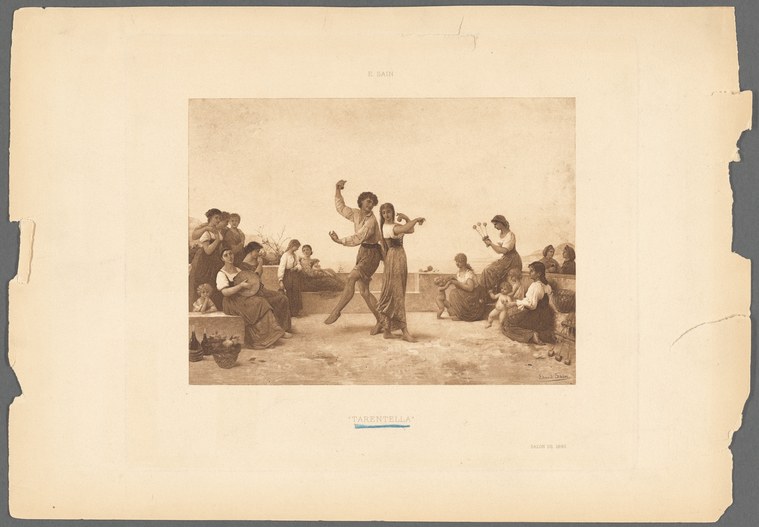
Tarentella [sic], Salon de 1890
Unknown artist
- Collection:
- Prints depicting dance
- Source:
- New York Public Library
- Rights:
- Public domain — free to use, share and adapt.
- Recorded as:
- Public Domain
This work is essential evidence for how non-ballroom European dance was understood and represented in fine art at the moment when photography was beginning to displace the engraving as a document. It shows the tarantella not through the eyes of an Italian practitioner or ethnographer but through a Parisian Salon aesthetic—which tells us as much about 1890s values and fantasies as it does about the dance itself. For historians of dance representation, it raises the question of how far visual art can be trusted as evidence of how dances were actually performed.
What you are looking at
A seaside or beach setting, rendered in warm sepia tones. A group of figures in 19th-century dress occupies the composition: women in long skirts and fitted bodices, men in jackets and trousers. The figures are arranged in loose clusters, some seated on the sand in the foreground and background, others standing or in motion in the center. The central action shows a pair of dancers—a man and woman—with arms raised and bodies in animated posture, suggesting rapid footwork and turning. The woman's skirt is caught mid-whirl. The light is soft and diffuse, characteristic of a printmaking technique rather than direct observation. The overall mood is one of leisure and social gaiety, the kind of impromptu outdoor entertainment that would have appealed to Salon audiences of the 1890s.
The dancing
The primary dancing couple occupies the center in a dynamic, face-to-face configuration with raised arms and weight transferred into the movement. The man's posture suggests rapid turning; the woman's body leans into the turn with her skirt billowing. Both appear to be executing quick, upward-rising steps rather than the smooth gliding motion of ballroom dance. The seated and standing spectators frame the dancers, their attention focused inward, creating a sense of audience participation typical of folk celebration. The bodies throughout are rendered with an understanding of weight shift and the effort required for sustained turning.
The dance depicted
The catalogue title names this as a tarantella, the southern Italian folk dance traditionally danced in pairs with rapid turning, upward-rising steps, and often accompanied by tambourines or hand-clapping. The image supports this identification: the couple's energetic turning, the raised-arm posture, the seaside setting (tarantellas were outdoor social dances), and the informal gathering of spectators all accord with how the tarantella was understood and performed in the late 19th century. The dance appears to be presented here as a spectacle for mixed company in leisure dress rather than in any formal theatrical or competitive context—this is the tarantella as it would be encountered in a Mediterranean holiday scene, the kind of exoticized cultural tourism that fascinated Northern European audiences in the 1890s.
How it was made
This is a sepia-toned etching or engraving, identifiable by the fine hatching and cross-hatching visible throughout the composition and the characteristic tonal gradation achieved through varying line density. The technique allows for both precision in the rendering of costume detail—the gathered skirts, the fitted jackets—and atmospheric effect in the broadly worked background. The soft, warm toning suggests either hand-coloring in sepia wash applied after printing, or use of a prepared sepia plate. The scale and finish suggest a work intended for reproduction and circulation through the Salon or art journals rather than a unique print; this technology enabled wide dissemination of dance imagery to a bourgeois audience.
About this work
This sepia etching captures a moment of tarantella dancing in an Italianate beach setting, likely from the 1890s or slightly earlier. The work exemplifies a widespread cultural practice of the period: the appropriation and aestheticization of European folk dance by Northern art establishments. The tarantella, with its energetic turning and outdoor informality, offered everything the 19th-century Salon expected from a "picturesque" European subject—exoticism without colonial distance, vivid movement, gendered spectacle, and the pleasures of leisure culture. The image sits at the intersection of ethnographic curiosity, orientalism, and the Salon's appetite for narrative genre scenes. It belongs in a dance gallery because it documents how a real dance was perceived, filtered, and remade as spectacle for a specific audience at a specific moment.
How to look at it
Attend first to the central couple's posture and the dynamics of the turning: the raised arms, the weight carried forward into the turn, the suggestion of continuous rotational energy. The artist has chosen the moment of maximum animation—when the couple is locked in the turn and the spectators' attention is most concentrated. Notice how the surrounding figures create a frame and context: this is not an isolated technical display but a social dance embedded in leisure culture. The soft, worked modeling of the background contrasts with the crisper delineation of the foreground figures, a compositional device that pushes the dancers forward and emphasizes the informality of the scene.
The period
The 1890 Salon was at the height of the Salon's power as a arbiter of fine art taste in Paris, even as photography and new printing technologies were beginning to reshape how images circulated. Tarantella imagery was fashionable among Salon painters of the late 19th century: the dance represented a nexus of appeals—Mediterranean exoticism, energetic female bodies, picturesque outdoor leisure, and a folk authenticity that stood in contrast to the formality of ballroom dance. The tarantella had appeared in Romantic literature and ballet (including in the ballet-pantomime repertoire) throughout the 19th century; by the 1890s it had become a standard motif in Salon genre scenes. The impulse to document and display European folk practices as aesthetic objects was part of a broader late-19th-century turn toward ethnographic and regionalist subject matter in art.
Where it lives
The work is held in the New York Public Library's collection of prints depicting dance, a collection that ranges across centuries and cultures and prioritizes visual documentation of movement over questions of artistic attribution or significance. The sepia-toned finish and catalogue notation suggest this is a single impression from a print or a hand-colored example within the larger collection.
Dance in this work
Questions about this work
What is a tarantella and why was it so popular in 19th-century art?
The tarantella is a rapid, energetic circle or couple dance from southern Italy, traditionally performed outdoors and often at celebrations or festivals. It attracted 19th-century Northern European artists as a symbol of Mediterranean vitality, peasant authenticity, and unrestrained feminine energy—all qualities that contrasted pleasingly with ballroom formality. It also had the advantage of being geographically distant enough to seem exotic but close enough to seem European and accessible to salon audiences.
How can you tell this is an etching and not a painting?
The fine parallel lines (hatching and cross-hatching) used to build tone and shadow are characteristic of engraving and etching technique. Paintings render tone through brushwork and pigment blending; prints build it through variation in line density. The even tonal coverage, the precision of the line work, and the sepia coloring applied as a wash all point to a printed medium.
Is this work historically accurate as a document of the tarantella?
Probably partially. The couple's energetic turning and raised-arm posture align with accounts of how the tarantella was performed; the outdoor, social setting is authentic. However, the figures' dress is entirely Northern European bourgeois—they wear the clothes of the 1880s-90s salon visitor, not Southern Italian folk dress. The image documents the tarantella as it was imagined by and for a Parisian audience, not as it was danced in its original context.
Why is the title spelled 'Tarentella' instead of 'Tarantella'?
The variant spelling 'Tarentella' was common in 19th-century French and English texts and referred to the same dance. The spelling likely reflects French pronunciation and usage conventions of the period in which the work was catalogued or published.
More dance artwork





