49 works in this view — arrow keys or swipe to move between them.
Dance in Art
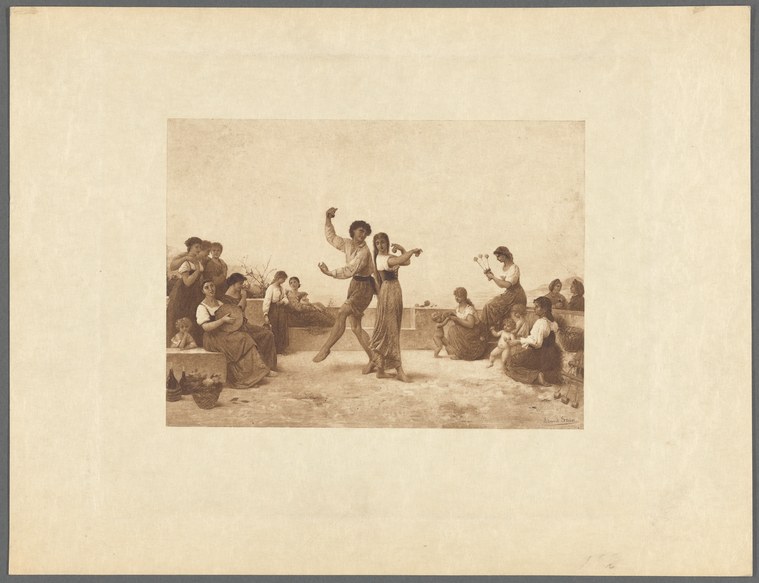
Copy of Sain's painting, without captions
Unknown artist
- Collection:
- Prints depicting dance
- Source:
- New York Public Library
- Rights:
- Public domain — free to use, share and adapt.
- Recorded as:
- Public Domain
This is one of the rare visual documents of 19th-century folk or regional social dancing from an everyday perspective, not a theatrical or satirical one. It records the postures, dress, and social structure of dance as ordinary people practiced it, making it invaluable for understanding how dance functioned in community and family life before it was systematized into competitive or commercial forms.
What you are looking at
A sepia-toned print depicting a seaside or beach gathering of figures in 19th-century dress arranged in a loose semicircle around a central dancing couple. The setting is spare—bare ground with minimal architectural detail, suggesting a coastal or rural location. A standing woman in the center, wearing a long dress with her arm raised, faces a male figure in darker clothing; their relative positions and her lifted arm suggest active movement. Seated figures dominate the composition, clustered on both sides: women in bonnets and long skirts occupy the left and right foreground, while additional figures are distributed across the middle ground. The light is diffuse and warm, characteristic of the printing technique, and the overall tone is documentary rather than idealized—this reads as a record of actual social practice rather than a theatrical fantasy.
The dancing
The central female dancer stands with her weight shifted, one arm raised in an expressive gesture suggesting either invitation or emphasis. Her male partner is positioned close but not in a formal closed hold. The surrounding figures are predominantly stationary: seated women observe from the periphery, their bodies angled toward the action, their long dresses anchoring them to the ground. The asymmetry is notable—the observers far outnumber the dancers, and their gazes appear to track the central couple's movement. No one is in pointe shoes or formal ballroom frame; the postures are relaxed, social, vernacular.
The dance depicted
This appears to document a 19th-century social dance in a rural or working-class seaside setting, most likely a regional or folk variant from a Mediterranean or Southern European context—the sparseness of the setting, the informal grouping, and the dress all point away from urban ballroom practice. The central woman's raised arm and the man's close but non-formalized position suggest a participatory, improvisational idiom rather than a codified technique. The gathering itself—mostly seated onlookers with one or two active dancers—is consistent with folk celebration where dancing rotates through available participants. The specific identity of the dance cannot be determined from the gesture alone, but the social structure and informality mark this as folk-regional rather than theatrical or ballroom.
How it was made
This is a photomechanical reproduction or salt-print from a drawing, executed in a sepia or warm-toned monochromatic palette. The soft tonal gradations and the fine line work suggest either a reproduction of a drawing by lithograph or photogravure—techniques that allow tonal subtlety while maintaining linear clarity. The mount and presentation (framed within a larger cream-colored sheet) indicate this is part of a collected or published series, and the documentary quality of the rendering suggests it was made to record or circulate an image of actual social practice rather than as fine art for exhibition. The technique would have made the image reproducible and relatively affordable, suitable for distribution in illustrated journals or collected prints.
About this work
This print documents a moment of social dancing in what appears to be a 19th-century rural or coastal community, likely from Southern Europe or a Mediterranean region. A man and woman occupy the center of a gathered crowd, mostly seated onlookers in period dress, in a pose that suggests active, informal movement. The work is significant as a historical record of folk or regional dance practice—not the stylized versions that made it into theatrical or ballroom contexts, but the lived social reality of dance as a participatory gathering. It belongs in a gallery of dance imagery because it shows dance as a social fact: who danced, how they dressed, who watched, and what the space of dancing looked like when it was not codified by schools or theaters.
How to look at it
Attend to the asymmetry of the composition: the central dancers are relatively still and modest in their gesture, while the seated figures create the real visual energy through their orientations and density. The artist has chosen not to freeze a moment of elaborate technique or display, but a quieter moment of social interaction—a woman extending an arm, a man close by, observers watching. This is not a climactic movement but an ordinary social moment, which is precisely what makes it valuable as historical evidence. Notice too the dress and the ground: the long skirts and bonnets date the scene precisely, while the bare earth and minimal setting tell you this is not an urban salon or theater but an actual community gathering.
The artist
The work is catalogued as a copy of a painting by Sain (possibly Alexis-Simon Madeleine Pinson, known as Sain, a 19th-century French academic painter), indicating it is a reproductive print rather than an original drawing or painting. Sain worked in the tradition of social realism and documentary painting, often depicting rural or working-class life with ethnographic interest. The fact that this work was copied and printed suggests it circulated as a popular or educational image, reaching audiences beyond gallery visitors.
The period
The 19th century saw growing interest in documenting rural and regional dance practices as industrialization and urbanization were perceived to threaten traditional forms. Romantic movement aesthetics elevated folk culture as authentic and spiritually valuable, while at the same time, dance was increasingly professionalized and systematized into ballet academies and ballroom instruction. This print sits at the intersection: it records folk practice with romantic documentary sympathy, but through the medium of fine art reproduction—making it both a preservation effort and a circulation of folk dance to urban, educated audiences who would never witness it live.
Where it lives
The work is held in the New York Public Library's collection of prints depicting dance. It is catalogued as a copy after a painting by Sain, though the specific date, original medium, and printing technique are not recorded. Its presence in a collected series of dance prints suggests it was gathered as part of deliberate curatorial interest in visual dance history.
Dance in this work
Questions about this work
Is this a real scene or a imagined one?
The catalogue record identifies it as a copy after a painting by Sain, a 19th-century academic painter known for social realism. Whether Sain painted from observation or from imagination is not documented. The specificity of the dress and setting suggests ethnographic intention—the artist meant to record how people actually dressed and gathered—but the posed quality of the central figures and the balanced composition suggest artistic arrangement rather than direct reportage. It is most likely a romanticized or idealized record: based on observed social practice but composed for aesthetic and narrative effect.
What dance is being performed?
The specific dance cannot be identified from the posture and gesture alone. The setting, dress, and social structure suggest a 19th-century folk or regional social dance from Southern Europe or the Mediterranean, but without additional context—music, location, or inscription—the identity remains uncertain. The informality of the gathering and the women's long skirts and bonnets are consistent with European folk dancing of the period, but that encompasses hundreds of named dances.
Why are there so many seated figures and so few dancing?
This reflects the actual social structure of folk and community dancing: in many traditions, participants rotate in and out, and a significant portion of the gathering consists of musicians, family members, and onlookers who watch, encourage, and wait their turn. The composition thus documents a real social fact, not a theatrical convention. It also suggests that the dancing was participatory and spontaneous rather than a professional performance with a clear divide between performer and audience.
When was this made?
The catalogue record does not provide a date. The dress and printing technique suggest the 19th century, likely the mid-to-late 1800s, but without an inscription, signature, or publication record, precision is not possible. The work may have been made as a contemporary document or created later as a historical or romantic record of folk life.
More dance artwork





