49 works in this view — arrow keys or swipe to move between them.
Dance in Art
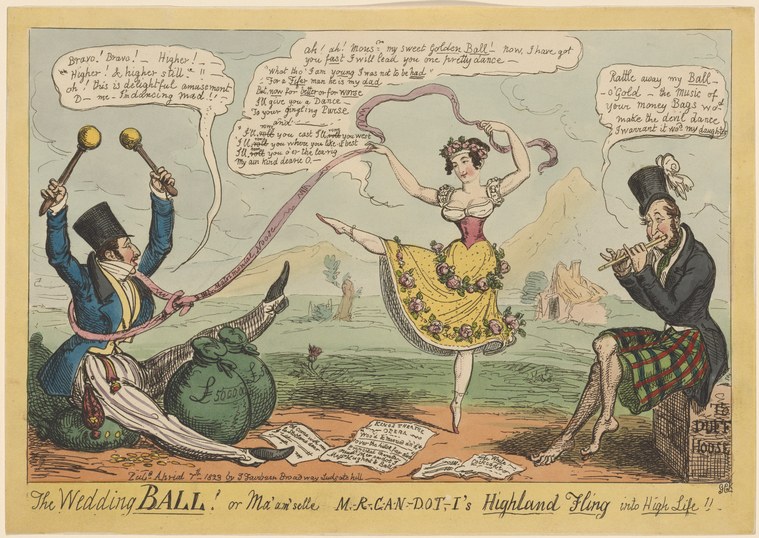
The wedding ball; or Ma'am'selle M-rcandot-i's highland fling into high life
Unknown artist
- Collection:
- Prints depicting dance
- Source:
- New York Public Library
- Rights:
- Public domain — free to use, share and adapt.
- Recorded as:
- Public Domain
This print is evidence of Highland fling as a fashionable social dance in British ballrooms during a period when Scottish identity was being commercialized for genteel consumption. It reveals the satirical eye turned on women's dance bodies in print culture—the exaggeration of bodily extremes, the mockery of aspiration, and the gendering of ridicule. For historians of dance and print, it documents the audience, the anxieties, and the visual conventions at work when folk dance met social ambition.
What you are looking at
A satirical engraving depicts three figures in a landscape, engaged in exaggerated ballroom dance. At left, a man in blue coat and top hat holds aloft two round objects (weights or rattles) with arms raised high, his body lunging forward in an extreme pose. At center, a woman in a yellow muslin gown with pink sash performs an energetic Highland fling, one leg extended high behind her, the other supporting an arched, dynamic torso; her arms sweep in elaborate curved ribbons through the air. At right, another man in black coat and top hat sits on what appears to be a bench or box, playing a stringed instrument (perhaps a fiddle), his body twisted in an awkward posture. The ground is bare and reddish; a distant landscape with small buildings and hills fills the background. Speech bubbles overflow with text (legible in parts: references to balls, dances, and "high life"). The whole scene is rendered in hand-colored engraving with precise line work and witty exaggeration of bodily extremes.
The dancing
The central dancer's Highland fling displays one leg thrust high in extension, the supporting leg bent, with the torso arched backward in extreme curvature—a technically impossible but visually comic pose that exaggerates the vigor of the dance. Her arms describe broad, sweeping arcs. The left figure's raised arms and forward lunge suggest wild exertion. The musician on the right is contorted into a playing posture that mirrors the dancers' distortion. No formal ballroom hold is present; instead, each figure occupies its own grotesque space, emphasizing isolation and absurdity rather than partnered grace.
The dance depicted
The title identifies this as a Highland fling, a Scottish folk solo traditionally performed by both men and women with precise footwork and controlled arm positions. This engraving satirizes the dance by inflating its physical demands into impossible extremity: the extended leg impossibly high, the arch of the spine verging on contortion, the arm movements exaggerated into wild ribbon-like sweeps. The "wedding ball" and references to "high life" in the speech bubbles suggest this is social dancing in an aspirational or newly genteel context—likely mocking the pretensions of lower-middle-class dancers attempting fashionable Highland reels at balls. The historical Highland fling (as opposed to later theatrical codifications) involved lower positions and more grounded footwork; this image preserves the Highland setting and solo format while caricaturing the affectation.
How it was made
This is a hand-colored engraving—fine lines incised into a copper plate, printed and then colored by hand (visible in the flesh tones, yellow gown, blue coat, and landscape wash). The technique allows for sharp, satirical line-work and exaggerated anatomical distortion. The extensive hand-lettering in speech bubbles and the caption below are integral to the print's meaning. This format—colored engraving with satirical text—was typical of popular social commentary in Britain in the late 18th or early 19th century, suggesting wide circulation among middle- and lower-middle-class buyers who read print satire.
About this work
This is a satirical hand-colored engraving that ridicules the Highland fling as performed in genteel balls by would-be fashionable dancers. The central figure performs the dance at an anatomically impossible extreme—leg thrown impossibly high, torso arched backward, arms sweeping in exaggerated ribbons—while two male companions (one holding weights or rattles, one playing a fiddle) adopt equally grotesque supporting poses. The title's reference to "Ma'am'selle M-rcandot-i's highland fling into high life" suggests mockery of pretension: a woman with a Francified name adopting a Scottish folk dance as a marker of social ascent. The work sits within a tradition of satirical prints that used dance to ridicule social climbers and nouveaux riches. It documents not how the Highland fling was actually performed, but how mid-market urban audiences understood and mocked the appropriation of folk dance by those seeking refinement.
How to look at it
Attend to the moment of maximum extension: the artist has frozen the dancer at an impossible point of physical stress—leg higher and torso more arched than any dancer could maintain—to maximize the absurdity. The curved sweeping ribbons emanating from her arms stylistically exaggerate movement. Compare the central dancer's contortion with the musician's twisted posture and the left figure's unbalanced lunge; all three bodies are pushed to visual extremes, suggesting that exaggeration itself is the joke. The speech bubbles anchor the satire in language: read them to understand what behavior is being mocked (aspiration, social climbing, the woman's foreign name in a folk context).
The period
The Highland fling emerged in Scotland as a solo competitive dance form, gaining popularity in Britain's urban ballrooms during the late 18th and early 19th centuries as part of a broader vogue for Scottish identity following the union and the romanticization of the Highlands. Simultaneously, satirical color-printed engravings were a major medium for social commentary, often targeting the dress, comportment, and pretensions of the rising middle classes. This print belongs to that tradition of visual satire, using the body in dance as a vehicle for ridicule. The woman's yellow muslin gown and fashionable appearance place her within the consumer culture of the Regency era; the engraver's exaggeration of her physical extremes reflects anxieties about women's public movement and display.
Where it lives
Held in the New York Public Library's collection of prints depicting dance. The print's format and coloring technique are consistent with commercial popular prints of the Regency era, suggesting it was intended for sale to a broad urban audience familiar with satirical engravings.
Dance in this work
Questions about this work
Is this how the Highland fling was actually performed?
No. The engraver has exaggerated the dance's physical demands for comic effect. The leg extension and spinal arch shown here would be impossible to hold; the arm movements are stylized as flowing ribbons rather than the controlled positions of the actual dance. This is satire, not documentation. However, the dance was performed as a solo in ball contexts, and it did involve leg extensions and upright carriage—the engraver simply pushed these features to absurd extremes.
Why is she performing the Highland fling at a ball?
By the early 19th century, the Highland fling had become fashionable in British ballrooms as a solo showpiece, part of a broader vogue for Scottish culture. The title's reference to a "wedding ball" and the characters' dress suggest this is a social dance event. The satirist seems to be mocking the pretension of someone with a French-sounding name ("M-rcandot-i") adopting a Scottish folk dance as a marker of fashion and refinement—a form of cultural climbing.
What is the man on the left holding?
The round objects appear to be weights, rattles, or theatrical properties—possibly meant to suggest that the dancers are flailing wildly rather than executing controlled steps. Without seeing the full text of the speech bubbles clearly, the exact meaning is ambiguous, but they emphasize the absurdity of the male figure's posture.
Who made this print and when?
The artist is not recorded. Based on the style, coloring technique, and subject matter, it was almost certainly produced in Britain during the Regency era (roughly 1811–1820) or slightly later, when such satirical color-printed engravings were at peak popularity. The format and hand-coloring suggest it was a commercial popular print, sold for modest cost to urban middle-class buyers.
More dance artwork





