49 works in this view — arrow keys or swipe to move between them.
Dance in Art
Dansseuse de Loango
Unknown artist
- Collection:
- Prints depicting dance
- Source:
- New York Public Library
- Rights:
- Public domain — free to use, share and adapt.
- Recorded as:
- Public Domain
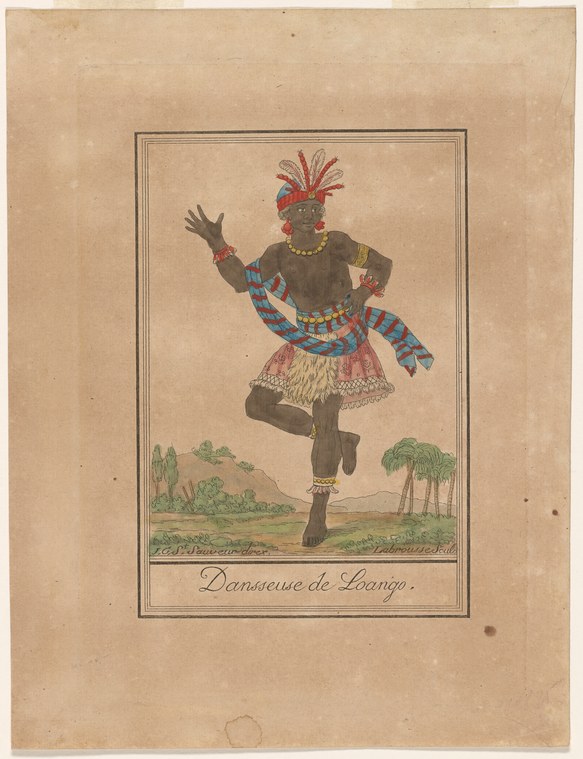
This image is a primary document of how European artists visualized African dance in the 18th century—filtered through print culture, racial ideology, and theatrical convention. For dancers and historians, it reveals not the dance itself but the history of European interpretation of African movement, costume, and performance, and the role of engraved prints in circulating and standardizing those representations across Europe.
What you are looking at
A single figure dominates this hand-colored engraving, shown in dynamic motion against a spare landscape. The dancer, identified in the inscription as a "Dansseuse de Loango" (Loango dancer), is captured mid-leap or mid-stride, one leg extended forward, the body twisted in an energetic pose. The figure wears a costume that combines multiple elements: a dark skin tone (likely printed or hand-colored), a feathered headdress in red and white, beaded necklaces, a patterned cloth wrapped around the hips in blue and white checks, a pale pink or whitish skirt or wrap at the hem, and dark leg wrappings or boots. The arms are raised and gesturing expressively—one hand open and stretched, the other bent. The background is minimal: low green vegetation and palm trees to the right suggest a tropical or African setting. The composition is framed within a neat double-line border, and the whole scene sits on a pale cream ground typical of 18th-century printmaking.
The dancing
A single dancer, shown in what appears to be a high, dynamic leap or striding step with the body weight forward and the legs in active extension. The head tilts back, the neck extended, and the arms frame the upper body in an expressive, reaching gesture. The pose suggests vigor and control—this is not a static portrait but a captured moment of athletic movement. The artist has paid attention to the musculature and anatomical structure of the figure, rendering it with understanding of bodily weight and momentum.
The dance depicted
The inscription identifies this as a dance from Loango, a historical region on the Atlantic coast of present-day Congo. The figure and movement style are consistent with Central African dance traditions, though the image itself—a European engraving—represents a European view of African dance filtered through 18th-century aesthetic conventions and colonial perspective. The dynamic leap, expressive arm gestures, and the feathered headdress suggest a ceremonial or celebratory context. Without additional documentation, the specific dance cannot be identified with certainty, but the image records a moment of African dance practice as perceived and interpreted for a European audience.
How it was made
This is a hand-colored engraving, executed in the fine-line technique characteristic of 18th-century European print culture. The base image was engraved—likely by a skilled craftsperson—and then individually colored by hand with watercolor or similar pigment, which explains the variations in tone and the soft quality of the hues. This technique was labor-intensive and expensive, placing such prints in the hands of educated and relatively affluent viewers. The circulation of such images through print collections and albums helped shape European knowledge of the wider world, even as the images themselves were filtered through European artistic conventions and racial assumptions.
About this work
This engraving records a European visual encounter with African dance in the 18th century—specifically, a dancer identified as being from Loango, a coastal region of Central Africa. The image is neither a documentary photograph nor a faithful ethnographic record, but rather a work of theatrical or curious representation, produced for European consumption at a moment when exotic and colonial imagery was becoming fashionable in art and print culture. The dancer is rendered with anatomical attention and a sense of dynamic movement, yet the framing, costume details, and context all reflect European aesthetic priorities and colonial attitudes. The work belongs in a dance gallery because it documents both a dance practice and the European art world's fascination with rendering non-European bodies in motion, a fascination that would shape artistic and anthropological representation for centuries.
How to look at it
Attend to the moment of movement the artist chose to freeze: a full-bodied leap or stride, captured mid-action rather than in a posed stillness. Notice how the body's weight and momentum are suggested through the angle of the torso, the extension of the limbs, and the tilt of the head. Observe too the costume details—the feathered headdress, the beaded necklaces, the patterned cloth—which may reflect actual garments or may be European interpretations of African dress. The spare landscape background emphasizes the figure's isolation and frames this as a specimen or curiosity for European viewing rather than a scene of lived social context.
The artist
The artist is not recorded in the catalogue. The work is typical of 18th-century European ethnographic or exotic print production, a mode in which unnamed craftspeople—engravers, colorists, and publishers—collaborated to produce images of distant peoples and lands for educated European audiences. Such prints often drew on travel narratives, secondhand accounts, or artistic imagination rather than direct observation.
The period
The 18th century saw an explosion of European interest in the wider world, driven by colonial expansion, travel narratives, and the Enlightenment appetite for knowledge of distant peoples. Prints depicting exotic dances, costumes, and customs circulated widely and helped form European perceptions of Africa, Asia, and the Americas. At the same time, European dance itself was highly formalized—court dance, ballet, and ballroom forms dominated elite performance. The juxtaposition of a dynamically rendered African dancer against the formal conventions of European printmaking is characteristic of how European artists simultaneously celebrated and exoticized non-European movement.
Where it lives
The work is held in the New York Public Library's collection of prints depicting dance, a broad thematic assembly that brings together images of movement and performance from across centuries and cultures. The catalogue record for this work is minimal, reflecting the common condition of prints in institutional collections, where individual items are catalogued summarily and the full visual evidence must be read from the object itself.
Dance in this work
Questions about this work
Was this artist present in Loango to draw from life?
Almost certainly not. This is a European engraving, produced for European audiences, and likely based on secondhand descriptions, travel narratives, or artistic imagination rather than direct observation. The technique—hand-colored engraving—requires a workshop and printing infrastructure located in Europe.
What does 'Loango' refer to?
Loango is a historical region on the Atlantic coast of what is now the Republic of the Congo, an area of intense European trading activity and colonial interest in the 17th and 18th centuries. The region gave its name to the Loango Kingdom and was a source of enslaved people, ivory, and other goods in the transatlantic trade.
Is this a reliable record of actual African dance?
It is a record of how a European artist chose to represent African dance for a European audience. The dynamic energy and anatomical attention suggest the artist understood something of human movement in motion, but the image is filtered through European aesthetic conventions, colonial perspective, and theatrical tradition. It tells us as much about 18th-century European imagination as about African dance practice.
More dance artwork





