49 works in this view — arrow keys or swipe to move between them.
Dance in Art
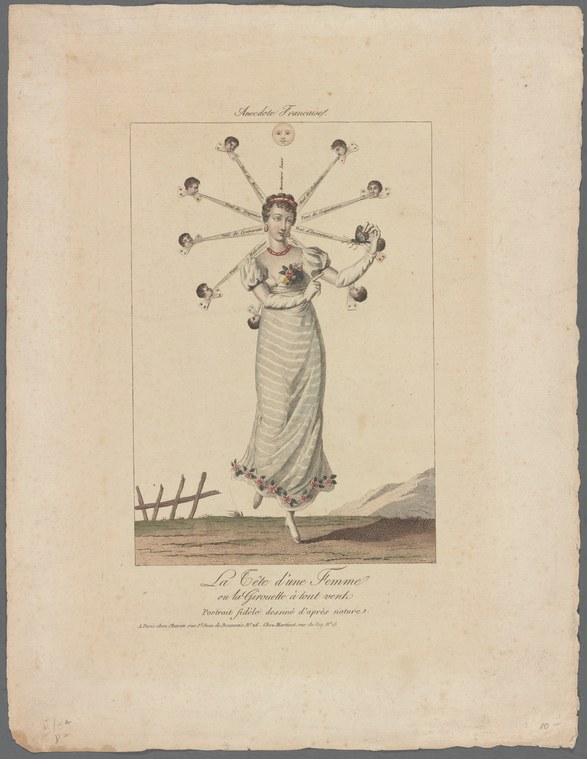
La tête d'une femme ou la girouette à tout vent: portrait fidèle dessiné d'après nature
Unknown artist
- Collection:
- Prints depicting dance
- Source:
- New York Public Library
- Rights:
- Public domain — free to use, share and adapt.
- Recorded as:
- Public Domain
The work reveals how dance imagery and the visual vocabulary of theatrical movement permeated European prints and popular culture in the Regency era, even in genres far removed from dance documentation. It also demonstrates the gendered language of the period: female bodies in motion were read as unstable, irrational, or morally suspect—a prejudice embedded in visual culture and made explicit here through the metaphor of the weathervane.
What you are looking at
A woman in high-waisted Regency dress stands center stage, her body tilted slightly backward in a dynamic pose. Her arms are raised and extended outward in eight directions, each terminating in a small cherub or putti head that appears to float or hover at the end of an elongated arm or limb. The central figure wears a long, flowing gown with horizontal pleating or gathering at the bodice and torso, consistent with women's fashion circa 1800–1815. Her feet are planted firmly on a sparse ground line; a wooden fence or paling appears in the lower left. The composition is symmetrical and highly stylized, presented as a formal engraving against a plain background. The title, rendered in French script at top and bottom, suggests this is a satirical or allegorical print—a woman depicted as a weathervane, responsive to every wind.
The dancing
The central female figure is the sole human body; the eight cherub heads are not independent dancers but rather graphic extensions or attributes of her single form. Her torso is held upright but tilted; her arms are extended in a wide, radiating V-pattern—four arms or limb-extensions reaching upward and outward to the upper corners, four reaching lower and outward to the sides. The pose suggests simultaneity and instability: she is balanced on both feet but appears suspended between competing directions. There is no clear footwork, stance, or balletic frame; the figure is iconic and heraldic rather than naturalistic.
The dance depicted
This image does not depict dance in the conventional sense; it is an allegorical or satirical print. The title—*La tête d'une femme ou la girouette à tout vent* ('The head of a woman, or the weather-vane to every wind')—indicates this is a commentary on female inconstancy or fickleness, visualized through a metaphor of the woman as a spinning, direction-shifting weathervane. The pose may allude to the pirouette or rapid turning of theatrical dance, and the radiating cherub heads suggest the dizzying disorientation of rapid rotation, but the work is social satire rather than a record of an actual dance practice.
How it was made
This is a hand-colored engraving or etching, executed with fine line work and finished with watercolor or hand-applied pigment (note the flesh tones and the subtle blue-gray wash on the fabric). The technique allowed for mass production and wide distribution of satirical imagery, and the careful stippling and cross-hatching characteristic of late 18th-century French printmaking are evident in the modeling of the figure and the ground. The small scale and refined execution suggest this was a luxury commodity aimed at an educated, literate audience familiar with visual allegory and French wit.
About this work
This is a satirical allegorical engraving, likely French, from the late 18th or very early 19th century. It depicts a woman transformed into a human weathervane, her body radiating eight cherub heads in a pose that evokes the instability and rotational movement of dance—particularly the pirouette—while using the language of dance to mock female volatility and inconstancy. The work sits at the intersection of dance imagery, social satire, and printmaking tradition, using the visual grammar of theatrical movement to deliver a pointed commentary on gender and character.
The image belongs in a gallery of dance in art because it exploits the visual language of Regency-era theatrical dance—the extended arms, the tilted torso, the suggestion of spinning—to make its satirical argument. Dance is not the subject but the vehicle: the *form* of dance carries the *meaning* of the critique. This is typical of how allegorical and satirical prints of the period borrowed from the vocabulary of ballet and pantomime to reach an audience already familiar with those forms.
How to look at it
Attend to the pose: the woman is not standing at rest but caught in a moment of rotational momentum, her body tilted as if mid-spin. The eight radiating heads are not eight women but eight visual echoes or emanations of a single head, compressed into a satirical emblem. The engraver has used the conventions of ballet—the extended arms, the lifted torso, the sense of weightlessness—to render the woman as a unstable, perpetually rotating object rather than an agent. The fence at the bottom grounds her literally and suggests she is rooted, immobilized, even as she spins: a clever visual contradiction that reinforces the satire.
The period
This print was produced in the era of the Directoire (1795–1799) or Consulate (1799–1804) and likely circulated during the Napoleonic Wars. The high-waisted, neoclassical silhouette and the refined style of the line work place it firmly in French printmaking of the late 18th century. At this time, satirical prints were a major form of political and social commentary in France; female dress and behavior were frequent targets of visual humor and critique. The allegorical use of classical and mythological language—here, the weathervane as an ancient emblem of fickleness—was a convention of educated visual culture. Simultaneously, Regency ballet was becoming more prominent in European theaters (the Romantic ballet would follow within decades), and the vocabulary of theatrical movement—extension, pirouette, the raised arm—was becoming increasingly recognizable to a broad audience.
Where it lives
This work is held in the Prints collection of the New York Public Library, part of its extensive holdings of European satirical and allegorical prints from the 18th and 19th centuries. It is classified as a print depicting dance, though its primary genre is satire.
Questions about this work
Is this actually a dance?
No. This is a satirical allegorical print that uses the visual language of dance—the extended arms, the tilted torso, the suggestion of rapid rotation—to convey a commentary on female inconstancy. The title, in French, compares the woman to a weathervane that turns in every direction. The pose may evoke the pirouette or a dizzying spin, but the work is social satire, not a record of an actual dance or dance technique.
What are the cherub heads?
The eight small heads radiating from the woman's body are not eight separate dancers or figures; they are graphic extensions or visual echoes of a single head, multiplied to suggest dizziness, distraction, or instability. In allegorical and heraldic art, such radiating or repeated elements often signify intensity, proliferation, or loss of unity. Here, they suggest a mind scattered in many directions at once.
What is the title, and why French?
The title, *La tête d'une femme ou la girouette à tout vent*, translates to 'The head of a woman, or the weather-vane to every wind.' It is in French because this is a French print, likely from the late 18th century when France was the dominant center of satirical printmaking. The pun in the title—conflating the woman's head with a weathervane—makes explicit what the image conveys visually: a woman who turns in every direction, unstable and unreliable.
More dance artwork





