49 works in this view — arrow keys or swipe to move between them.
Dance in Art
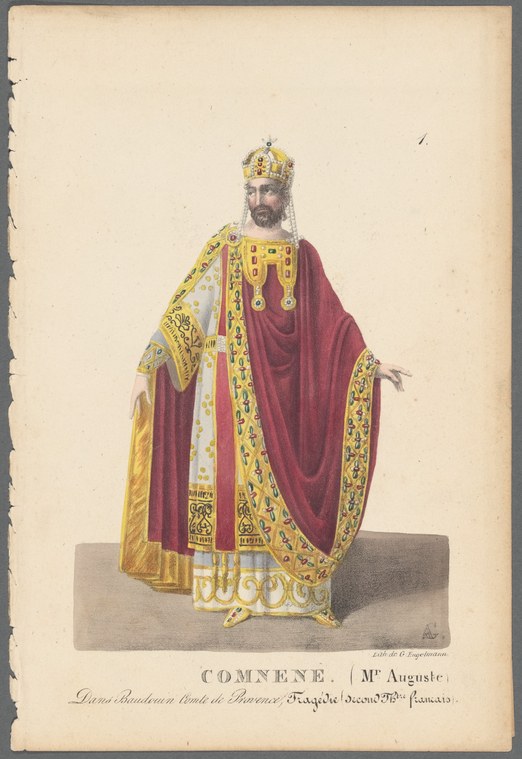
Comnene. (Mr. Auguste) Dans Baudouin comte de Provence, Tragédie (second Th[éâ]tre français)
Unknown artist
- Collection:
- Prints depicting dance
- Source:
- New York Public Library
- Rights:
- Public domain — free to use, share and adapt.
- Recorded as:
- Public Domain
For historians of dance and theater, this image documents the performance conventions and costume standards of the French Comédie-Française in the 18th century. The formal stance and elaborate dress reveal what was expected of performers in roles of authority and nobility—knowledge that informs understanding of how court dances, dramatic dances, and theatrical spectacle shaped one another.
What you are looking at
A single figure dominates the composition, standing centered against a neutral background on a shallow platform. This is an actor or dancer in formal theatrical costume, wearing a long crimson robe with dramatic golden brocaded borders running down the front and around the hem. Over this sits an equally ornate outer cloak or mantle in deep red, lined and bordered with gold patterning and jeweled embellishment. The figure wears a jeweled crown and holds the outer robe open with one hand in a gesture of display or declaration. The costume is unmistakably that of a Baroque court figure or classical king—the silhouette, proportions, and textile treatment all point to 17th- or 18th-century stage dress. The hand position and bodily stance convey authority and theatrical presence rather than active movement; this is a portrait of a character in costume, not a captured moment of dance itself.
The dancing
The single figure stands upright with formal posture, weight evenly distributed. One arm is extended outward and slightly downward, holding open the outer mantle to display the full costume; the other rests at the side. The stance is static and presentational rather than dynamic—the body faces forward, the head tilts slightly with a dignified expression, and the overall frame suggests the formal bearing required of court or heroic dramatic characters. There is no indication of movement, partnering, or the physical language of social dance.
The dance depicted
The image does not depict active dance but rather a character portrait from stage drama. The inscription identifies this as Comnène (Comnena), a character who appeared in *Baudouin, comte de Provence*, a tragedy performed at the Théâtre-Français (Comédie-Française). The costume is that of a classical or oriental queen or noblewoman—note the regal crown, the sumptuous drapery, and the formal heraldic quality of the embroidered borders. This is theatrical costume documentation rather than dance imagery, though it records the dress and bearing of performers in a period when dance was integrated into dramatic spectacle.
How it was made
This is a hand-colored engraving, identifiable by the fine parallel line work visible in the drapery and the architectural setting. The coloring—the rich reds, golds, and flesh tones—has been applied after printing. The technique allowed for precise reproduction and distribution of theatrical costume documentation, and the care taken with the hand-coloring suggests this was a premium object, likely sold to theater patrons, collectors of costume history, or those interested in the Comédie-Française's productions. The inscription at the base is in italic typeface and includes the character name and the play title.
About this work
This is a costume study for a character in French classical tragedy, rendered as a hand-colored engraving and circulated as a record of theatrical dress and performance practice. It belongs in a gallery of dance in art because it documents the formal costume and bodily deportment expected of performers in the period when court dance and theatrical spectacle were intimately linked. The work preserves not active choreography but the visual and sartorial language through which dancers and actors of the Baroque stage conveyed nobility, authority, and dramatic character. It is evidence of how costume, posture, and formal presentation functioned together to communicate theatrical identity.
How to look at it
Observe the frontal stance and the precise control of drapery—both hallmarks of formal 18th-century stage presence. The extended arm holding open the mantle is a calculated gesture of display, not a moment caught in motion. The costume itself is the subject: note how the engraver and colorist have rendered every detail of the embroidered borders, the weight of the fabrics, and the jeweled crown. This is a formal portrait, designed to document not dance but the authoritative appearance required of an actor playing a classical queen.
The artist
The artist's name is not recorded in the catalogue. The print is signed (faintly) in the lower right but the signature is not legible in this reproduction. Costume engravings of this type were common products of 18th-century French theatrical publishing and documentation; they served both as souvenirs for patrons and as records for costume makers and other theater practitioners.
The period
This work dates from the era of French classical tragedy at the height of the Comédie-Française's prestige, when elaborate costume and formal deportment were essential components of dramatic performance. The late 17th and 18th centuries saw the codification of courtly movement and gesture—the formality visible in this figure's stance reflects the training in French court etiquette and carriage that all performers of tragic roles were expected to command. The richness of the embroidered costume also reflects the expense and visual spectacle that attended productions of serious drama.
Where it lives
The work is held in the New York Public Library's collection of prints depicting dance. It is part of the Library's theatrical and dance iconography holdings, which preserve such costume documentation as evidence of performance practice and visual culture.
Questions about this work
Is this a dance image?
Not strictly. It is a costume portrait of an actor in a dramatic role. However, it belongs in a dance gallery because it documents the formal stance, costume, and deportment that performers of the era were trained to embody, and because court dance and dramatic spectacle were inseparable in this period. Understanding how performers were dressed and how they carried themselves illuminates the broader context in which dance was performed.
Who was Comnène?
Comnena (Comnène in French) is a character in the tragedy *Baudouin, comte de Provence*, a work performed at the Comédie-Française. The character's regal costume and bearing suggest a role of high rank or authority. Without access to the play text, we cannot determine her exact dramatic function, but the elaborate costume indicates a significant part.
What is hand-colored engraving?
An engraving is made by incising lines into a metal plate, which is then inked and printed. Hand-coloring means an artist applied watercolor or similar pigments to each printed impression by hand, making each copy unique and labor-intensive. This technique was used for theatrical costume documentation because it combined the precision of engraving with the visual richness of color, and the hand-coloring made the costume details vivid and accurate.
More dance artwork





