49 works in this view — arrow keys or swipe to move between them.
Dance in Art
Folk and ethnic dancing in wood engravings
Unknown artist
- Collection:
- Prints depicting dance
- Source:
- New York Public Library
- Rights:
- Public domain — free to use, share and adapt.
- Recorded as:
- Public Domain
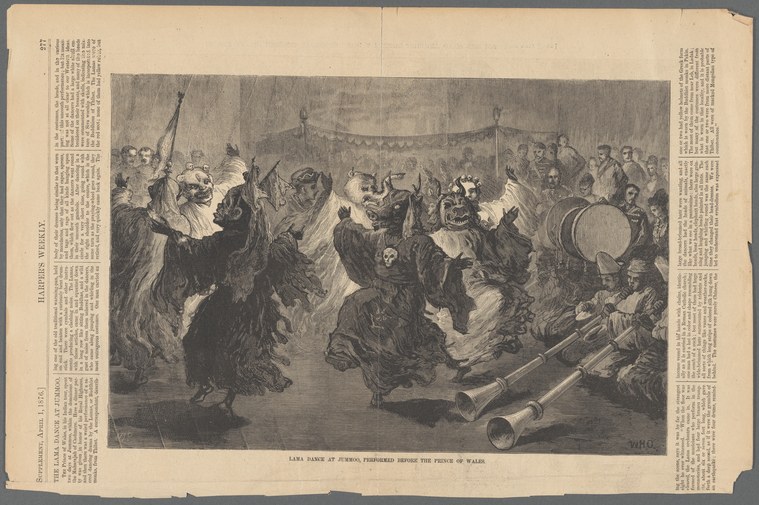
This image is valuable because it captures folk dance in its native context—not as a museum display or a performance for spectators, but as embedded social practice. It shows the visual reality of how regional European communities organized celebration and music-making, and the democratic, body-forward character of participatory dance forms that existed outside the ballroom and concert hall. For historians of social dance and labor, this is primary visual evidence of a vanished world.
What you are looking at
A crowded, energetic celebration unfolds in what appears to be a public gathering or festival. The composition centers on a group of people in mid-movement, their bodies animated and gesturing outward. The figures wear what seems to be 19th-century dress—long coats, hats, and full skirts—creating a dense mass of bodies. In the foreground, musical instruments lie on the ground: a large drum and what appears to be wind instruments. A banner or cloth is strung overhead, and spectators line the edges of the scene, watching from windows and elevated positions. The engraving's linear hatching and strong contrasts create a sense of movement and celebration, with the crowd's energy radiating outward from the center. The setting is ambiguous—it could be a town square, courtyard, or festival ground—rendered in the documentary style of 19th-century wood engraving.
The dancing
The dancers occupy the center with arms raised, extended, or gesturing broadly—open, expansive postures suggesting folk celebration rather than ballroom technique. Bodies lean forward or sway; the weight shifts appear grounded rather than elevated. The figures are densely packed, moving in no formal line or set pattern, suggesting spontaneous social participation rather than choreographed formation. Both men and women are present, many wearing hats, and the overall impression is of multiple individuals dancing simultaneously in an informal, communal style.
The dance depicted
The image depicts a folk celebration, almost certainly European or European-influenced, given the 19th-century dress and the formal documentation style. The raised instruments, open postures, and density of unformed participation point to a community festival or street celebration—possibly a carnival, fair, or seasonal gathering. The presence of drums and wind instruments suggests music-driven social dance of a regional folk tradition. Without identifying markers (costume embroidery, specific instruments, architectural setting), the exact tradition cannot be named, but the democratic, participatory character and the absence of structured couple-work rule out ballroom forms and point to regional European folk dance, possibly German, French, or Low Countries.
How it was made
This is a wood engraving, a relief printing technique that uses the end grain of a wooden block and fine tools to create detailed linear marks. The technique allows for mass reproduction and fine detail—visible here in the careful hatching that models form and suggests movement through parallel lines following the body's contours. Wood engravings of this type were standard in 19th-century newspapers, journals, and illustrated books, reaching a broad middle-class audience. The technique's economy and repeatability made it ideal for documentary illustration of contemporary social scenes, festivals, and customs.
About this work
This wood engraving documents a folk celebration, likely from a 19th-century European community festival or carnival. The work captures not a staged or theatrical performance but a participatory moment of social dance—the kind of public gathering that defined regional identity and cultural continuity in the pre-modern leisure calendar. As a printed illustration, it serves as both artistic record and documentary evidence of how ordinary people danced and celebrated in the period. The work belongs in a dance history collection precisely because it is unstaged and unidealized: it shows dance as social practice, embedded in costume, instruments, and communal participation rather than as a formal technique to be mastered.
How to look at it
Notice the absence of closed partnering or formal holds—the dancers are not arranged in squares, lines, or couple formations. Watch how the artist has used the engraving tool to suggest weight and movement through the direction of hatching lines, which follow the body's mass and action. The spectators framing the scene are important: they mark this as a public occasion, something watched and participated in collectively. The scattered instruments on the ground place music at the center of the action, suggesting that the dance follows the musicians' energy rather than a predetermined pattern.
The period
The 19th century saw an explosion of illustrated journalism and popular printing in Europe. Wood engravings became the standard medium for reproducing images in newspapers and periodicals aimed at the growing middle class. Parallel to this technological shift, the Romantic movement had awakened European intellectual interest in folk culture, regional costume, and 'authentic' national traditions. Folk dances were collected, documented, and increasingly idealized by educated observers as expressions of national character. This engraving participates in that documentary impulse: it records a folk celebration with the implied claim to authenticity and accuracy, even as the formal composition and artistic technique shape how the scene is understood.
Where it lives
The work comes from the New York Public Library's collection of prints depicting dance. It is held as part of a thematic grouping rather than catalogued with a known publication or individual artist attribution. The catalogue record provides minimal information, suggesting the print's provenance and original source publication remain to be established.
Dance in this work
Questions about this work
Is this a specific named dance?
The image does not include identifying markers—costume details, specific instruments, or architectural setting—that would allow certain identification of the regional tradition. It depicts the general character of 19th-century European folk celebration: participatory, music-driven, and informal in structure.
Who are these people?
The work is titled as a depiction of folk and ethnic dancing, which in 19th-century usage typically meant the customs of rural, regional, or working communities rather than the ballroom culture of urban elites. The specific community is not identified in the available record.
Why was this made?
As a wood engraving, it was made for mass reproduction in illustrated periodicals or books. The 19th century saw high demand for images of regional customs and folk life, driven both by journalistic interest in social documentation and by Romantic-era fascination with 'authentic' national traditions.
What do the open arm positions tell us?
The raised and extended arms suggest celebratory, non-formal movement—the body language of participation and joy rather than the controlled frame and closed position of ballroom technique. This is consistent with social folk dance, where movement tends to be expansive and expressive rather than contained.
More dance artwork





