49 works in this view — arrow keys or swipe to move between them.
Dance in Art
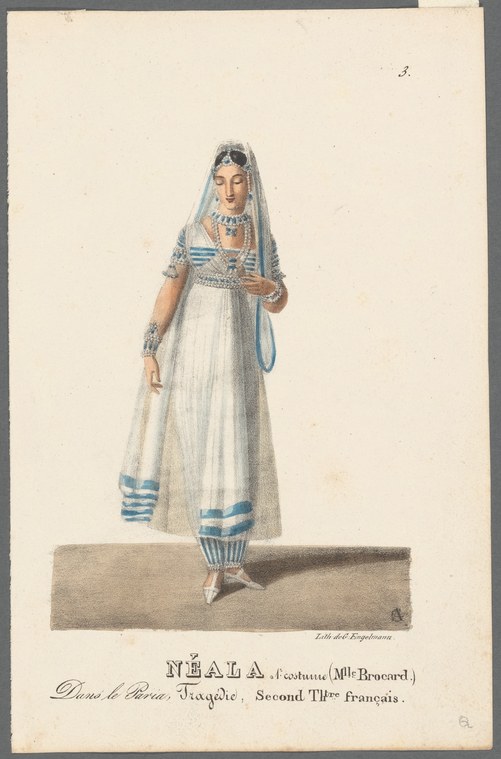
Neala. 1r. costume (Mlle. Brocard.) Dans le Paria, Tragédie, Second Th[éâ]tre français
Unknown artist
- Collection:
- Prints depicting dance
- Source:
- New York Public Library
- Rights:
- Public domain — free to use, share and adapt.
- Recorded as:
- Public Domain
This work is valuable as evidence of how theatrical femininity, foreignness, and exotic identity were constructed through costume and posture on the Parisian stage. The neoclassical dress, veil, and jewelry mark the character as non-European or orientalized, a common theatrical convention of the period that shaped European audiences' understanding of gender and otherness.
What you are looking at
A single female figure stands in frontal pose against a neutral ground, wearing a high-waisted white muslin gown with blue horizontal stripes at the hem and cuffs. She wears a blue veil or headdress draped over her head and shoulders, jewelry including a choker and bracelets, and flat white shoes or stockings. Her pose is upright and composed, with one arm bent at the elbow and the other relaxed at her side. The figure occupies the center of the composition on a shallow platform, isolated against a plain background. The style is a hand-colored engraving or lithograph typical of early 19th-century theatrical costume documentation.
The dancing
A single standing figure in a formal, presentational stance rather than an active dance pose. The body is upright with no weight transfer evident; both feet appear planted. The arms are held modestly—one slightly raised, one at the side—in a posture consistent with a formal greeting or curtsy preparation rather than mid-movement. The overall frame suggests a portrait of costume and role rather than a captured moment of dance.
The dance depicted
The inscription identifies this as the costume of Mlle. Brocard in the role of Neala from *Dans le Paria, Tragédie* (presumably *Le Paria* or *Les Parias*, a play performed at the Théâtre du Second-Empire or similar venue). The figure's pose and dress suggest this is a theatrical character portrait rather than a representation of a specific dance. While neoclassical theatrical dress of this period often incorporated movement, the frontal standing pose here is documentary rather than kinetic. This appears to be a costume plate—a record of what an actress wore in a dramatic role—rather than evidence of a particular dance or choreography.
How it was made
This is a hand-colored engraving or lithograph, a standard format for theatrical costume documentation in the early 19th century. The fine line work, subtle color blocking, and technique of reproducing and circulating the image suggest it was produced as a print for sale or distribution, likely from a theater archive or artist's portfolio. Such prints served both as souvenirs and as records of successful productions, and their relative affordability made them accessible to a broad audience interested in theater and fashion.
About this work
This is a theatrical costume plate documenting the dress worn by an actress named Mlle. Brocard in a dramatic role in a play performed in Paris in the early 19th century. It is not a representation of dance per se, but rather a portrait of stage costume and character. The work belongs in a dance collection insofar as theatrical dress, presentation, and the body on stage are central to performance history, and neoclassical dramatic roles sometimes incorporated choreographed movement or formal gesture. The plate's style and printing technique are characteristic of the documentation practices of early 19th-century Paris theater.
How to look at it
Attend to the costume's construction: the high waistline, the striped linen, the veil, the jewelry—all markers of theatrical exoticism and wealth. The actress's formal pose and neutral expression are conventional for costume plates of this era; the goal is to display the dress and character type, not to suggest motion. Notice how the shallow ground and frontal stance create an effect of display, as if on a stage but frozen for inspection.
The artist
The artist is not recorded. The print is signed indistinctly in the lower right. The style and quality suggest a professional theater print-maker working in Paris in the early 19th century, likely producing costume plates for commercial distribution to theater audiences and collectors.
The period
This work dates to the height of neoclassicism in French theater and the popularity of dramatic plays set in exotic or historical locales. *Le Paria* and similar works exploited orientalist themes and costume to create spectacle. The early 19th century saw flourishing production and circulation of theatrical prints, which became a major form of popular visual culture and fan documentation. Actresses' images in costume were highly marketable.
Where it lives
This print is held in the NYPL's collection of prints depicting dance. It is cataloged as a costume plate related to a theatrical production, though the specific venue, date, and run of *Dans le Paria, Tragédie* are not recorded in the catalogue entry.
Questions about this work
Is this a dance image?
Not strictly. It is a theatrical costume plate—a portrait of an actress in character dress. It documents stage fashion and character type rather than choreography or movement. It belongs in dance collections because stage costume, presentation, and the body in performance are integral to theatrical dance history.
What play was this from?
The inscription names the work as *Dans le Paria, Tragédie* (In Paria, Tragedy), performed at the Théâtre du Second-Français or a similar Parisian venue. The catalogue record does not provide performance dates or a more complete title, and the play is not widely known today.
Who was Mlle. Brocard?
She was a Parisian actress active in the early 19th century, but little biographical information survives. This print is one of the few records of her work. Such costume plates were the primary means by which theater performers' images circulated among the public.
What does the costume tell us?
The neoclassical dress, veil, choker, and jewelry mark the character as exotic or foreign—likely North African or Middle Eastern, a common orientalist convention on the Parisian stage. The high waistline and muslin are characteristic of Empire-period neoclassical fashion.
More dance artwork





