49 works in this view — arrow keys or swipe to move between them.
Dance in Art
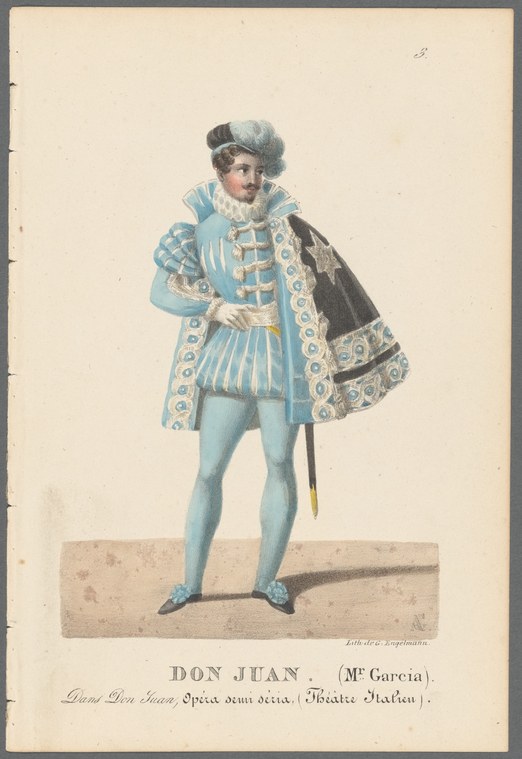
Don Juan. (Mr. Garcia). Dans Don Juan, Opéra semi séria, (Théâtre Italien)
Unknown artist
- Collection:
- Prints depicting dance
- Source:
- New York Public Library
- Rights:
- Public domain — free to use, share and adapt.
- Recorded as:
- Public Domain
This print documents the intersection of dance, theater, and costume at a major European opera house during a pivotal moment in the history of theatrical dance—the transition between formal court dance and the emerging Romantic ballet vocabulary. As a named role performed by an identifiable dancer (Mr. Garcia), it preserves concrete evidence of who danced, what they wore, and how the role was understood and presented to audiences. For dance historians, such costume plates are among the few visual records available of male dancer roles from this period outside of ballet.
What you are looking at
A single male dancer in elaborate early 19th-century court dress stands in contrapposto against a plain cream ground, his figure silhouetted on a shallow tan platform. He wears a sky-blue silk jacket with elaborate white and gold braid frogging across the chest and down the front edges, the sleeves articulated with vertical pleating. A white ruffled collar frames his neck. Over this he drapes a blue cloak lined with black silk and decorated with white and gold ornamental patterns. His legs are encased in blue stockings, and he wears blue heeled shoes with decorative buckles. His dark hair is styled in the fashion of the period, brushed back and voluminous at the crown. His left arm is raised and bent at the elbow in an elegant gesture; his right arm hangs at his side, hand resting on or near his hip. His weight appears centered, his posture formal and dignified. The overall effect is a portrait of aristocratic bearing rather than a moment of active dance.
The dancing
The single figure occupies most of the compositional space, presented frontally with a slight turn at the hips suggesting three-quarter orientation. The raised left arm and lifted wrist convey courtly elegance rather than dynamic movement; the hand appears relaxed and graceful. The right arm, held low and inward, creates a contained frame. The turned-out legs and the positioning of weight suggest familiarity with formal dance posture, though the figure is stationary rather than caught mid-movement. The dancer's vertical alignment and the deliberate placement of limbs indicate training in the conventions of aristocratic comportment.
The dance depicted
This is a costume plate or role documentation for a male dancer performing in a semi-serious opera (*Don Juan, Opéra semi séria*) at the Théâtre Italien, likely in the early 19th century. The inscription identifies the role and the performer (Mr. Garcia). The figure is not shown dancing but rather posed in the formal dress required for the role, a convention of theatrical documentation from this period. The blue court dress and elaborate braid work signal a nobleman or aristocratic character. The static presentation suggests this is evidence of how the role was costumed and carried rather than a depiction of choreography; it functioned as a record of the performer's appearance and authority in the role.
How it was made
This is a hand-colored engraving or aquatint, techniques that allowed for the precise rendering of embroidery detail and the subtle graduation of color in the fabrics. The use of stippled or tonal grounds to suggest volume and the delicate hand-coloring of the silks indicate this was a commercial print, likely published as part of a series documenting performers and roles at a major opera house. The technique—combining engraved line work with selective watercolor—was ideally suited to capturing the intricate costume detail that identified and celebrated a performer's status. Such prints circulated among theater patrons and collectors and served as souvenirs or reference documents.
About this work
This is a costume and role documentation for a male dancer in *Don Juan*, a semi-serious opera performed at the Théâtre Italien in the early 19th century. The work belongs to a tradition of theatrical portraiture in which performers were documented in character dress, presented formally rather than in action. The print records not choreography but theatrical presence: the body as the vehicle of aristocratic identity and operatic convention. For scholars of dance in opera, theatrical costume history, and early 19th-century performance practices, this image is evidence of how male dancers inhabited formal courtly roles and how that inhabitation was visually recorded and circulated.
How to look at it
This is not action but presentation: the dancer is not shown moving but standing in the formal posture that would characterize his entrance or his bearing while singing or supporting a female dancer. Observe the precision of the braid work and the architectural layering of the jacket and cloak—these details mattered enormously in how a performer was recognized and valued. The raised arm is the key gesture: it conveys courtly elegance and was likely a signature position within the role. The stillness and formality are deliberate; in a theatrical context dominated by recitative and aria, the male dancer often functioned as a framing figure, his corps or solo presence lending weight and dignity to the scene rather than executing complex steps.
The artist
The artist is not recorded in the catalogue. The print bears the signature or mark of an engraver at the base, but it is not legible in reproduction. The work was likely produced by a commercial printhouse associated with the Théâtre Italien or a Parisian theater publisher, as part of a series documenting performers and roles. Such prints were often created by in-house or contracted artisans rather than by named fine artists, which may account for the absence of artist attribution.
The period
This image dates to the early decades of the 19th century, when male dancers in serious opera were still expected to embody courtly grace and aristocratic bearing. The semi-serious opera (*opera semi seria*, also called *dramma giocoso*) blended serious and comic elements and was a popular form in Italian opera houses and their French counterparts. The Théâtre Italien in Paris was a major venue for Italian opera, and performances there were attended by fashionable society. At this moment in theater history, printed costume documentation was becoming a standard practice for major roles, creating a visual archive of how performers were seen. The style of dress shown here—elaborate court costume from an earlier era—reflects how historical roles were typically costumed in the Romantic period, often with archaeological interest but also with contemporary theatrical embellishment.
Where it lives
This is a hand-colored engraving from the New York Public Library's collection of prints depicting dance. Such prints were commercial publications, distributed to theater subscribers, patrons, and print collectors in the early 19th century. The work is housed as part of a larger collection documenting theatrical performers and roles, making it part of an archival tradition of theater documentation.
Questions about this work
Who was Mr. Garcia?
The catalogue does not identify Mr. Garcia beyond his role in this performance. Male opera singers and dancer-singers of the period with this surname included members of the prominent García singing family, but without additional documentation it cannot be confirmed. The role is identified here by performer name only, following the theatrical convention of identifying a role by its interpreter.
What is a semi-serious opera?
An *opera semi seria* or *dramma giocoso* mixed serious and comic elements within a single work, creating a hybrid form between tragic and comic opera. These were popular in Italian opera in the 18th and early 19th centuries. Mozart's *Don Giovanni* is a famous example, and the genre conventions shaped how such works were staged and costumed.
Why is the figure standing still and not dancing?
This is a costume and role documentation print, not a depiction of choreography. In the early 19th century, such prints recorded how performers appeared in role—their dress, bearing, and social identity—rather than capturing specific movements. The formal, frontal presentation was a convention of theatrical portraiture designed to showcase the performer and the role equally.
How does this compare to male dancer images from later in the 19th century?
Later Romantic and Classical ballet prints show male dancers in action—jumping, turning, supporting a ballerina—whereas this image presents formal courtly bearing. The contrast reflects a shift in how male dancers were valued: from aristocratic presence and courtly grace to technical virtuosity and partnering skill. Opera seria roles favored the former; ballet increasingly emphasized the latter.
More dance artwork





