49 works in this view — arrow keys or swipe to move between them.
Dance in Art
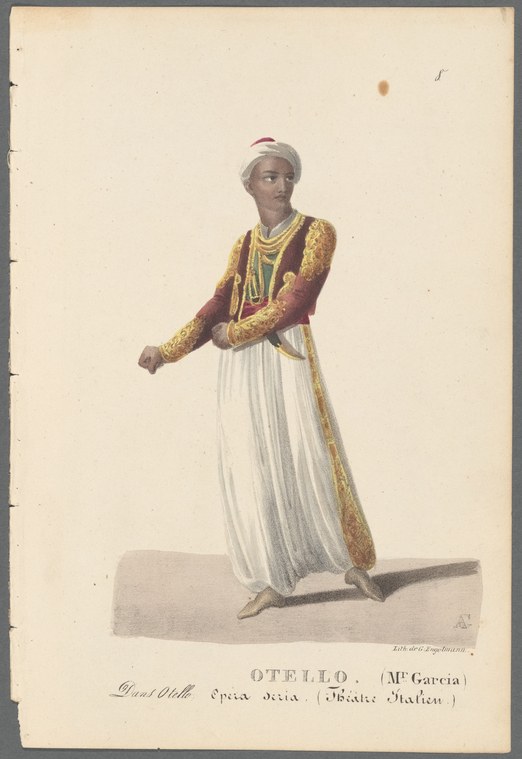
Otello. (Mr. Garcia) Dans Otello, opéra seria, (Théâtre Italien)
Unknown artist
- Collection:
- Prints depicting dance
- Source:
- New York Public Library
- Rights:
- Public domain — free to use, share and adapt.
- Recorded as:
- Public Domain
This print documents how opera singers of the early 19th century were trained in and performed formal gesture and stage movement, a technique that formed part of the broader vocabulary of theatrical dance training. García was a pivotal figure in voice pedagogy, and this image records the physical presence and deportment expected of a leading tenor in this era, bridging operatic singing and movement practice.
What you are looking at
A single male figure stands in a three-quarter pose against a plain cream background, his weight settled on his left leg with the right slightly advanced. He wears a richly decorated costume of the early 19th century: a deep burgundy or rust-colored jacket heavily embroidered in gold thread, worn over a white pleated skirt that falls to mid-calf in the neoclassical style. A gold-bordered sash crosses his torso, and he wears a white turban or headdress on his head. His left arm extends outward in a gesture of address or appeal, while his right hangs at his side. The figure's posture and expression suggest a dramatic moment—the pose of an operatic protagonist at a moment of declaration or anguish. The rendering is a hand-colored engraving or lithograph, with careful attention to the folds and drape of the fabric and the precise articulation of the embroidered detail.
The dancing
The dancer occupies the full height of the composition in a classical contrapposto stance. His extended left arm frames an open upper body; the right side remains relatively still. The pose suggests theatrical address rather than active choreographic movement—the body is poised and formally composed rather than in mid-motion. A single figure is represented, isolated on stage or in presentation space, which emphasizes the performer's individual presence and dramatic authority.
The dance depicted
This is a costume study for Rossini's opera seria *Otello*, performed at the Théâtre Italien in Paris, depicting the lead role as performed by Manuel García, the renowned tenor and voice teacher of the period. The image documents stage dress and the formal presentational style of early 19th-century opera seria rather than dance in the modern sense. However, the figure's pose reflects the conventions of dramatic movement training in this era—what was called the *pantomime* or expressive gesture technique that formed part of operatic performance. García would have moved between sung passages and formal gestural tableaux of this kind. The costume itself (derived from Orientalist conventions of the early 19th century) tells us that the opera's narrative required this exotic styling.
How it was made
This is a hand-colored engraving or lithograph, likely produced in Paris in the 1820s–1830s for distribution as a theatrical souvenir or print series. The technique allowed for multiple impressions and wide circulation among opera-goers and collectors of theatrical imagery. The hand-coloring (visible in the careful application of gold, burgundy, and blue tones) was added after printing, a labor-intensive practice that indicates this was a premium product aimed at an educated middle-class audience who attended the Théâtre Italien. The precision of the line work and the delicate rendering of embroidered detail suggest a professional printmaker, though the artist's name is not recorded in the catalogue.
About this work
This is a costume documentation print of Manuel García in the role of Othello from Rossini's *Otello*, performed at the Théâtre Italien in Paris. It represents the intersection of opera performance and visual culture in the early 19th century. While not a depiction of dance choreography, it documents the formal, gesture-based movement vocabulary of opera seria—the stylized pantomimic technique through which dramatic emotion was conveyed between sung passages. The image captures the theatrical conventions of its moment: the exotic costume, the contrapposto stance, the theatrical isolation of the figure. Such prints were collected as records of famous performances and celebrated singers, circulating among the concert-going and opera-attending public.
How to look at it
Observe the formal balance of the pose: the contrapposto arrangement, the carefully composed arm gesture, and the frontal presentation of the figure to the viewer. This is not a moment of dynamic movement but of theatrical presence—the kind of still, posed moment that would punctuate an operatic scene. The ornamental richness of the costume, rendered in meticulous detail, directs attention to the performer's status and the production's magnificence. The white background isolates the figure entirely, emphasizing that this is a document of costume and stage persona rather than a narrative scene.
The artist
The print is unattributed, but was likely produced by a professional theatrical print publisher in Paris during the 1820s–1830s. Such prints were a standard commercial product, created after successful performances and sold through music retailers and theaters. The inscription in French indicates a Paris-based publisher, and the style is consistent with other theatrical costume prints of the period circulating in French cultural markets.
The period
The early 19th century saw the rise of opera seria as a major form of elite entertainment in European cities, particularly Paris, Naples, and Milan. Rossini's *Otello* (1816) was a landmark work, and the Théâtre Italien in Paris was the premier venue for Italian opera. This period predates the rise of Romantic ballet (which emerged in the 1830s), and opera performance was dominated by the virtuosity of the voice; movement was formal, gestural, and subordinate to singing. The exotic costuming seen here reflects the Orientalism that influenced both opera and visual culture of the period. Printed costume and portrait documentation of celebrated singers was a major form of cultural commerce in this era.
Where it lives
This print is held in the New York Public Library's collection of prints depicting dance. It is a commercial theatrical souvenir, one of many such prints produced to document celebrated opera singers and roles in the 1820s–1830s.
Questions about this work
Is this a dance image or an opera image?
Both. It documents a moment of theatrical performance in which movement, gesture, and formal presentation were essential to the art. Opera singers of this era trained in movement and pantomime as part of their craft, and the posed, gestural vocabulary visible here was part of the broader language of theatrical dance training and performance in the period.
Who was Manuel García?
García (1775–1832) was a renowned Spanish tenor, composer, and teacher, celebrated across Europe for his vocal range and dramatic presence. He performed at the most prestigious opera houses and was foundational to the history of voice pedagogy; his methods influenced singing instruction for generations. This print documents him at the height of his career.
Why is the costume so elaborately embroidered?
Early 19th-century opera seria productions were spectacles of visual magnificence, with costume and staging designed to impress an aristocratic and upper-middle-class audience. The exotic styling also reflected the cultural fashion of the period—Orientalism—which influenced how non-European and historical settings were imagined in European art and performance.
More dance artwork





