49 works in this view — arrow keys or swipe to move between them.
Dance in Art
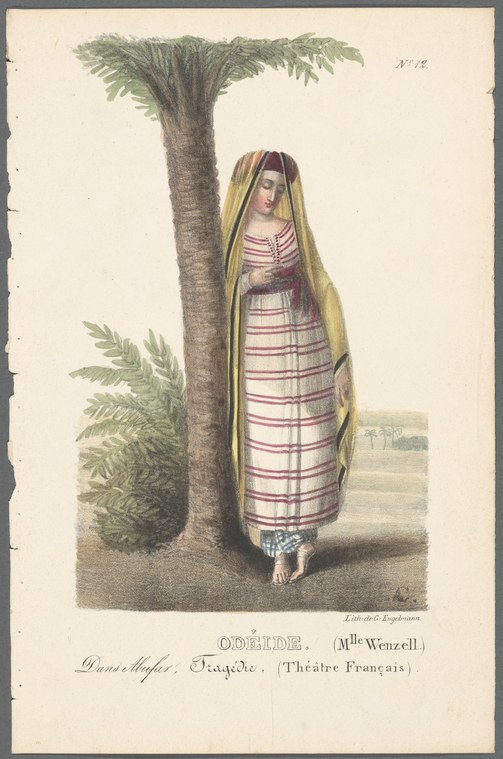
Odéide. (Mlle. Wenzell.) Dans Abufar, Tragédie, (Théâtre Français)
Unknown artist
- Collection:
- Prints depicting dance
- Source:
- New York Public Library
- Rights:
- Public domain — free to use, share and adapt.
- Recorded as:
- Public Domain
This print preserves a named performer's appearance on a major French stage and illustrates how neoclassical theatre mobilised costume and setting to suggest historical otherness. It is one of the few detailed records of how an early professional female dancer's body was presented in a theatrical context, and what costume and posture conveyed about character.
What you are looking at
A young woman stands alone in an exotic landscape dominated by a tall date palm tree, its trunk rendered in careful perspective and its fronds spreading overhead. She is dressed in a long, narrow garment of white linen wrapped tightly around her body in horizontal stripes of red or pink, arranged in the style of ancient Egyptian dress. A gold or yellow veil drapes from her head down her back. She stands barefoot on bare ground, her posture upright and formal, her gaze directed forward. The background shows a flat, arid landscape with hints of distant architecture or settlement. The composition places her as a solitary figure of contemplation or ceremony, neither moving nor in repose, but in a state of dignified stillness.
The dancing
The figure's body is frontal and immobile, weight distributed evenly on both feet. Her arms hang at her sides. There is no indication of motion, partnering, or gestural expression. The pose is one of standing ceremony or presentation rather than dance movement. Her frame is slender and enclosed by the wrappings of her costume.
The dance depicted
This image does not depict active dance. The figure is named as Odéide from the theatrical production *Abufar* (Tragedy) at the Théâtre Français. Odéide is an Egyptian character in this neoclassical drama, and the image documents her costume and bearing as a stage character rather than capturing a moment of choreographed movement. The work is a character portrait in costume, not a dance representation.
How it was made
This is a hand-coloured engraving or aquatint, recognisable from the fine line work, the precision of the palm tree's rendering, and the delicate watercolour washes applied to the figure's dress and veil. The technique allowed for high-quality reproduction of the print and distribution to theatre audiences and collectors. The careful colouring of each impression by hand indicates this was an expensive, curated object for a wealthy or cultivated audience interested in theatre and antiquarian spectacle.
About this work
This is a character portrait engraving documenting a stage costume from a neoclassical tragedy performed at the Théâtre Français in the late 18th or early 19th century. It preserves the appearance of a named dancer or actor, Mlle. Wenzell, in the role of Odéide, an Egyptian character. The work sits at the intersection of theatre documentation, fashion history, and antiquarian revival — recording both a performer's body and the period's fascination with exotic historical dress. It belongs in a dance history collection because it documents stage practice and the visual presentation of dancers in historical costume dramas.
How to look at it
Attend to the precision with which the artist rendered the costume: the tight horizontal wrapping of the linen, the weight and fall of the veil, the bare feet and unshod stance. The palm tree frames and contextualises the figure, situating her in an imagined Egypt. The engraver has chosen not a moment of action but a formal presentation — the pose used in official theatrical documentation to convey character identity and dignity. The stillness is itself a convention: it permits the viewer to examine costume and bearing as representations of historical otherness.
The artist
The engraver is not recorded in the catalogue. The print is signed in the lower margin, but the signature is not legible in this reproduction. Hand-coloured theatrical engravings of this type were produced by specialist print shops associated with Paris theatres, circulating among theatre subscribers and collectors. The quality of the engraving and the care of the colouring suggest a professional atelier with access to the Théâtre Français.
The period
This work dates to the era of French neoclassical theatre, when dramatists like Voltaire and his successors drew on Greek, Roman, and Egyptian historical and legendary subjects. The staging of such works involved elaborate historical costume and scenic design intended to educate and elevate audiences. Simultaneously, the late 18th and early 19th centuries saw the rise of the professional dancer as a named, portable celebrity — prints of dancers in famous roles were popular commodities, circulated like modern theatrical photography. The Egyptian aesthetic was fashionable in European decorative arts and theatre after the mid-18th century, culminating in intense Egyptomania following Napoleon's Egyptian campaign (1798–1799).
Where it lives
This print comes from the New York Public Library's collection of prints depicting dance. It is a theatrical engraving from a commercial print series documenting performances at the Théâtre Français, likely issued for sale to theatre subscribers and collectors during or shortly after the production's run.
Questions about this work
Is Mlle. Wenzell dancing in this image?
No. This is a character portrait in stage costume, not a captured moment of movement. The pose is formal and static, documenting how the performer appeared as the character Odéide rather than showing her in choreographed action.
What is Abufar?
Abufar is a neoclassical tragedy performed at the Théâtre Français. The title refers to an Arab hero. The play drew on the period's interest in Oriental and historical subjects. Odéide, an Egyptian woman, was a supporting character.
Why was she dressed this way?
The tight linen wrappings and veil are theatrical approximations of ancient Egyptian dress, reflecting late 18th-century European ideas about Egypt based on ancient texts and, increasingly, archaeological knowledge. The costume was meant to signal the character's foreign, historical identity to the audience.
Who engraved this?
The engraver's name is present in the signature at the lower margin of the print but is not legible in this image. It was produced by a professional print shop serving the Théâtre Français.
More dance artwork





