49 works in this view — arrow keys or swipe to move between them.
Dance in Art
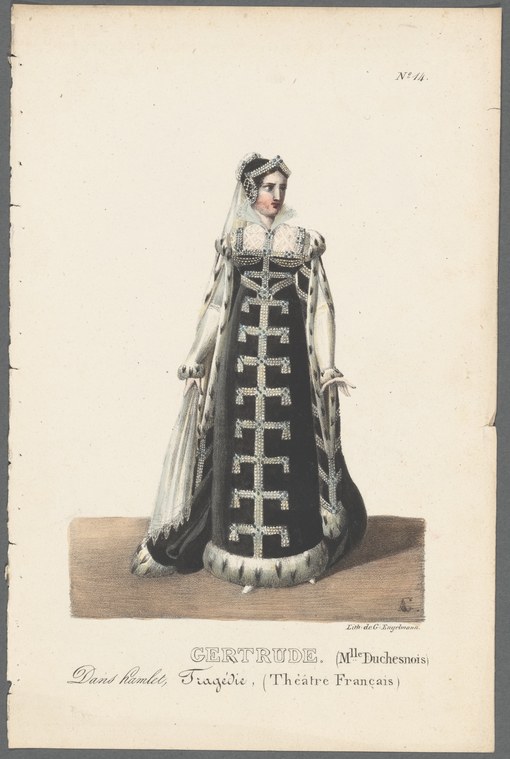
Gertrude. (Mlle. Duchesnois) Dans Hamlet, Tragédie, (Théâtre Français)
Unknown artist
- Collection:
- Prints depicting dance
- Source:
- New York Public Library
- Rights:
- Public domain — free to use, share and adapt.
- Recorded as:
- Public Domain
Although not depicting dance, this work documents a moment when theatrical performance, costume, and spectacle were inseparable concerns in Paris, and when theatrical portraiture was a significant visual and commercial practice. It shows how early 19th-century theaters preserved and disseminated the visual memory of celebrated performances.
What you are looking at
A single female figure stands in formal frontal pose against a plain background, wearing an elaborate dark gown with a high waistline and long train. The dress is densely decorated down the front with a repeated geometric cross or plus-sign pattern in white or pale trim, creating vertical emphasis. A flowing white veil or headdress drapes from her head down the back, partially visible over one shoulder. The garment appears to be of considerable weight and formality, with what may be fur trim at the hem. Her posture is upright and composed, with arms hanging naturally at her sides. The figure is rendered in color hand-tinting over a printed base, creating a portrait effect typical of theatrical costume documentation.
The dancing
The single dancer is rendered in a static, frontal presentation stance rather than an active dancing position. Her weight is evenly distributed, arms relaxed at her sides with hands visible. The pose conveys dignity and stillness rather than movement or gesture. No active footwork, arm extensions, or dynamic frame is visible; this is a presentational costume portrait rather than a capture of movement.
The dance depicted
This is almost certainly not a depiction of dance in action, but rather a costume study or theatrical character portrait. The inscription identifies this as Gertrude from Hamlet as performed at the Théâtre Français, likely by the actress Mlle Duchesnois. If this depicts a moment from the play's performance, it would be from a formal court or funeral scene rather than a dance proper. The garment and pose suggest tragic Shakespearean drama rendered in early 19th-century French theatrical dress convention rather than any specific dance form.
How it was made
This is a hand-colored engraving or aquatint, typical of theatrical portrait documentation from the early 19th century. The base print is finely detailed, with the cross-pattern on the dress clearly defined; hand coloring has been applied to create depth and fabric texture. This technique allowed for mass production of theatrical costume reference images, circulated to audiences and to other theaters as records of celebrated performances. The combination of print and hand-coloring suggests a mid-range commercial circulation rather than a unique artwork.
About this work
This is a theatrical portrait documenting the costume worn by an actress playing Gertrude in a production of Hamlet at the Théâtre Français in the early 19th century. It belongs to the visual archive of stage costume history and the documentation of Romantic-era theatrical practice, rather than to dance proper. The work is valuable as evidence of how classical drama was dressed and presented on the French stage during this period, and it testifies to the practice of circulating costume studies to build theatrical reputation and memory.
How to look at it
Examine the costume rather than the figure: the deliberate geometric patterning of the cross motifs creates visual formality and suggests embroidery or applied trim typical of tragic costume design. The veil and the train emphasize stasis and gravity rather than movement. The frontal presentation pose is documentary rather than dramatic—the actress is shown as a costume object for the record, not captured mid-scene or mid-gesture. This is how theatrical memory was preserved: as a standing figure in costume, awaiting identification and admiration by the viewer.
The artist
The engraver is not recorded in the catalogue. The inscription 'Lith de E. Strandboth' or similar at bottom left may indicate the lithographer or engraver's name, but it is not fully legible in reproduction. This appears to be a professional theatrical documentation work, likely produced by a Paris theater or print shop specializing in costume studies.
The period
This dates to the early 19th century, when French Romantic theater was dominant and Shakespeare in translation was being revived and reimagined for the Paris stage. The Théâtre Français (Comédie-Française) was the national theater, and celebrated performances there were documented and circulated through costume prints. This was the era of Romantic drama and elaborate historical costume design, not of classical ballet or social dance. The costume itself—heavy, formal, decorated with geometric precision—reflects early 19th-century ideas about tragic queenship and dignity.
Where it lives
Held in the New York Public Library's collection of prints depicting dance. This collection classification suggests the print was acquired as part of a broader dance-history archive, though the work itself documents theatrical costume rather than dance practice.
Questions about this work
Is this a dance image?
No, not in the active sense. This is a costume portrait of an actress in a tragic drama role. While theatrical performance and dance were closely related in this period, this particular work documents a moment of formal repose in a Shakespearean play rather than choreographed movement. It belongs to the visual history of theater rather than dance.
Who was Mlle Duchesnois?
Cathérine-Joséphine Rafin, known professionally as Mlle Duchesnois (1777–1835), was one of the leading tragediennes of the Théâtre Français and a celebrated performer of classical roles including Gertrude, Clytemnestra, and Lady Macbeth. She was known for dignity and classical restraint in tragic roles.
Why is this in a dance collection?
Early 19th-century theatrical performance was not rigidly separated into dance, drama, and spectacle. Theatrical gesture, movement quality, and composed stillness were all valued as forms of bodily expression. This costume study may have been collected as evidence of how the body was formally presented and aestheticized on the stage during this period.
More dance artwork





