49 works in this view — arrow keys or swipe to move between them.
Dance in Art
Ballroom dancing on British and American 19th-century music covers
Unknown artist
- Collection:
- Prints depicting dance
- Source:
- New York Public Library
- Rights:
- Public domain — free to use, share and adapt.
- Recorded as:
- Public Domain
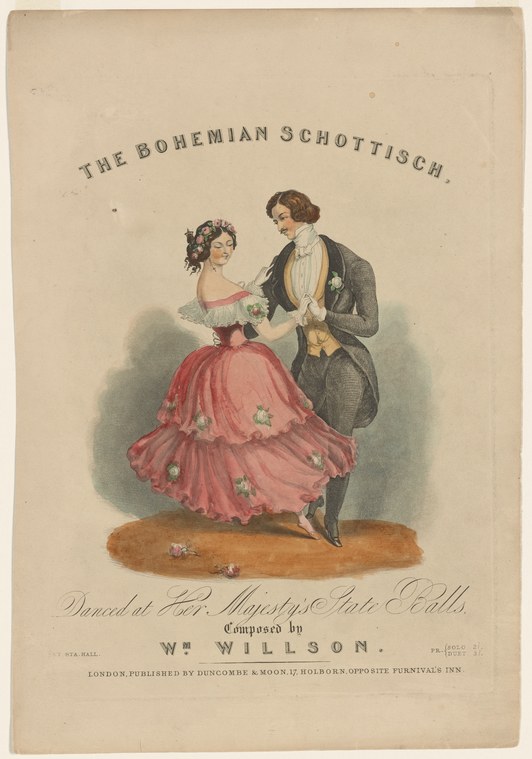
This print documents the Schottische at the height of its popularity in the Anglo-American ballroom world, capturing not just the dance form but the social codes and material culture surrounding it. For dance historians, it offers evidence of the visual conventions used to market and teach fashionable dances in the 19th century, and the way couples' positioning, formal dress, and gender presentation were inseparable from the dance itself.
What you are looking at
A couple dances in formal attire against a pale background with soft gray shading. The woman wears an elaborate ball gown in deep pink or coral silk with a low neckline, bare shoulders, and a voluminous skirt gathered and ruched into soft folds, with white floral sprigs or ribbons scattered across the fabric. Her dark hair is dressed with flowers or ornaments. The man wears formal evening dress: a dark tailcoat with white shirt front and bow tie, his posture upright and confident. The pair are positioned in an intimate dance frame, the woman's body angled toward her partner, suggesting a moment of social courtship on the dance floor. The composition is centered and theatrical, with the couple spotlit against neutral space. The print is hand-colored in the style of 19th-century music cover chromolithography, with particular attention to the shimmer and volume of the woman's skirt.
The dancing
The couple are in closed ballroom position, the man's right hand at the woman's waist, her left hand resting on his shoulder; her right arm extends toward his left in the classic frame. Their bodies maintain the formal upright carriage required by 19th-century ballroom etiquette. The woman's weight appears centered, her posture controlled; the man leans slightly toward his partner. The positioning and frame suggest the controlled elegance of period ballroom dance rather than the vigorous social dances of earlier or later eras.
The dance depicted
This is a Schottische, a mid-19th-century ballroom dance of Germanic origin that became standard in both British and American drawing rooms and dance halls from the 1840s onward. The Schottische combined elements of the polka, mazurka, and country dance in a hopping, syncopated step pattern, danced by couples in closed hold. The formal dress and interior setting indicate this is a ballroom Schottische rather than a folk or theatrical variant. The image captures the dance at a moment of social presentation rather than energetic movement—typical of the still, posed style of period music-cover illustration, which prioritized the elegance of the couple and the fashion of the gown over the dynamics of the footwork.
How it was made
This is a hand-colored lithograph or chromolithographic print, typical of mid-to-late 19th-century British music covers. The technique allowed rapid, affordable color reproduction and wide circulation; the soft palette and careful gradation of tone in the background are characteristic of chromolithography from this period. Such prints appeared as front matter to published sheet music and served as both commercial advertisement and visual documentation of fashionable dance costume and deportment. The quality of printing and coloring suggests a London publisher of some standing.
About this work
This is a music-cover illustration for a Schottische composed by W. Willson and published in London by Duncombe & Moon. The Schottische was one of the most popular ballroom dances of the mid-Victorian era, occupying a middle ground between the stately formality of the waltz and the livelier social dances that preceded it. The image documents both the dance itself and the visual culture of its performance: the impeccable tailoring of formal dress, the elaborate fashionability of the woman's gown, and the composed social grace expected of dancers in polite society. As a music cover, it served as a advertisement for the published composition and as a window into the ballroom life of its era.
How to look at it
Note the absolute formality of the frame: the couple are presented frontally, as if for formal portrait, rather than captured mid-motion. The woman's gown is the visual center—its volume, color, and elaborate construction are the measure of fashionability and status. The man's formal tailcoat and the woman's bare shoulders and low neckline mark this as an elite social dance, not a folk or theatrical variant. The composer's and publisher's names are prominent, indicating this was both a musical and a commercial object, marketed as much through visual appeal as through the dance's popularity.
The artist
Unknown artist, working for the London music publisher Duncombe & Moon. The publisher was active in the mid-to-late 19th century and produced illustrated sheet music covers in the chromolithographic style. The artist, while uncredited, was working within an established commercial practice of illustrating ballroom dances for the sheet-music market, a genre that demanded both elegance of design and accuracy of dance costume.
The period
The Schottische emerged in the 1840s and dominated the ballroom from the 1850s through the end of the century. In Britain and America, it occupied the space between the slow, emotionally intense waltz and the energetic, syncopated dances imported from Latin America and Africa that would come to dominate the 20th century. The mid-Victorian ballroom was governed by strict conventions of propriety, dress, and behavior; the Schottische, despite its hopping step, was considered appropriately decorous for mixed social dancing in polite society. Music covers of this type were mass-produced commodities that shaped and reflected popular taste in dance, fashion, and deportment.
Where it lives
This is a hand-colored lithographic music cover from the New York Public Library's collection of prints depicting dance. It is catalogued as a ballroom dance on British and American 19th-century music covers, a genre that extends across many composers and publishers of the period.
Dance in this work
Questions about this work
What is a Schottische and how was it danced?
The Schottische is a couple dance in 2/4 time that originated in Germany or Scotland (the etymology is disputed) and became hugely popular in English-speaking ballrooms from the 1850s onward. It combined the closed-hold frame of the waltz with a hopping, syncopated step pattern derived from the polka and mazurka. Couples faced each other in closed position and moved forward, backward, and in circular patterns, with the characteristic hop giving the dance a lively but controlled energy. Unlike some contemporary dances, it was considered thoroughly respectable for mixed-gender ballroom dancing in polite society.
Who danced the Schottische and where?
The Schottische was danced by middle and upper-class couples in the ballrooms of Britain, America, and the British Empire throughout the Victorian era and beyond. It appeared in country-house dances, public assembly rooms, and formal dinner dances. As a published and widely distributed dance, it was learned from dance masters and from instruction in ballroom-dancing schools. The music was published in enormous quantity, making it one of the most commercially successful dances of its century.
What does the woman's gown tell us about this dance?
The elaborate, full-skirted gown in fashionable fabrics and colors was essential to the visual performance of ballroom dancing. The Schottische's hopping action would have caused the skirt to move and catch light dynamically, and the volume and construction of the gown were part of what made the dance visually appealing to spectators. The bare shoulders and low neckline mark this as formal ballroom dress of high status; the woman's body was on display as much as the man's deportment, and both were markers of gentility and social position.
More dance artwork





