49 works in this view — arrow keys or swipe to move between them.
Dance in Art
The royal polka
Unknown artist
- Collection:
- Prints depicting dance
- Source:
- New York Public Library
- Rights:
- Public domain — free to use, share and adapt.
- Recorded as:
- Public Domain
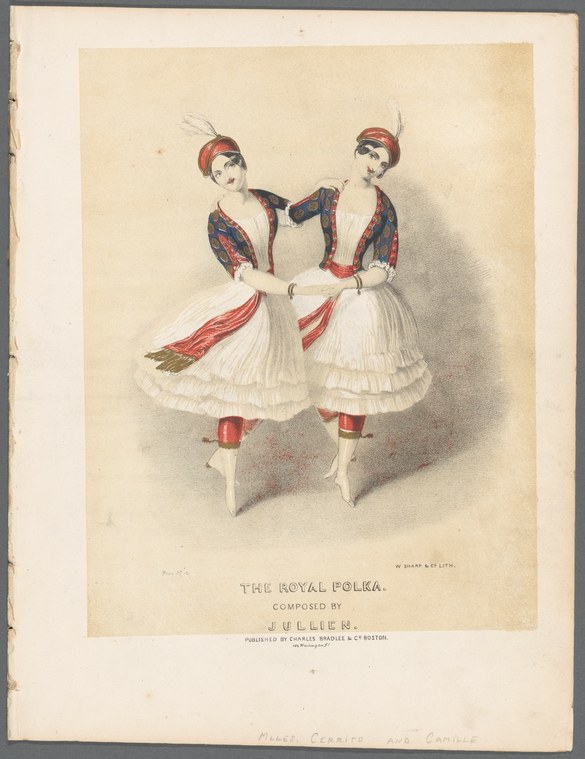
The polka was one of the first truly mass-market dances, crossing class and national boundaries to achieve unprecedented popularity. This image documents how the polka appeared on stage—not as austere ballroom choreography but as vivid, colorful, folk-inflected spectacle. For historians of nineteenth-century dance and popular culture, it provides visual evidence of theatrical marketing, costume convention, and the physical vocabulary performers used to represent this iconic dance.
What you are looking at
Two young women in identical poses face each other in a mirror-image composition, each wearing a short white pleated skirt trimmed with red ribbon, a decorative jacket in deep blue and red with short sleeves, and a red cap or bonnet with a feathered plume. Both dancers are captured mid-leap or mid-stride, their bodies lifted and energetic, legs extended in a lively kick. The skirts billow around them, frozen in motion. The background is a plain cream wash with subtle shading that suggests depth without specificity. The overall effect is one of synchronized, youthful exuberance—two dancers performing the same step in perfect unison or call-and-response. The print is hand-colored in the manner of nineteenth-century theatrical ephemera, with careful attention to costume detail but minimal scenic context.
The dancing
Both dancers are shown in nearly identical positions: torsos upright, legs extended dynamically in what appears to be a high kick or leaping step, arms at the sides or slightly raised. The posture is buoyant and weightless, suggesting a moment caught mid-jump. Their faces are turned slightly toward the viewer, with expressions of engagement. The matching costumes and mirror composition emphasize synchronization—this is not a couple in a closed ballroom hold, but two individuals performing the same folk or theatrical step.
The dance depicted
The title identifies this as a polka, one of the most popular European social dances of the nineteenth century. The Polka originated in Bohemia in the 1830s and swept across Europe and North America by the 1840s, becoming a staple of ballrooms, theaters, and folk celebration. The high-stepping, bouncy action visible here—the lifted legs and energetic upright carriage—is characteristic of polka technique. The costume (the colorful embroidered jackets, pleated skirts, feathered caps) suggests a folk or theatrical adaptation rather than pure ballroom dress, which points to a staged or performed version of the polka as entertainment. The identical pairing and synchronized movement suggest this may represent a theatrical duo or a folk ensemble variation.
How it was made
This is a hand-colored lithograph, a reproductive medium that allowed theatrical images to circulate widely and inexpensively among audiences and performers. The soft tonal background, the careful delineation of costume detail in color, and the printed credit line at bottom (visible as a typical lithograph inscription) confirm the technique. Lithography enabled the affordable mass production of theatrical souvenirs and promotional images in the nineteenth century, making it the dominant medium for dance imagery intended for popular consumption.
About this work
This is a theatrical print documenting 'The Royal Polka,' a dance composition attributed to Jullien, a prominent nineteenth-century dance master and composer. The print captures two performers in the energetic, high-stepping style that made the polka a sensation across Europe and America. The hand-colored lithograph format was standard for theatrical ephemera of the era, reaching audiences through playhouses, dance halls, and music shops. It documents both the polka as a performed dance and the visual language used to promote and celebrate popular entertainment in the mid-nineteenth century.
How to look at it
Attend to the moment the artist chose: the peak of the leap or kick, with both dancers weightless and symmetrical. Notice how the lithographer rendered the costume in vivid detail—the embroidery, the pleats, the feathered ornaments—while keeping the figures' bodies simplified and stylized rather than anatomically exact. This was a convention of theatrical prints: costume was paramount, bodies were idealized and decorative. The mirror-image composition serves both as an advertisement of the step itself (showing it clearly from the front, and repeating it to emphasize its catchiness) and as a design principle that creates visual harmony and balance on the page.
The artist
The composition is credited to Jullien, a renowned mid-nineteenth-century choreographer, composer, and impresario who specialized in popular dance and theatrical music. The print itself bears publication information typical of the era (visible at the bottom), indicating it was issued by a London or Paris theatrical print publisher. The artist who created the lithographic image is not recorded, which was common for commercial theatrical prints of this period, where the dance master's name and the dance title mattered more to audiences than the printmaker's attribution.
The period
The 1840s–1850s were the height of polka mania in Europe and America. The dance had captured public imagination as a symbol of modernity, energy, and democratic social pleasure—less formal than the waltz, more rhythmically driving, and associated with folk vitality. Theaters capitalized on the craze by commissioning new polka compositions and choreographies, often mixing ballroom technique with folk costume and theatrical spectacle. Lithographic prints like this one were produced by the thousands, serving as both souvenirs for dancers and promotional material for theaters. The image reflects the era's fascination with choreographic novelty and the commercial infrastructure of theatrical dance.
Where it lives
This work is part of the NYPL's Prints depicting dance collection, a repository of theatrical ephemera, dance instruction materials, and performance documentation spanning several centuries. The collection includes playbills, costume designs, performance records, and promotional prints such as this one.
Dance in this work
Questions about this work
What is a polka?
The polka is a lively couple's dance in 2/4 time, originating in Bohemia in the 1830s. It is characterized by a hopping, bouncing step and an upright, energetic posture. Unlike the smooth, gliding waltz, the polka has a crisp, percussive rhythm and emphasizes vertical movement. It became one of the first truly global popular dances, spreading from Europe to America and beyond within decades.
Who was Jullien?
Jullien (full name Louis Antoine Jullien) was a celebrated mid-nineteenth-century French conductor, composer, and ballet master. He was known for creating popular theatrical entertainments, dance compositions, and concert spectacles that blended classical and folk music. His name on a dance print indicated prestige and novelty—audiences knew his choreography would be lively and fashionable.
Why are the two dancers identical?
The mirror-image composition serves multiple purposes: it clearly displays the step for viewers unfamiliar with the dance, it creates visual balance and harmony on the page, and it emphasizes the synchronized, repetitive nature of social dance. In performance, this may have represented either a pas de deux (duet) or the way a polka step would be performed by couples in unison across a ballroom.
How was this print made and distributed?
This is a hand-colored lithograph, a reproductive technique that allowed multiple copies to be made from a single stone. Lithographs were affordable and could be produced in quantity, making them ideal for theatrical promotion and souvenirs. These prints were sold at theaters, music shops, and through print publishers, reaching middle-class audiences interested in dance, theater, and fashion.
More dance artwork





