49 works in this view — arrow keys or swipe to move between them.
Dance in Art
Elssler quadrilles.: Arranged by Ch. Zeuner
Unknown artist
- Collection:
- Prints depicting dance
- Source:
- New York Public Library
- Rights:
- Public domain — free to use, share and adapt.
- Recorded as:
- Public Domain
This document captures a moment of intersection between theatrical stardom and popular social dance—how a celebrated dancer's name could be licensed to market ballroom music to ordinary dancers. It also shows the visual language used to sell dance to the print-buying public in antebellum America, and demonstrates the important role of Charles Zeuner and similar composers in mediating between the concert stage and the ballroom.
What you are looking at
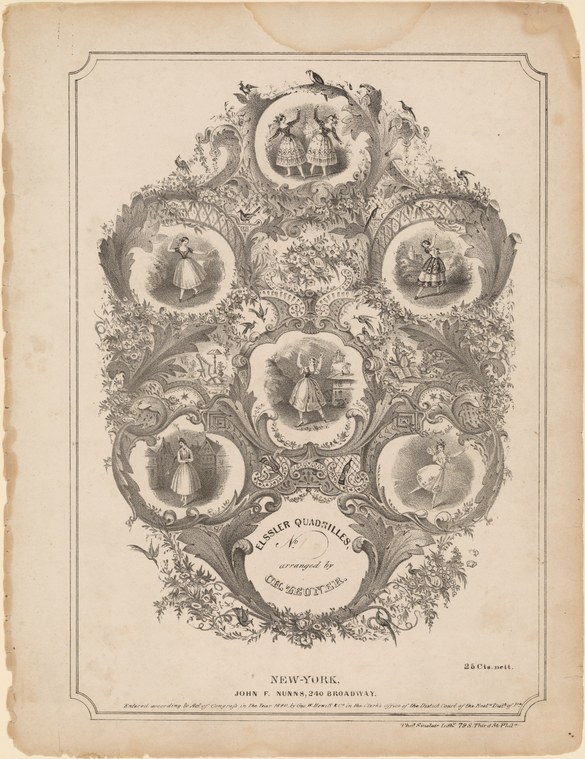
This is an ornamental engraved title page for a quadrille composition arranged by Charles Zeuner, featuring a densely decorated rococo-style frame filled with scrollwork, foliage, and cherubs. Within this elaborate border are seven oval vignettes depicting individual dancers and pairs in ballroom costume. The central top roundel shows two women in full-skirted dresses of the 1840s–50s era. The three larger side ovals show solitary female dancers in similar period dress, each captured in a moment of ballroom movement. Two lower ovals show pairs of dancers—a man in dark coat and a woman in a full skirt—in what appears to be a waltz or similar partnered dance. The women wear the characteristic silhouettes of the mid-19th century: tight-waisted bodies, full skirts at mid-calf, and bonnets or headpieces. The engraving is finely detailed, with delicate cross-hatching creating depth and shadow. The title cartouche at the base reads 'ELSSLER QUADRILLES / Arranged by / Ch. Zeuner,' identifying this as a published dance music score. The publisher's mark 'NEW-YORK: / JOHN F. NUNNS. 246 BROADWAY.' anchors the lower section.
The dancing
Each figure stands or moves with the upright, controlled posture expected of fashionable ballroom dancers in the 1840s–50s. The solitary women are shown with arms positioned at the sides or raised in graceful attitudes; the paired dancers stand in closed ballroom position with the man's right arm behind the woman's waist and both arms extended. The weight distribution is poised and vertical; there is no suggestion of folk energy or athletic extension. The skirts are rendered to show the volume of crinoline or horsehair construction, and in the dancing pairs the woman's skirt shows the swirl of rotation. The figures are elegantly proportioned but small in scale relative to the ornamental frame, fitting the conventions of decorative engraving.
The dance depicted
This is a quadrille arrangement dedicated to or named for Fanny Elssler, the celebrated romantic-era ballerina. The quadrille itself was not a ballet form but a fashionable ballroom dance of the period—a group dance for four couples performed to a series of musical figures. Charles Zeuner was a composer and conductor working in New York in the 1840s–50s who arranged popular dance music, including quadrilles based on themes from contemporary operas and named after famous dancers. The vignettes show ballroom costume and partnered movement, not the pointe work or tutus of theatrical ballet, yet Elssler's fame lay in dance theatre. The arrangement likely capitalised on her renown to sell sheet music to amateur dancers in America, translating her stardom into popular social dance.
How it was made
This is a finely engraved steel or copper plate print, likely wood or steel-engraved based on the fineness of the line and the density of detail in the rococo frame. The technique allowed for mass reproduction and wide circulation as a printed commodity—this was a published sheet music title page sold through a Broadway music shop. Engraving of this ornamental quality was expensive and reserved for works intended for a middle-to-upper-class audience who could afford printed music and fashionable dancing lessons. The precision of the line work and the skill in depicting the figures and drapery suggest a specialised dance-music publisher's commitment to visual appeal as part of the product's market value.
About this work
This is the title page of a published quadrille arrangement for piano or small ensemble, issued in New York in the mid-19th century. It capitalises on the contemporary fame of Fanny Elssler by naming the dance after her, though the work itself is a ballroom quadrille for amateur dancers rather than a theatrical piece. The engraved vignettes show both solitary dancing figures and paired ballroom movement, illustrating the fashionable dress and posture of the period. It is an artifact of the transatlantic trade in popular dance culture—a way that European theatrical celebrity was converted into printed sheet music and domestic dance instruction in America. The ornamental frame and quality of engraving signal its intended audience: educated, affluent, and interested in both aesthetic refinement and social dancing.
How to look at it
Focus on the vignettes within the ornamental frame rather than the frame itself. Notice the progression from solitary dancers to paired couples—this was the typical structure of a quadrille, which often began with individual or group figures before resolving into partnered waltzing. Observe the posture and arm positions of the paired dancers: they demonstrate the closed ballroom hold that became standard in the mid-19th century. The rendering of the women's skirts gives a sense of the voluminous silhouette required by fashion and the swirl it created in motion. The ornamental surround is typical of mid-century music publishing—it signals refinement and marketability to a genteel consumer.
The artist
Charles Zeuner (1795–1857) was a German-born composer and conductor who emigrated to America and became a leading figure in Boston and New York musical life. He composed and arranged quadrilles, cotillions, and other fashionable dances, and published extensively. His arrangements of operatic themes and named quadrilles were a staple of American ballroom culture in the 1840s–50s. Zeuner also composed sacred music and was active as a church organist and teacher. His dance publications in particular reveal the commercial machinery that connected European theatrical celebrity to American domestic consumption.
The period
The 1840s–50s were the height of the Romantic era in ballet and the peak of Fanny Elssler's international fame. Elssler, an Austrian dancer, became a rival to Marie Taglioni in popularity and toured America in 1840–42 to enormous acclaim. Simultaneously, the quadrille was at the apex of fashionable ballroom dancing in both Europe and America, replacing the cotillion as the primary group dance. Dance music publishers in major cities like New York capitalised on theatrical celebrities by issuing quadrilles and other dances named after famous performers, creating a market for both sheet music and the printed images that adorned title pages. This was part of a broader phenomenon of celebrity culture and commercial entertainment expanding in the urban United States.
Where it lives
This is part of the New York Public Library's collection of prints depicting dance, catalogued as ephemera or sheet music cover art. It is a commercial printed object produced for retail sale through a music publisher on Broadway, making it part of the material culture of popular entertainment rather than a fine art print.
Dance in this work
Questions about this work
Who was Fanny Elssler?
Fanny Elssler (1810–84) was an Austrian dancer and one of the most celebrated performers of the Romantic era. She specialised in character dances and national dances (particularly the cachucha) and was famous for her technical brilliance and dramatic presence. She toured America in 1840–42 and became a celebrity there, rivalling the ballerina Marie Taglioni in public adulation. She retired from the stage in 1851.
What is a quadrille?
A quadrille is a ballroom dance for four couples (eight dancers), performed in a square formation. Each couple takes one side. The dance consists of five figures, each performed to a distinct musical phrase. Popular throughout the 19th century, it required coordination but not the technical training of ballet, making it the standard group dance of polite society.
Who was Charles Zeuner?
Charles Zeuner was a German-born composer and organist (1795–1857) who emigrated to America and became prominent in Boston and New York. He published extensively, specialising in dance music arrangements including quadrilles and cotillions, many named after famous dancers or operatic themes. He also composed sacred music and was a church musician.
Was this actually danced by Elssler?
No. The quadrille was a ballroom dance for amateurs, not a theatrical work. This is a commercial product: publishers issued dance music named after famous performers to boost sales. Elssler would have danced theatrical pieces on stage; this sheet music was for middle-class dancers in ballrooms.
More dance artwork





