49 works in this view — arrow keys or swipe to move between them.
Dance in Art
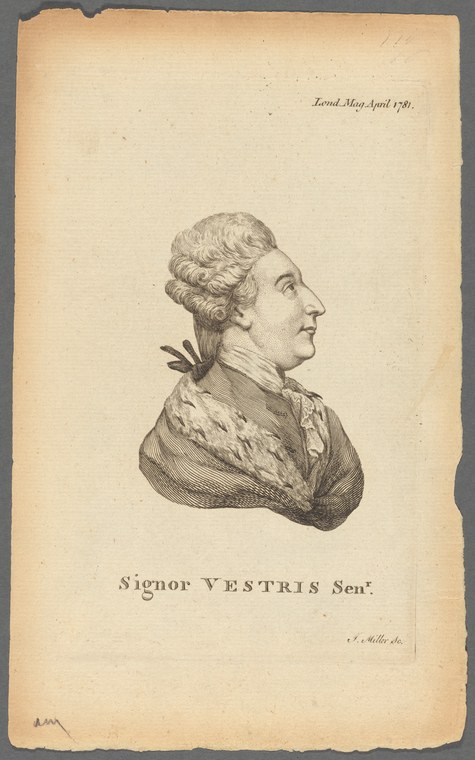
Signor Vestris Senr. [Gaëtan Vestris]
Unknown artist
- Collection:
- Prints depicting dance
- Source:
- New York Public Library
- Rights:
- Public domain — free to use, share and adapt.
- Recorded as:
- Public Domain
Vestris was a legendary figure in dance history — famous for his elevation, pirouettes, and the precision of his technique, and for his role in establishing classical ballet as a professional and respectable art form. This portrait is one of the visual records of him that circulated during his lifetime, making him one of the earliest dancers to be memorialised in widely distributed prints. For historians and dancers, it is evidence of how Vestris was seen and promoted in his own time, and of the celebrity status he commanded.
What you are looking at
A bust-length portrait in profile shows a man facing left, rendered in fine engraving. He wears a dark coat over a white shirt or waistcoat, with a narrow black ribbon tied at the nape of his neck. His hair is styled in the pale, powdered waves typical of late 18th-century fashion, swept back and gathered. The figure is depicted from the shoulders up against a plain background, the engraving technique allowing subtle gradations of tone across the face and fabric. The inscription below reads "Signor VESTRIS Senr." — identifying this as a portrait of Gaëtan Vestris, one of the most celebrated male dancers of his era. The work is dated "Lord May April 1789" at top right, placing it in the late 1780s when Vestris's fame was at its peak.
The dancing
This is a portrait head, not a depiction of dancing, so there are no dancers, holds, or gesture to read. The sitter is shown in a composed three-quarter-profile pose typical of formal portraiture. His gaze is level and dignified, his posture upright. The portrait captures him as a public figure rather than in the act of performance.
The dance depicted
Gaëtan Vestris (1729–1808) was the most celebrated male dancer of the 18th century, renowned for his technical virtuosity, nobility of bearing, and dominance in the Paris Opéra for more than forty years. He epitomised the ideal of the danseur noble — the aristocratic, technically perfect male dancer of classical ballet. This portrait, made when Vestris was in his sixties but still performing and teaching, captures him in street dress rather than costume. It is a record of his public identity as a celebrated performer and pedagogue, not a representation of his dancing itself.
How it was made
This is an engraving, a reproductive print technique that allowed the portrait to circulate widely among audiences interested in dance and theatrical celebrities. The fine lines and careful cross-hatching show the engraver's skill in rendering the subject's features and the texture of fabric and hair. Engravings of celebrated performers served as public records of their fame and were sold to admirers; this work's inscription and date suggest it was made for circulation during Vestris's later career. The technique's precision and reproducibility made it the standard medium for portraiture of public figures in this period.
About this work
This is a formal portrait engraving of Gaëtan Vestris, the pre-eminent male dancer of the late 18th-century Paris Opéra and one of the first dancers to achieve the status of a international celebrity. The work documents not a moment of performance but Vestris's public identity and the fame he commanded. It belongs in a gallery about dance because Vestris was one of dance history's most influential figures: he defined the technical and aesthetic standards of male ballet for his generation, trained leading dancers across Europe, and established the possibility of the male dancer as a star in his own right rather than merely a partner to ballerinas.
How to look at it
Look at the dress and styling: Vestris is shown not in theatrical costume but in fashionable civilian clothes, which emphasises his status as a man of affairs and the world, not merely a performer. The formal three-quarter profile pose and the precision of the engraving technique assert dignity and permanence. The date and inscription anchor him in historical time — April 1789, on the eve of Revolution, when he was sixty years old and still commanding respect. This is how Vestris wished to be remembered: as a gentleman and a master of his art, not as a spectacular body in motion.
The artist
The engraver is not recorded in the catalogue. The inscription "A Mille dir." at lower left may indicate the printmaker or publisher. Late 18th-century portrait engravings of celebrated performers were typically produced by professional reproductive engravers working from drawings or paintings; the quality of this work suggests it was made by a skilled practitioner. Without further research, the specific engraver cannot be identified.
The period
Vestris was active during the reign of Louis XVI and the early years of the French Revolution. The late 1780s, when this portrait was made, was the height of his career as a teacher and mentor, though he continued to perform into his seventies. The period saw the consolidation of classical ballet technique and the emergence of ballet as a respectable art form taught in academies and performed in state-supported theatres. The circulation of celebrity portraits in print was a new phenomenon of this era, part of a broader growth in theatrical publicity and the cult of the performer. This engraving exemplifies how dancers were beginning to be treated as public figures worthy of visual commemoration.
Where it lives
The work is held in the Prints collection of the New York Public Library. It is one of a series of portrait engravings of celebrated performers made for circulation among theatregoers and collectors of theatrical imagery. The inscription "Lord May April 1789" and the attribution to Vestris suggest it was produced as a commercial print for public sale.
Questions about this work
Who was Gaëtan Vestris and why is he important to dance history?
Gaëtan Vestris (1729–1808) was the most celebrated male dancer of the 18th century and a dominant figure at the Paris Opéra for over forty years. He revolutionised male dancing by combining extraordinary technical skill — especially in jumps and turns — with noble bearing and artistic presence. He trained the next generation of dancers across Europe and proved that a male dancer could be a star in his own right. His legacy shaped the development of classical ballet technique and pedagogy.
Why is this a portrait rather than a depiction of him dancing?
This engraving was made as a celebrity portrait for public circulation, not as a record of a specific performance. During Vestris's era, famous performers began to be commemorated in formal portraits much like other public figures. The portrait served to honour him as a celebrated artist and to satisfy audiences' curiosity about his appearance. It is one of the earliest visual records of a male dancer as a public personality.
What does the clothing tell us?
Vestris is shown in fashionable civilian dress — a dark coat and white shirt with a black ribbon at the neck — rather than in theatrical costume. This choice emphasises his status as a gentleman and a man of the world, not merely a performer. It reflects the ambition of late 18th-century dancers to be seen as respectable artists worthy of the same social regard as musicians or writers.
What is an engraving and why was this technique used?
An engraving is a print made by incising lines into a metal plate, which is then inked and printed on paper. The technique allowed images to be reproduced in multiple copies and sold to a wide audience. Engravings were the standard medium for circulating portraits of celebrated public figures in the 18th century, making them the visual equivalent of today's celebrity photographs. This print would have been sold to admirers of Vestris and to collectors of theatrical imagery.
More dance artwork





