49 works in this view — arrow keys or swipe to move between them.
Dance in Art
Le galop infernal
Unknown artist
- Collection:
- Prints depicting dance
- Source:
- New York Public Library
- Rights:
- Public domain — free to use, share and adapt.
- Recorded as:
- Public Domain
For dance historians, this print is evidence of how fiercely the galop was contested in its own moment, and how visual media was weaponized in that contest. For art historians, it exemplifies the 19th-century satirical print as a vehicle for social commentary, and the way distortion and exaggeration could render invisible anxieties about class, gender, and bodily control visible on the page.
What you are looking at
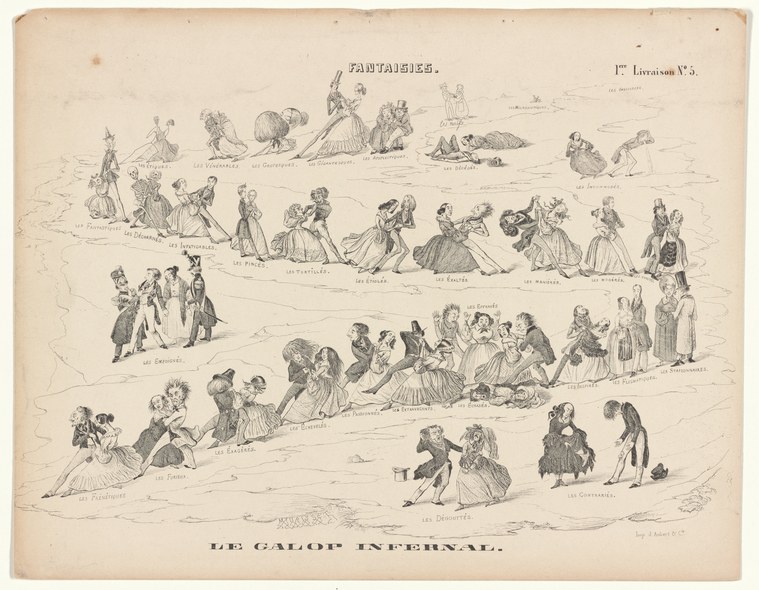
A densely populated satirical scene depicting dozens of figures in various states of chaotic motion across a flat landscape. The composition is organized into horizontal bands of activity: upper register shows contorted, impossible acrobatic figures and creatures; the middle and lower registers teem with fashionably dressed women in wide skirts and men in formal dress, many in pairs or small groups, their postures exaggerated and grotesque. The women wear the voluminous skirts and bonnets of the early 19th century. Some figures are falling, collapsing, or tangled together; others leap or twist with anatomically implausible elasticity. The title *Le galop infernal* (The Infernal Galop) and French labels beneath individual vignettes identify the action: the overall effect is of frenzy and disorder, a visual mockery of the galop as a wild, uncontrollable dance craze.
The dancing
The bodies are rendered in pen with exaggerated, contorted postures that defy natural anatomy. Couples are shown in closed hold attempting the galop, but their frames collapse or twist; limbs flail; skirts billow impossibly. Individual figures are isolated in grotesque arabesque-like positions, some hovering or floating, suggesting the artist's mockery of the dance's supposed madness. The extreme elongation of limbs and distortion of spines emphasizes loss of bodily control. Many figures are shown from the side, allowing the artist to exaggerate the forward thrust and backward lean of the galop's characteristic motion.
The dance depicted
This is a satirical print about the galop, a fast couple dance that swept through European ballrooms in the 1820s–30s and provoked intense anxiety among critics who saw it as scandalously wild, sexually suggestive, and symptomatic of social disorder. The galop appears here not as a dance instruction or celebration, but as a subject of ridicule: the title *infernal* signals moral panic. The engraving mocks the dance's speed and the loss of dignity it supposedly caused, showing dancers overwhelmed, falling, and behaving with abandon. The galop was a partner dance in rapid 2/4 time, often preceded by or combined with the chassé, danced in closed position with pronounced forward and backward sway—here rendered as complete physical collapse.
How it was made
This is a lithographic or engraved print, produced from a continuous line drawing. The technique of pen outline with no shading or wash allows rapid reproduction and distribution—essential for a topical satirical work aimed at a broad urban audience. The dense composition and repeated figure types suggest the work was made for serial or broadsheet publication, likely in France during the galop craze. The absence of fine modeling or perspective reinforces the caricatural intent: the flatness makes the distortion more forceful.
About this work
This is a satirical print mocking the galop, a dance craze that convulsed European ballrooms in the 1820s–30s. The artist presents the dance not as a social pleasure but as a form of madness—*infernal* in its consequences. Dozens of fashionably dressed ballroom dancers are shown in wildly distorted, anatomically impossible postures, falling, flailing, and losing control. The work is both a document of how the galop was danced (fast, in closed couple position, with pronounced sway) and a window into contemporary anxiety about new dances and their supposed moral dangers.
The print belongs to a long European tradition of satirizing fashionable dances—from the earlier attacks on the waltz to later mockery of the can-can. It captures a specific historical moment when the galop was genuinely controversial, and it reveals how visual satire could shape public perception of dance practice.
How to look at it
The artist has frozen the galop at its moment of maximum chaos. Attend to the contorted spines and flailing limbs: these register the artist's sense that the galop involved a dangerous loss of self-control. Notice how the women's skirts billow and twist, obscuring the footwork but emphasizing the speed and disorientation. Look at the paired figures in the middle registers: even where couples are in recognizable closed position, their frames twist or collapse. The upper register, with its impossible acrobatic poses, is the artist's way of saying the galop is not a dance at all but a form of bodily madness. The satire works by literalizing the period's hyperbolic language about the dance as 'infernal' and uncontrollable.
The period
The galop became fashionable across Europe in the 1820s, imported from Hungary or Germany into Vienna and Paris, and spreading rapidly to London and beyond. It was a couple dance in fast 2/4 time, danced in closed position with a characteristic forward-and-back motion and a hopping or chassé step. The speed and physical proximity of the partners alarmed moralists and dancing masters, who saw it as a symptom of democratic excess and the loosening of propriety. Medical writers claimed it caused fainting, palpitations, and nervous exhaustion, particularly in young women. The dance generated caricature and satirical verse; prints like this were part of a wider cultural conversation about what new dances meant for social order.
In visual art, the period saw the rise of the lithographic print as a medium for rapid, topical satire. Works by artists like Honoré Daumier and others used physical distortion, crowded composition, and exaggeration to critique fashion, politics, and social manners. This print sits squarely in that tradition, using the body of the dancer as a vehicle for social criticism.
Where it lives
From the New York Public Library print collection, likely a French lithograph or engraving from the 1820s–30s. The work circulated as a broadsheet or was included in a series of topical satirical prints, the format that made such commentary accessible to the urban middle-class audience most invested in debates about ballroom fashion and propriety.
Dance in this work
Questions about this work
What is a galop?
A fast couple dance in 2/4 time that became fashionable in European ballrooms in the 1820s. Danced in closed position, it featured a rapid chassé or hopping step and a characteristic forward-and-back sway. It was imported from Central Europe and spread quickly to Paris, Vienna, and London, where it provoked intense moral anxiety.
Why did people find the galop so shocking?
The speed, the physical contact between partners, and the pronounced bodily movement were seen as scandalous and sexually suggestive. Critics claimed it caused nervous exhaustion, particularly in women, and interpreted it as a sign of social disorder and the breakdown of aristocratic restraint. Medical writers warned of fainting and palpitations.
Is this print by a famous artist?
The artist is not recorded in the catalogue. However, the style and subject place it firmly within the tradition of French satirical print-making of the 1820s–30s. It may be the work of a prolific anonymous caricaturist or one of the many artists who worked in the popular broadsheet trade.
How does the artist show the galop is supposed to be danced?
Despite the exaggeration, the print preserves accurate details: the closed couple hold, the rapid forward-and-back motion, the emphasis on speed. The artist has simply made these features grotesquely extreme, using physical distortion to express the contemporary fear that the galop represented a loss of bodily and social control.
More dance artwork





