49 works in this view — arrow keys or swipe to move between them.
Dance in Art
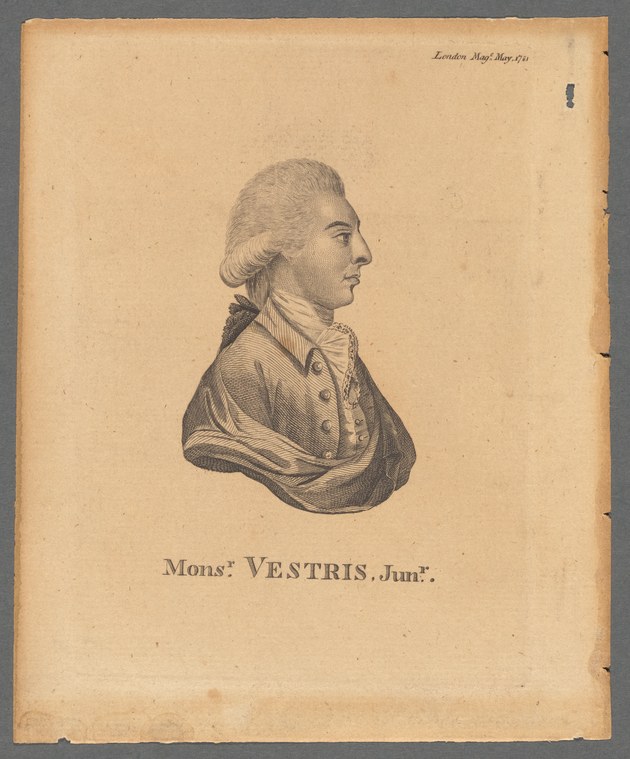
Monsr. Vestris, Junr. [Auguste Vestris]
Unknown artist
- Collection:
- Prints depicting dance
- Source:
- New York Public Library
- Rights:
- Public domain — free to use, share and adapt.
- Recorded as:
- Public Domain
Vestris was arguably the first male dancer to achieve the status of a modern celebrity—known across Europe, courted by aristocracy, commanding enormous fees, and the subject of commercial portraiture and prints. This image is evidence of that status and of the cultural prominence ballet had attained in the late 18th century. It also documents how performers of the period chose to present themselves to the public: formally dressed, dignified, and positioned as exemplars of taste and refinement rather than as entertainers or acrobats.
What you are looking at
A bust-length portrait in profile facing left, rendered as an engraving or stippled print on aged paper. The subject wears the formal dress of the late 18th century: a coat with visible buttons and trim, a white cravat or neckerchief, and hair swept back in the fashion of the period, possibly powdered or light in tone. The figure is shown from the shoulders up, set against a plain background, with careful attention to the modeling of the face and the texture of the fabric. The inscription below reads "Monsr. VESTRIS, Junr." in serif capitals. The print shows the wear of age—foxing and discoloration of the paper—and bears a date notation in the upper right corner reading "London May-June 1791."
This is a formal commemorative portrait, likely made for circulation among the London theatre-going public or the dance world itself. The style and format—a profile bust, the formal dress, the careful engraving technique—suggest it was made to record and celebrate a notable public figure, probably for inclusion in a portfolio, periodical, or collection of portraits of celebrated performers.
The dancing
The subject is shown in three-quarter profile, the neck held upright with dignity, the shoulders squared and relaxed. No arms or hands are visible; the composition is a pure bust study, focusing entirely on the head, neck, and upper torso. The posture suggests ease and confidence rather than the mid-movement energy of an action portrait. This is portraiture of a performer, not portraiture of performance.
The dance depicted
Auguste Vestris (1760–1842), known as "le dieu de la danse," was the most celebrated male dancer of the late 18th century and the dominant figure in European ballet of his time. He was the son of the equally famous Gaétan Vestris and inherited his father's status as the leading male dancer in Paris. This print records him at the height of his fame, likely during or shortly after a London engagement. The image itself does not depict him dancing; rather, it is a portrait of him as a public figure and celebrity. However, the formality and care of the engraving—and the fact that it was made at all—testifies to the prestige and cultural importance dance held in this period, and to Vestris's singular prominence.
How it was made
This is an engraving or stipple engraving, a printing technique that used small dots and fine lines to build tone and model form, particularly effective for rendering fabric and skin texture. The technique allowed wide distribution of the image, and the date notation suggests it was made for a market: London audiences in 1791 would have been able to purchase or collect such prints, much as fans today might buy photographs or trading cards of performers. The medium implies Vestris was a celebrity of sufficient renown to warrant commercial portraiture.
About this work
This is a formal engraved portrait of Auguste Vestris, the dominant male dancer of late 18th-century European ballet, made in London in 1791 during or shortly after one of his celebrated performances there. It is not a dance scene but a celebrity portrait—a record of how the most famous dancer of his era was seen and marketed to the public. The work belongs to a long tradition of engraved performer portraits, and testifies to the status dance and dancers had attained in the culture of the period.
The image is valuable precisely because it is not a narrative dance scene. It shows us how the person of the dancer mattered: the formal dress, the composed bearing, the care lavished on the engraving all position Vestris as a public figure and cultural authority, not merely an entertainer. This is what it meant to be the most celebrated dancer in Europe in 1791.
How to look at it
Look at the bearing and the dress. The subject is shown not in the costume of a role (as theatrical portraits often were) but in fashionable day dress, which emphasizes his status as a man of fashion and culture, not merely a performer. The careful modeling of the face and the formal three-quarter profile are conventions borrowed from portrait engraving of statesmen and men of letters. The artist is saying: this dancer is not a curiosity or an acrobat; he is a man of consequence. The date in the corner is important too—it anchors the image to a moment of Vestris's presence in London, implying that the print was made to capitalize on his fame while he was performing or recently performed there.
The artist
The artist is not recorded. The print was published or made in London, and the stipple engraving technique was popular in Britain in the 1780s and 1790s for theatrical and celebrity portraiture. Many such prints were made of notable performers, often engraved by multiple hands; the original artist may have been a print-seller or publisher rather than a named engraver.
The period
The late 18th century saw ballet transformed from a courtly entertainment into a public theatrical spectacle, performed in opera houses and available to paying audiences. The rise of the professional male dancer—as distinct from the court dancer or the acrobat—dates to this period. Vestris epitomized this transformation. He was trained in the French ballet tradition (his family was central to that tradition), but his fame was international. By 1791, he had performed in Paris, London, Milan, and other major cities, and was known to be both technically virtuosic and a commanding stage presence.
The 1780s and 1790s also saw an explosion in the production of engraved theatrical portraits, sold as prints to the public. This was a major form of celebrity marketing and fan culture before photography. The format of this print—a formal bust, suitable for framing, affordable to a broad audience—was designed for exactly that market.
Where it lives
The print is held in the New York Public Library's collection of prints depicting dance. The catalog record identifies it only by the inscription visible on the print itself; no publisher, engraver, or accession information is recorded. The notation "London May-June 1791" appears to be part of the original print, suggesting it was made in or for the London market during or shortly after that date.
Questions about this work
Is this a portrait of Vestris dancing?
No. This is a formal portrait bust of Vestris the person, not a depiction of him in performance. He is shown in fashionable dress, posed sedately, with no indication of movement or dance. The significance is that he was important enough to warrant a formal engraved portrait at all—something that shows how much prestige dance and dancers had attained by the 1790s.
Who was Auguste Vestris?
Vestris (1760–1842) was the most celebrated male dancer of the late 18th century, known across Europe and commanding fees that made him wealthy. He was the son of Gaétan Vestris, also a famous dancer. He epitomized the rise of the professional male dancer and the transformation of ballet from a court entertainment into a public theatrical spectacle.
What is a stipple engraving?
Stipple engraving is a printmaking technique that builds tone using small dots rather than lines, which allows for fine modeling of form and texture—especially effective for rendering fabric, skin, and hair. It was popular in the 1780s and 1790s for theatrical and celebrity portraiture, and prints made this way could be sold affordably to a broad public.
Why was this made in London in 1791?
Vestris was performing in London during this period and was extremely famous there. The print was likely made to capitalize on his celebrity—sold to audiences and fans during or shortly after his performances. These portrait prints were a major form of theatrical marketing and celebrity merchandising of the era.
More dance artwork





