49 works in this view — arrow keys or swipe to move between them.
Dance in Art
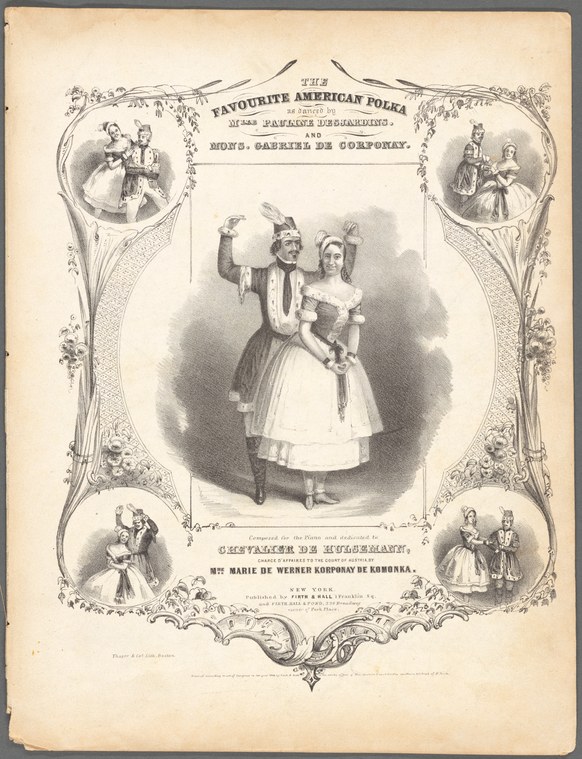
The favourite American polka, as danced by Mlle. Pauline Desjardins and Mons. Gabriel de Corponay, composed ... by Marie de Werner Korponay de Komonka
Unknown artist
- Collection:
- Prints depicting dance
- Source:
- New York Public Library
- Rights:
- Public domain — free to use, share and adapt.
- Recorded as:
- Public Domain
The polka was one of the most socially transformative dances of the 19th century, and this print captures the moment and manner of its establishment in elite ballroom culture. It documents not just the dance form but the commercial machinery—named dancers, printed music, promotional imagery—that turned a Central European folk dance into an international fashion. For anyone studying the history of ballroom dance, popular culture in the 1840s–1850s, or the relationship between dance and commercial print culture, this image is a primary source.
What you are looking at
A decorative lithographic print celebrating a specific polka performance, centered on a full-length portrait of a woman in mid-dance, flanked by four smaller vignettes showing paired dancers in various embrace positions. The central female figure wears a white ball gown with a full skirt caught in motion, her posture upright and composed, one arm raised. She is framed by an ornate border of flowering vines and scrollwork in the Romantic-era commercial print style. The four surrounding scenes—at top left and right, bottom left and right—show couples in close partnership, the women in similar white gowns, the men in dark formal wear, their bodies angled in the characteristic tilted stance of polka. The overall composition emphasizes the polka as a fashionable social dance of the ballroom, performed by well-dressed urban dancers.
The dancing
The central dancer stands with weight centered, her frame vertical and dignified rather than dynamic—the moment captured is one of composed elegance rather than mid-step. Her raised arm and the billowing skirt suggest movement, but the posture is controlled. In the surrounding vignettes, couples hold in a close closed position typical of polka, with the man's right arm around the woman's back and their bodies tilted forward in the characteristic polka lean. The female figures throughout maintain the upright carriage and full-skirted silhouettes of 1840s–1850s ballroom fashion. The dancers' frames are consistently formal and restrained, showing that this is a refined parlor dance, not a folk or rural variant.
The dance depicted
This is a Polka, the immensely popular couple's dance that swept Europe and North America from the 1840s onward. The title credits the dance to composer Marie de Werner Korponay de Komonka and specifies that it was "as danced by Mlle. Pauline Desjardins and Mons. Gabriel de Corponay"—these were likely well-known ballroom dancers or performers who popularized a particular version of the polka in their era. The image shows the polka in its ballroom context: a close-hold partner dance performed by people in formal dress at fashionable social events. The tilted posture and compact, bouncy movement suggested by the composition align with the polka's characteristic hopping rhythm and forward momentum.
How it was made
This is a lithograph, a process that allowed for mass production of decorative prints and made them commercially viable for dancing masters, composers, and the ballroom public. The ornate floral border, varied tonal shading, and combination of large central image with smaller surrounding scenes are all characteristic of mid-19th-century commercial dance instruction and performance prints. Lithography's ability to capture gradation and detail made it ideal for depicting the fashionable dress and refined manners that were as much part of the appeal of ballroom dancing as the dance itself. The work was likely published as sheet music cover art or as a souvenir print to be purchased by attendees of the dance or admirers of the performers.
About this work
This is a commercial lithographic print documenting the Polka as performed and taught in the ballroom society of the mid-19th century. It celebrates a specific performance or teaching partnership between two named dancers and links the dance to a musical composition, a common way of monetizing and promoting fashionable dances of the era. The ornate, theatrical presentation—despite the domestic ballroom context—reflects the polka's extraordinary popularity at this moment: it was not merely a folk novelty but a prestige entertainment, associated with Continental elegance and modern urbanism. For dance historians, the image is valuable precisely because it shows the polka not as we might imagine it from folk descriptions, but as it was actually performed in formal ballrooms by trained dancers in fashionable dress.
How to look at it
The central figure is not captured mid-step or in a moment of exuberant movement, but rather in a pose of refined stillness—the raised arm and swirling skirt are stylized suggestions of motion rather than a documentary freeze-frame. This is typical of ballroom dance prints, which aimed to present the dance as elegant and controlled rather than wild or ecstatic. Look at the four surrounding vignettes to see the actual partnering: the close embrace, the forward tilt, and the stepping positions that define the polka. The ornamental border and the careful composition emphasize that this is a fashionable social event, a matter of taste and refinement, not athletic spectacle.
The period
The polka emerged in Bohemia in the 1830s and became a sensation across Europe and North America by the 1840s. This print dates to that explosive period of adoption, when the polka was being enthusiastically taken up by the urban ballroom public and was seen as modern, Continental, and fashionable—a contrast to the staid, formal dances it displaced, such as the cotillion and the quadrille. The commercial promotion of named dancers and composers, and the linking of dance to printed music and image, was standard practice for fashionable dances of the period. Lithographic printing technology made it possible to produce images like this in quantity, distributing them to ballroom patrons, dance students, and the general public.
Where it lives
The work is held in the New York Public Library's collection of prints depicting dance. It is a commercial lithograph, likely produced in or around the 1840s–1850s for sale to the dancing public or as promotional material for the named performers.
Dance in this work
Questions about this work
Who were Pauline Desjardins and Gabriel de Corponay?
The print credits them as the dancers who performed this version of the polka, but they are not identified further in the visible text. They were likely ballroom dancers or dance instructors of some reputation in their time, prominent enough to be named on a commercial print. Such promotional linking of a dance to named performers was common practice in the 19th century ballroom world.
What is the polka and why was it so popular?
The polka is a lively couple's dance in duple time, originating in Bohemia in the 1830s. It became a sensation in the 1840s because it was new, energetic, and Continental—it offered a faster, more playful alternative to the formal, stately dances that had dominated the ballroom. Its adoption in Paris and London by fashionable society made it a symbol of modernity and cosmopolitan taste.
How does the polka compare to other ballroom dances of this era?
The polka was faster, bouncier, and more intimate than the quadrille or cotillion, which involved multiple couples in geometric formations. The polka was a couple's dance in a closed hold, with a hopping rhythm and forward momentum. It was less formal and more personal than the dances it displaced, which appealed to the urban, middle-class ballroom society of the mid-19th century.
What can we learn from this print about how the polka was danced?
The surrounding vignettes show the characteristic closed hold and forward-leaning posture of the polka. The women are in full skirts and upright carriage; the men support them with arm around the back. The tilted frame and compact positioning suggest the bouncy, hopping movement and rapid stepping that defined the polka. The formal dress and refined demeanor indicate that this was a ballroom dance for fashionable society, not a folk or popular-class amusement.
More dance artwork





