49 works in this view — arrow keys or swipe to move between them.
Dance in Art
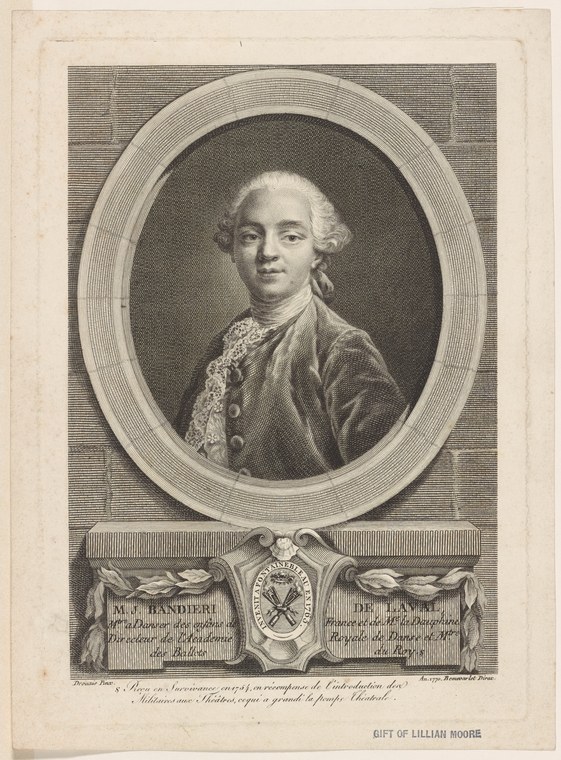
M. J. Bandieri de Laval: Mtre. a danser des enfans de France et de Me. la Dauphine. Directeur de l'Academie Royale de Danse et Mtre. des ballets du Roys
Unknown artist
- Collection:
- Prints depicting dance
- Source:
- New York Public Library
- Rights:
- Public domain — free to use, share and adapt.
- Recorded as:
- Public Domain
This portrait documents the professionalization and institutionalization of dance instruction in eighteenth-century France. It shows that by this period, the master of dance held sufficient rank and cultural authority to merit an engraved portrait—a medium typically reserved for nobility, clergy, and prominent intellectuals. For scholars of dance history, the image is evidence of the formality and prestige of the Royal Academy of Dance and the caliber of figures who directed it.
What you are looking at
This is an engraved portrait of a man in eighteenth-century court dress, presented in an oval frame against a hatched background. He wears a velvet coat with ornate frogging or braid fastenings down the front, beneath which a richly decorated waistcoat is visible. His hair is styled in the fashion of the period, pulled back and powdered. Below the portrait sits a decorative cartouche bearing the subject's name and titles in French, flanked by allegorical emblems—a palm frond and laurel wreath on either side, and what appears to be a crossed-palm emblem in the center. The inscription identifies him as a master of dance to the children of France and director of the Royal Academy of Dance. The entire composition is framed within a rectangular border with decorative corner elements, typical of formal portrait prints of the period.
The dancing
The figure is shown from the shoulders up, turned slightly to the viewer's left in a three-quarter view. His posture is upright and dignified, his expression composed and forward-gazing. There is no active dance gesture visible; this is a formal commemorative portrait rather than a representation of dancing. The hand is not visible in the framed section, which focuses entirely on the head, shoulders, and upper torso.
The dance depicted
This is not a depiction of dance in action. Rather, it is a formal portrait of a dance master—a figure of professional and institutional importance in eighteenth-century French court culture. The inscription records that the subject (Bandieri de Laval, as noted in the catalogue) held the prestigious position of master of dance to the children of France and was director of the Royal Academy of Dance (Académie Royale de Danse). The work documents the status and formal authority of a professional dance teacher in the ancien régime, a period when dance was a central accomplishment of noble education. His inclusion in an engraved portrait series suggests his prominence and the cultural importance of his role.
How it was made
This is a line engraving, executed with fine parallel hatching to create tone and volume. The technique is characteristic of eighteenth-century portrait prints: the regularity of the hatching, the precision of the oval frame, and the decorative cartouche all indicate professional reproductive engraving intended for circulation among an educated audience. The print would have been distributed to memorialize the subject and circulate his image within court circles and among families employing dance masters. The technique allows for fine detail in the rendering of fabric, facial features, and hair, and the oval format was conventional for formal portraiture of the period.
About this work
This is an eighteenth-century engraved portrait of Bandieri de Laval, a prominent French dance master and director of the Royal Academy of Dance. It belongs in a gallery about dance not because it depicts dancing, but because it preserves the image of a historical figure who shaped the teaching and practice of dance in the ancien régime. Dance masters like Laval occupied a unique social position: educated professionals who moved between court and aristocratic households, codifying technique and standards. The work is a historical document of the institution and personnel of formalized dance instruction in eighteenth-century France. It tells us that dancing, by this period, was prestigious enough that its masters merited formal, engraved commemoration—a sign that dance had achieved the status of a liberal art worthy of professional authority and publication.
How to look at it
Attend to the dress: the precision of the coat, the embroidered waistcoat, the formal grooming indicate a man of rank and authority. The oval frame and hatched background are conventions of formal portraiture designed to create an illusion of three-dimensionality and gravitas. The cartouche below is as important as the face—it names the sitter and his titles, making clear that this is a portrait of institutional significance, not merely a pleasant likeness. The engraving technique itself—the regularity and skill of the hatching—conveys that this was a figure of sufficient importance to warrant professional printmaking and distribution.
The artist
The engraver is not recorded in the catalogue. The style and execution are consistent with French eighteenth-century portrait engraving, a well-developed professional practice. Such commemorative portraits were often executed by specialized reproductive engravers working from drawings or paintings, and the work bears the hallmarks of competent journeyman printmaking. The inscription and cartouche suggest a formal commission, likely from the Academy or the subject's family.
The period
The Royal Academy of Dance (Académie Royale de Danse) was founded in 1661 under Louis XIV, making it one of the oldest state-sponsored academies in France. By the eighteenth century, it had become the preeminent institution for the codification and teaching of French court dance. This period saw the professionalization of dance through published treatises, standardized technique, and the emergence of the master as an authority figure. Simultaneously, engraved portraiture was flourishing as a medium for commemorating notable figures and circulating their images to a broad audience. The combination of the portrait and the institutional title reflects the elevation of dance to a discipline worthy of formal, published commemoration.
Where it lives
The print is held in the New York Public Library's collection of prints depicting dance. It appears in this collection as a historical record of a significant figure in French dance institutions and pedagogy, and as documentary evidence of how dance masters were commemorated in the eighteenth century.
Questions about this work
Is this person actually dancing?
No. This is a formal portrait of a dance master, not a representation of dance in action. The figure is presented in the conventions of eighteenth-century court portraiture: upright, dignified, and facing the viewer. The portrait documents the person, not the practice.
What was the Royal Academy of Dance?
Founded in 1661 under Louis XIV, it was the preeminent institution for codifying and teaching French court dance. Masters of the Academy, like Bandieri de Laval, were responsible for standardizing technique and training nobles and the royal children in dance. By the eighteenth century, appointment to such a position represented the highest professional achievement in dance.
Why would a dance master's portrait be engraved and published?
In the eighteenth century, engraved portraiture was a mark of cultural status and authority. Publishing a portrait of the director of the Royal Academy signaled his importance to potential students and patrons, and served to commemorate his position within an elite professional institution.
How is this useful for studying dance history?
The portrait and its inscription are primary historical documents that confirm the professional standing of dance masters in this period, the existence and prestige of the Royal Academy, and the names and roles of historical figures who shaped how dance was taught and understood in the ancien régime.
More dance artwork





