49 works in this view — arrow keys or swipe to move between them.
Dance in Art
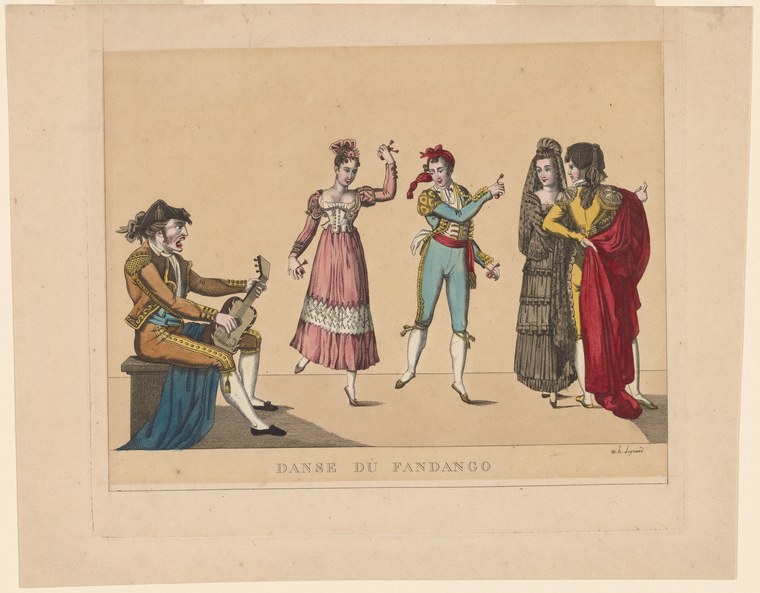
Danse du fandango
Unknown artist
- Collection:
- Prints depicting dance
- Source:
- New York Public Library
- Rights:
- Public domain — free to use, share and adapt.
- Recorded as:
- Public Domain
The fandango was the first Spanish dance to achieve lasting popularity in Northern European courts, and this print is direct evidence of how it was taught, performed, and understood by elites who encountered it as a marker of sophistication and continental taste. For historians of dance dissemination and of European-Spanish cultural exchange, the image documents the specific bodily practices that made the fandango legible and desirable to foreign audiences.
What you are looking at
A hand-colored engraving showing five figures in a studio or performance space with a neutral backdrop. On the left, a seated musician plays a stringed instrument (possibly a guitar or vihuela), wearing ochre and blue garments. Center stage, a woman in a pink dress with white lace hem raises one arm in an expressive gesture, her body in a characteristic contrapposto pose. To her right, a young man in turquoise breeches and yellow jacket gestures with both arms in an animated, theatrical manner. On the far right, two figures in elaborate dress—one in dark patterned fabric and the other in a red cloak—observe the dancers. The composition suggests a moment mid-performance, with the central pair as the active dancers and the figures at right as witnesses or additional participants. The title "DANSE DU FANDANGO" appears in capital letters beneath the image.
The dancing
The two central dancers occupy separate spaces rather than a closed hold. The woman plants her weight on one leg while raising the opposite arm high and back, a posture suggesting the arched, proud carriage of Iberian dance. The man's arms are spread wide and slightly bent, his knees flexed in a more sprightly, bouncing stance. Both figures display the lifted chest and engaged core typical of Spanish court dance. The musician anchors the left edge, and the two observers at right create an asymmetrical but balanced composition that frames the action rather than participating in it.
The dance depicted
This is a fandango, the Spanish couple dance that became fashionable in European courts during the late eighteenth century. The fandango is characterized by quick, lively footwork, hand clapping (castanets in professional performance), and a flirtatious dynamic between partners—though this image shows them dancing separately rather than as a couple. The woman's raised arm and the man's animated gestures are consistent with the dance's reputation for passion and theatrical expressivity. The presence of the live musician confirms this is a dance dependent on instrumental accompaniment (guitar or similar) rather than vocal music alone.
How it was made
This is a hand-colored engraving, a reproductive print technique that allowed rapid dissemination of images across Europe. The line work shows confident control of anatomy and drapery, while the hand-coloring—applied after printing—gives each figure distinct hue and suggests a high-quality, possibly luxury production. The style and technique place it within the late eighteenth-century fashion for prints documenting exotic or newly fashionable dances, intended for collectors and the socially aspirant rather than mass circulation.
About this work
This engraving documents the fandango at the moment of its greatest European vogue, when the Spanish dance captivated aristocratic and upper-middle-class audiences who saw it as thrillingly foreign and sensual. The image captures the dance's essential visual markers—the proud carriage, the animated arms, the separation of the partners—while the inclusion of a live musician grounds it in actual performance practice. It is both a record of how the fandango was danced in European courts and a testament to the appeal of Iberian culture in the age of Enlightenment.
How to look at it
Notice the deliberate separation of the dancers: they are not in contact, which sets the fandango apart from the coupled dances of the French court tradition. Observe the woman's upright carriage and the height of her raised arm—this is not the restrained elegance of a minuet, but a prouder, more self-assertive posture. The man's wide, bent-armed gestures suggest quick weight shifts and a playful courtship dynamic. The musician's presence reminds us that this dance lived through sound as much as sight.
The artist
The artist is not recorded. The print shows the hand and training of a skilled engraver familiar with both anatomy and the conventions of costume and dance documentation, suggesting a professional studio production, possibly German or French, intended for an educated clientele.
The period
The fandango reached peak popularity in European courts between the 1760s and 1790s, when it represented the height of Spanish fashion and the allure of Iberian exoticism. At the same time, the late Enlightenment saw growing interest in documenting national and regional dances as expressions of character and culture. Prints like this one served both as fashion plates and as ethnographic documents, allowing people who had never traveled to Spain to participate in the visual culture of the fandango craze.
Where it lives
Held by the New York Public Library as part of its collection of prints depicting dance. The work is catalogued with minimal metadata, suggesting it entered the collection as a single print rather than as part of a documented series or album.
Dance in this work
Questions about this work
What is the fandango?
The fandango is a Spanish couple dance in triple meter, danced with quick footwork, hand clapping or castanets, and a flirtatious or competitive dynamic between partners. It originated in Andalusia and became fashionable in European courts in the mid-eighteenth century, where it was celebrated as exotic and passionate—a contrast to the restrained etiquette of French court dances.
Are the dancers in contact?
No. Unlike many couple dances, the fandango was often danced with the partners separated or at a distance, engaging in a kind of playful spatial dialogue. They might approach and retreat, but the separated stance shown here is authentic to the period's fandango practice.
Who performed the fandango?
In Spain, the fandango was a folk and professional dance performed in taverns and at celebrations. When it reached European courts, aristocratic amateurs learned it as a fashionable novelty, while professional Spanish dancers also performed it for court audiences. This image likely documents an aristocratic or upper-class performance or lesson.
Why does the musician sit while they dance?
The guitarist or vihuela player provided the rhythmic and melodic foundation for the fandango. Sitting allowed the musician to focus entirely on maintaining the tempo and character that the dancers depended on. The musician and dancers were partners in creating the complete performance.
More dance artwork





