49 works in this view — arrow keys or swipe to move between them.
Dance in Art
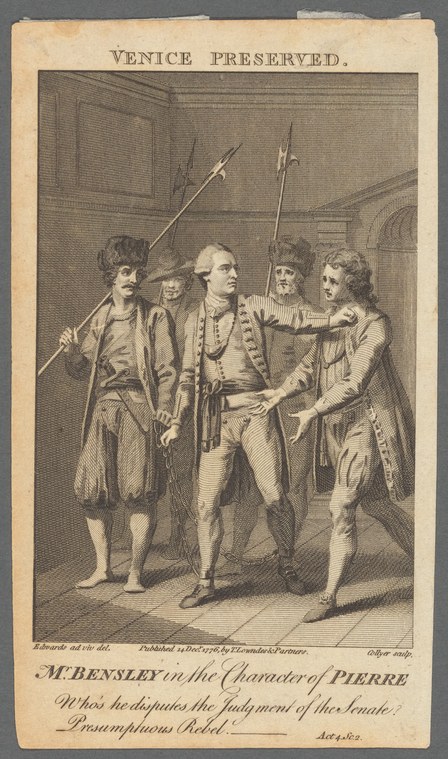
Mr. Bensley in the character of Pierre, Venice preserved
Unknown artist
- Collection:
- Prints depicting dance
- Source:
- New York Public Library
- Rights:
- Public domain — free to use, share and adapt.
- Recorded as:
- Public Domain
This print documents an important theatrical role and performance style at a moment when the boundaries between acting, pantomime, and dance were fluid. For historians of stage movement and theatrical training in the 18th century, it is evidence of how actors used their bodies to convey emotion and moral crisis. The print's circulation and careful composition also tell us that this was considered a culturally significant moment worth preserving and reproducing for a wide audience.
What you are looking at
This engraving depicts a dramatic theatrical moment in an interior setting, likely a palace or grand hall with classical architecture visible in the background. Five figures are arranged in a tense tableau: a man in the center, dressed in 18th-century coat and breeches, is surrounded by four other figures—two youths in light dress on the left and right, and two figures (one of whom appears child-sized) at the center-right. Two of the surrounding figures hold pikes or halberds with sharp points raised threateningly. The central male figure gestures with one hand in a posture of pleading or restraint, his body angled away from the weapons. The composition creates a moment of high dramatic tension: the geometric arrangement of the figures, the upraised weapons, and the central figure's defensive posture suggest a scene of confrontation, judgment, or violent threat. The engraving's fine cross-hatching and use of light and shadow emphasize the gravity of the moment.
The dancing
The central male figure stands in a contrapposto stance with weight shifted, one arm extended in an imploring gesture toward the figures surrounding him. His body angle and arm position suggest either supplication or an attempt to shield himself from the raised weapons. The two youths flanking him are posed more upright and static, while the smaller figures near the center-right appear to be in supporting or accusatory positions. There is no dance-like frame or partnered hold; the arrangement is theatrical and hierarchical rather than choreographic, with the central figure isolated and the others arrayed around him as a collective force.
The dance depicted
This image does not depict social dance. It is a theatrical or dramatic scene, most likely from a 18th-century stage production. The title references *Venice Preserved*, a tragic play by Thomas Otway (1682), and identifies the character as Pierre—a revolutionary conspirator. The engraving documents a moment of political or personal crisis within the narrative: Pierre confronted by armed guards or executioners. The gestures and positioning are those of dramatic acting and pantomime rather than codified dance movement, though 18th-century theatrical performance did incorporate stylized movement and gesture that bordered on the balletic. No specific dance style is identifiable in this work.
How it was made
This is an engraving, identifiable by the fine parallel lines (cross-hatching) used to build tone and shadow, and the sharp, precise line work characteristic of intaglio printing. The technique allowed for high-quality reproduction and wide circulation, and the inscription at the bottom indicates it was published for a theatrical audience—likely as a souvenir, advertisement, or record of a notable performance. The engraving's formal composition and careful rendering of costume detail and facial expression suggest it was created to document or immortalize a celebrated actor's performance in a specific role.
About this work
This is an engraving documenting a dramatic moment from Thomas Otway's 1682 tragedy *Venice Preserved*, showing the actor Mr. Bensley performing the role of Pierre, a republican conspirator facing judgment and threat. The work is part of the prints-depicting-dance collection, though it records theatrical drama rather than dance proper. It belongs in a dance gallery because 18th-century theatrical performance was a continuum: trained actors used codified gesture, pantomime, and stylized movement that drew from the vocabulary of dance, and because theatrical prints such as this shaped how dance and dramatic movement were understood and circulated in the period. The engraving is evidence of how the body was posed, framed, and made meaningful on the stage in an era when gesture was as important as spoken text.
How to look at it
Attend to the positioning of the central figure: the angle of his body, the extension of his arm, the way his weight shifts away from the threat—these are the language of 18th-century gesture acting. The raised weapons and the surrounding figures create a geometric composition that forces the eye to the vulnerable center. Notice too the detail of costume: the coat, the breeches, the neat hair suggest a character of rank and dignity brought low by circumstance. The engraver has frozen a moment of maximum dramatic intensity—not action, but the moment just before or during crisis, where all the power lies in posture and the play of light.
The artist
The engraver is not recorded. The inscription states the work was 'Published as the Act directs by [H?] and Furnivall,' suggesting commercial publication in the London theatrical print market. Prints of celebrated actors in famous roles were a major genre in 18th-century Britain, created rapidly to capitalize on popular performances and distributed through booksellers and theatrical venues. The quality of this engraving and the care taken with costume and physiognomy suggest it was made by a skilled practitioner working within the established convention of theatrical portraiture.
The period
This engraving dates to the late 18th century (the record gives no specific date, but the style and publication method point to the 1780s–1790s). *Venice Preserved* was a staple of the English stage and a vehicle for star actors throughout this period. The engraving belongs to a larger culture of theatrical commemoration: prints of actors in famous roles were collected, traded, and displayed much as photographs and playbills would be later. The 18th century was also the moment when ballet and theatrical dance were becoming codified as distinct arts separate from dramatic acting, yet the use of stylized gesture and movement remained central to both. This print sits at that intersection: it records a dramatic scene but one executed by a trained performer whose body language would have been as carefully studied and rehearsed as any dance movement.
Where it lives
This print is held in the New York Public Library's collection of prints depicting dance. Such theatrical prints were typically published in London by theatrical booksellers and printers; the inscription suggests commercial distribution, which would have made them accessible to a broad audience of theatre-goers and print collectors.
Questions about this work
Who was Mr. Bensley?
Henry Bensley was an English actor active in the late 18th century, known for roles in tragedy and serious drama. He performed at major London theatres including Drury Lane and Covent Garden. This engraving preserves a record of his interpretation of the role of Pierre, a character central to one of the period's most performed plays.
What is Venice Preserved about?
Thomas Otway's *Venice Preserved* (1682) is a tragedy centred on a conspiracy to overthrow the Venetian republic. Pierre is a republican conspirator caught between political conviction and personal loyalty. The play was enormously popular on the 18th-century English stage, revived repeatedly, and known for spectacular staging and opportunities for male actors to display emotional and physical virtuosity.
Why is a theatrical print in a dance collection?
In the 18th century, dance and theatrical acting shared a common vocabulary of trained, stylized movement and gesture. Actors used their bodies as precisely as dancers did, and prints such as this document the performance conventions of the era. Including theatrical prints helps show the context in which theatrical dance developed and how movement was understood across different performance genres.
How was this print made?
This is an engraving, created by incising fine lines into a metal plate (usually copper) with a pointed tool. Ink is then applied to the plate, wiped clean from the surface, and the inked lines are transferred to paper under pressure. Engravings allowed for fine detail and were well-suited to theatrical portraiture. This print was likely made shortly after the performance to capitalize on public interest in the actor and role.
More dance artwork





