49 works in this view — arrow keys or swipe to move between them.
Dance in Art
Festivities and spectacles
Unknown artist
- Collection:
- Prints depicting dance
- Source:
- New York Public Library
- Rights:
- Public domain — free to use, share and adapt.
- Recorded as:
- Public Domain
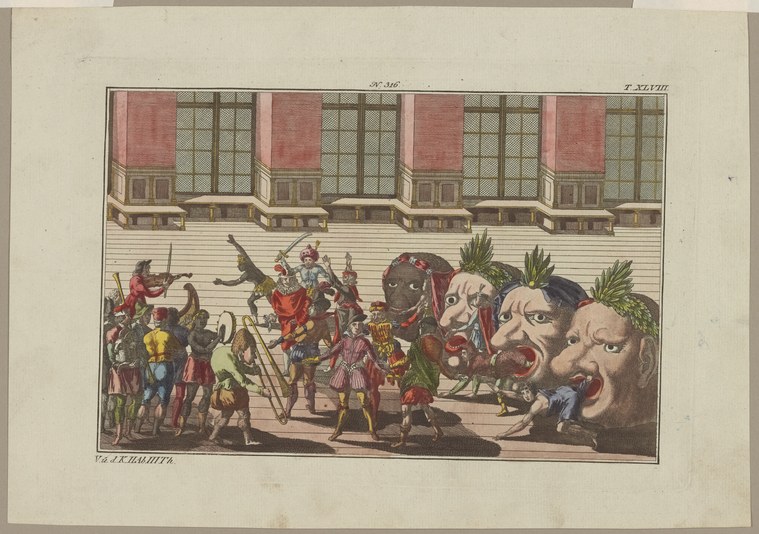
This print documents the spectacular and grotesque tradition of carnival—a cultural practice that paralleled and contrasted with codified courtly dance. For dance historians, it reveals the full spectrum of movement culture: formal dance existed alongside and in tension with carnival's anarchic, masked, mechanized alternatives. The scale and the grotesquerie suggest how early modern festivity used the body and the theatrical apparatus to create spectacle through distortion rather than through trained movement.
What you are looking at
A carnival or theatrical procession unfolds before a classical building with large windows and rusticated stonework. At left, a crowd of costumed figures in mixed dress—some in plumed or elaborate costume, others in simpler garb—watch or participate in the spectacle. At center and right, the focal point: three enormous grotesque heads, painted or carved with exaggerated features—bulging eyes, gaping mouths, protruding teeth—dominate the composition. These heads are mounted on tall supports and appear to be wheeled or carried as part of a parade vehicle or pageant car. The figures below and around them are dwarfed by these constructions. The palette is warm—ochres, reds, and flesh tones—with gold accents on the architecture. The action suggests movement and noise: the small figures gesture, point, and mill about in response to the spectacle. This is a moment of public festivity, likely civic or religious carnival, where elaborate mechanical or costume-based theatrical elements were paraded through urban streets.
The dancing
The human figures are rendered small and individually varied. Some stand in profile, others face forward or turn; a few gesture upward or outward toward the giant heads with arms raised or extended. None are engaged in codified dance postures—there are no couples in hold, no synchronized lines, no recognizable dance frame. The crowd appears to be spectators and participants mingling, some in costume (feathered caps, varied dress), some in plainer clothes. The scale relationship is theatrical and deliberately distorting: the human body is subordinate to the grotesque props. This is processional and carnivalesque rather than ballroom or staged dance.
The dance depicted
This is not a depiction of choreographed dance but of carnival festivity and pageantry. The 'dancing' if it occurs here is incidental to the spectacle—the movement is that of a procession, a crowd responding to elaborate theatrical machinery and grotesque masks. The image documents the type of civic or religious festival (likely 16th or 17th century Italian or Northern European) in which masked figures, mechanical heads, and costumed characters paraded through streets as entertainment. The figures move in relation to the spectacle rather than executing any recognized dance form. This is evidence of how carnival festivities and theatrical pageantry differed from courtly or social dance of the same era.
How it was made
This is a hand-colored engraving or woodcut, executed in the Northern European tradition of the 16th or 17th century. The fine linear hatching visible in the shadows, the crisp outlines, and the careful perspective rendering of the building are characteristic of engraved print technology. The color—applied by hand after printing—uses translucent washes that sit on top of the black line work. This technique allowed wide circulation: multiple impressions could be produced from a single plate and colored by workshop hands or collectors. The popularity of such festivity prints suggests they were documentation and celebration of actual civic events, sent to other courts and cities as records of spectacle.
About this work
This hand-colored engraving documents a carnival or civic festival featuring grotesque masked heads mounted on parade machinery, surrounded by costumed and ordinary figures. It belongs to a significant tradition of 16th–17th century Northern European prints recording public spectacle and theatrical festivity. The work is not a record of dance but of the carnivalesque and mechanical theater that often accompanied or replaced organized dance in public ceremony. It shows how elaborate costume, scale distortion, and grotesque figuration created wonder and disorder as alternatives to the geometric control of courtly dance. The image matters because it reveals what Renaissance and early modern people considered festive spectacle: not the minuet or the pavane but the grotesque, the mechanical, the processional, and the anarchic.
How to look at it
Attend first to the scale relationship: the human body is deliberately minimized against the grotesque architectural props. Notice how the heads are painted with exaggerated features—bulging eyes, gaping mouths, teeth—that would be impossible in human anatomy. The crowd's gestures suggest amazement, participation, and movement, but no organized choreography: this is the chaos of carnival, not the order of dance. The perspective and the careful rendering of the building ground the spectacle in a real or plausible urban setting, suggesting this is a record or idealization of an actual public event rather than pure fantasy.
The period
This work dates to the 16th or 17th century, a period when both courtly dance and civic carnival were flourishing in Europe. The Renaissance court fostered choreographed, geometric dance (pavanes, galliards, branles) as demonstrations of order and control. Simultaneously, carnival—particularly in Italian and Germanic cities—preserved older, anarchic traditions of masking, grotesquerie, and mechanical spectacle. These existed in productive tension: carnival was the licensed space for inversion, excess, and disorder, while the court danced order and measure. Northern European prints like this one served to circulate knowledge of spectacular events to distant courts, functioning as both documentation and fantasy.
Where it lives
The work is part of the New York Public Library's collection of prints depicting dance and spectacle. It is catalogued as a dance-related work, though it documents festivity and pageantry rather than choreographed dance proper.
Questions about this work
Is this a dance scene?
Not in the formal sense. This is a carnival or civic procession featuring grotesque masked heads and mechanical theatrical elements. The figures move in relation to the spectacle rather than executing any choreographed dance form. It documents the broader culture of public festivity that coexisted with courtly dance.
What are those giant heads?
Likely painted wooden or fabric heads mounted on tall supports or wheeled pageant cars. They are grotesque caricatures—exaggerated, comic, and designed to provoke wonder or laughter. Such mechanical marvels were common in Renaissance and early modern civic festivals and religious processions.
What country and period is this from?
The style, composition, and iconography suggest Northern Europe (possibly German or Flemish) in the 16th or 17th century. The engraving technique and the hand coloring are consistent with that tradition. Without a signature or inscription, a precise attribution is not possible.
Why would a dance collection hold this?
Because movement culture encompasses more than codified dance forms. Carnival, procession, and public spectacle were central to how early modern bodies moved together in social space. This print reveals what festivity looked like before modern concepts of choreography.
More dance artwork





