49 works in this view — arrow keys or swipe to move between them.
Dance in Art
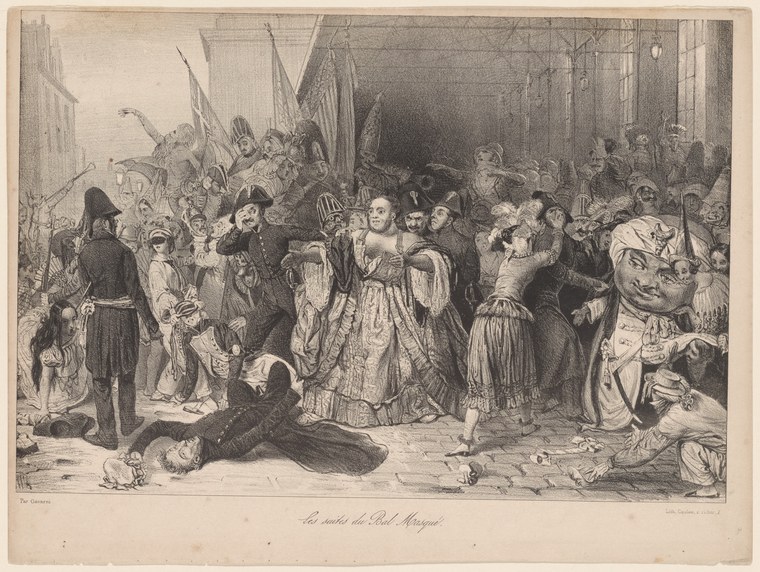
Les suites du bal masqué
Unknown artist
- Collection:
- Prints depicting dance
- Source:
- New York Public Library
- Rights:
- Public domain — free to use, share and adapt.
- Recorded as:
- Public Domain
Masquerade balls were a distinctive 18th-century social institution that fundamentally shaped how dance was understood—not as art to be watched but as social practice enabling transformation and license. This print preserves evidence of how dance and costume created spaces for social mobility and role-play, a dimension largely absent from formal ballet documentation.
What you are looking at
A crowded masquerade ball in full revelry, viewed from slightly elevated vantage point. The composition is densely packed with figures in fancy dress and masks, occupying a columned interior space with dramatic chiaroscuro lighting—bright areas suggest candlelight, while shadows pool in the architectural recesses. In the foreground, figures in ornate 18th-century costume mill about; a woman in an elaborate pale gown with panniers stands centrally, surrounded by masked revellers in silks and satins. A man in black with a tricorn hat is visible to the left. The middle ground shows more densely clustered dancers and promenaders; the background is rendered in shadow with glimpses of columns and architectural detail. Several figures are seated or reclining in the foreground, creating depth and narrative incident. The overall effect is one of controlled chaos—a moment of peak festivity with figures in various poses of conversation, flirtation, and movement.
The dancing
Bodies are arranged in social clusters rather than in coordinated dance formations. Most figures stand upright in conversational groups; many wear masks and hold them to their faces or at their sides. A few central figures are more dynamically posed, with arms raised or extended in gesture. The woman in the pale gown has one arm extended in what may be a dancing gesture, though the pose is ambiguous—equally plausible as theatrical gesture or social address. Weight is distributed across multiple figures in no unified stance; this is a ballroom gathering rather than a synchronized corps. No visible partner holds, closed positions, or coordinated footwork; the energy is social rather than choreographic.
The dance depicted
This depicts a masquerade ball—a social dance event rather than a staged theatrical performance. The title 'Les suites du bal masqué' (The Consequences of the Masked Ball) suggests this is one of a series of prints documenting the moral or social aftermath and incidents of such an event. While couples and groups may be dancing, the print emphasizes the social chaos, flirtation, and transgressive freedom that masked balls afforded. The dress and setting indicate an 18th-century Parisian context, when such balls were fashionable entertainments combining minuet, cotillion, and country dances in a context where anonymity and costume permitted social license impossible in formal court settings.
How it was made
This is an engraving or etching, identifiable by the linear hatching technique used to build tone and shadow, the precise linear rendering of architectural detail, and the characteristic parallel-line cross-hatching in the shadow areas. The medium allowed fine detail in costume and facial expression (where visible) and could be reproduced multiple times, making this a mass-produced print for popular consumption. The careful composition despite the crowded subject suggests this is the work of a practiced printmaker, not a documentary sketch. Engravings of this period were expensive enough to circulate among educated buyers but accessible to a broader audience than unique paintings, suggesting this was aimed at collectors interested in contemporary social life and fashion.
About this work
This engraving documents a masquerade ball, one in a narrative series exploring the social intrigue, transgression, and aftermath such events enabled in 18th-century Paris. The print captures the distinctive social condition of the masked ball—a space where conventional hierarchy, gender roles, and decorum could be suspended. Rather than choreographically analyzing a formal dance, it records the social dance of flirtation, revelation, and costume play. The work belongs in a gallery of dance in art because it depicts how dance functioned in 18th-century aristocratic life not as staged performance but as social practice: a context for courtship, transgression, and the performance of identity.
How to look at it
Attend to the multiple moments frozen simultaneously in this dense composition: conversations, gestures, the woman's extended arm, the prone figures, the architecture framing the event. The engraver has chosen to depict not the formal beginning of a dance but the peak of social chaos and pleasure—the moment when order has dissolved into spectacle. Notice how costume and mask are emphasized; the fancy dress is as much the subject as any movement. The linear hatching technique creates dramatic shadow, investing ordinary social encounter with theatrical weight and moral gravity.
The artist
Unknown. The print is unsigned or the attribution is not recorded. The style is consistent with mid-to-late 18th-century French engravings documenting contemporary social life. The series format ('Les suites du bal masqué' implies multiple prints) suggests a commercial publishing venture aimed at capturing fashionable Parisian society.
The period
The masquerade ball was a fashionable entertainment in 18th-century Europe, particularly in Paris and Venice. These events occupied an ambiguous social space: they were entertainments of the aristocracy and wealthy bourgeoisie, yet the anonymity afforded by mask and costume created possibilities for social transgression and role reversal. The popularity of the masquerade in visual culture—satirical prints, theatrical treatments, and moral commentary—reflects anxieties about social order, gender, and propriety. Prints documenting the consequences and incidents of such balls were popular commodity items, often satirical or morally charged. Contemporary dance in such settings combined courtly dances (minuet, cotillion) with newer ballroom forms, but social interaction and flirtation were as important as choreography.
Where it lives
Held in the Prints collection at the New York Public Library. Described as depicting dance; the collection comprises prints and engravings documenting dance in various contexts.
Questions about this work
What is a masquerade ball and why would it be depicted in art?
Masquerade balls were fashionable 18th-century entertainments where guests wore masks and costumes, creating temporary anonymity and social license. They were depicted in prints and paintings because they represented a transgressive space where normal social rules could be suspended—a subject of both fascination and moral concern. Artists and printmakers captured these events to appeal to viewers' curiosity about the fashionable world and to satirize or moralize about the social disorder they enabled.
Is this a depiction of choreographed dance or social dancing?
Primarily social dancing in a context that permitted transgression and role play. While formal dances like the minuet and cotillion would have been performed at masquerade balls, this print emphasizes the social chaos, flirtation, and costume play rather than any specific choreography. The multiple simultaneous moments—conversations, gestures, people seated or reclining—indicate the printmaker was interested in the social event as a whole rather than the formal structure of the dances within it.
What does the title 'Les suites du bal masqué' mean and why does it matter?
'Les suites' means 'the consequences' or 'the aftermath.' This suggests the print is part of a series tracking not the ball itself but its social consequences—the affairs, scandals, or moral fallout it generated. This framing indicates the print had a satirical or moralistic purpose, using the masquerade as a lens through which to examine contemporary society.
More dance artwork





