49 works in this view — arrow keys or swipe to move between them.
Dance in Art
Pepita de Oliva
Unknown artist
- Collection:
- Prints depicting dance
- Source:
- New York Public Library
- Rights:
- Public domain — free to use, share and adapt.
- Recorded as:
- Public Domain
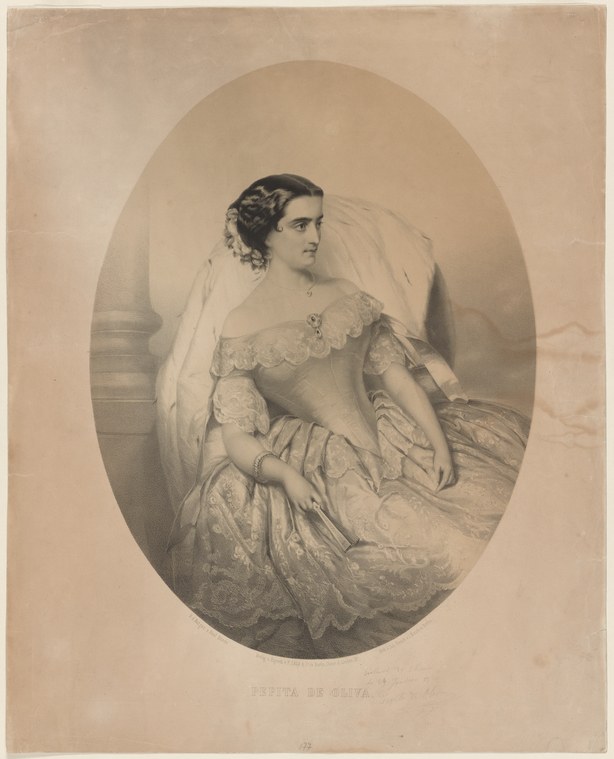
This portrait is valuable to dance historians as evidence of celebrity culture around performers, the visual language used to market dancers (especially women) in mid-nineteenth-century theatre, and the specific style conventions of theatrical dress and presentation in that period. The careful rendering of costume—the lace, the veil, the fit of the gown—tells us what counted as desirable feminine presentation on stage at the time, and how portraiture participated in that construction.
What you are looking at
A young woman in an elaborate mid-nineteenth-century ball gown sits in a three-quarter pose, gazing toward the left. She wears a white or cream silk dress with a fitted, off-shoulder bodice adorned with delicate lace and ribbon trim, and a voluminous skirt of layered tulle or similar fabric that extends to the floor. A gossamer veil is draped loosely over her dark hair, which is parted and pulled back in the style of the 1840s-50s. She reclines in an attitude of studied elegance against cushioned upholstery, one arm resting naturally across her lap. The background is a soft, warm tone with the faintest suggestion of drapery or interior setting, rendered through stippled engraving technique. The title inscribed below identifies her as 'Pepita de Oliva.' The entire composition is framed within an elegant oval border, a standard format for theatrical portraiture of the era.
The dancing
A single figure dominates the image. The woman's posture is contemplative rather than active—her body is relaxed, weight settled into the seat, with no indication of movement or balletic tension. Her arms are not raised or extended in any position recognizable from dance vocabulary; instead they rest passively at her sides and across her lap. Her head is turned slightly, offering a three-quarter view that was the standard angle for mid-century theatrical portraits. There is no suggestion of turnout, lifted épaulement, or other technical markers of balletic training visible in the pose.
The dance depicted
This is a portrait of a performer, not a depiction of dance itself. Pepita de Oliva was a Spanish dancer and actress prominent in mid-nineteenth-century European theatre, particularly known for roles in romantic and dramatic works. The image captures her as a subject of celebrity portraiture rather than in performance or rehearsal. While her profession was dance—likely both classical ballet and theatrical roles in the Spanish tradition—nothing in this particular image shows her dancing or even adopting a dancer's frame. It is a drawing-room portrait that happens to commemorate a dancer, not a choreographic or kinetic record.
How it was made
This is a steel or copper engraving, rendered in the stipple and line technique characteristic of fine theatrical portraiture from the 1840s-1850s. The technique—thousands of tiny dots and fine lines built up to create tone and texture—was expensive and time-consuming, which meant such images were produced primarily for established performers with commercial appeal. The oval framing mat and formal presentation indicate this was a standalone print, likely sold separately as a theatrical souvenir or included in theatrical periodicals. The soft, flattering rendering and careful attention to costume detail are hallmarks of mid-century commercial dance portraiture.
About this work
This is a celebrity portrait of a nineteenth-century Spanish performer, rendered as a steel engraving in the refined stipple technique of the 1840s-50s. Pepita de Oliva, identified in the inscription, was a working dancer and actress of her era, and this image documents her as a public figure and fashion icon rather than as a performer in motion. It sits at the intersection of dance history, theatrical portraiture, and the commercial culture of celebrity that developed around performance in the industrial era. The work belongs in a dance gallery not because it shows dancing, but because it shows who dancers were, how they were marketed, and how the body of the performer—even at rest—was constructed as a spectacle.
How to look at it
Notice the restraint and formality of the pose. This is not a theatrical 'attitude' or a moment of dramatic action, but a studied arrangement designed to flatter and idealize. The costume—the lace, the veil, the precise arrangement of the skirt—is the real subject; the body is its display case. Observe how the engraver has used tone and texture to create an impression of luxury and refinement: the soft shadow on the cushions, the delicate cross-hatching on the lace, the subtle gradations in the fabric. This was a luxury product designed to preserve the image of a famous performer for those who could not see her in person.
The artist
The engraver is not recorded in the catalogue. The print was produced as a commercial theatrical portrait, likely by a London or Paris publishing house specializing in theatrical prints. Such works were often the product of workshops where multiple hands contributed—a painter or lithographer would create the design, and an engraver would translate it into the fine line-work and stipple required for mass production. The oval format and careful attention to physiognomy and dress suggest a commercially successful print shop with experience in theatrical portraiture.
The period
This portrait dates from the height of the Romantic era in ballet and theatre (likely 1840s-1850s), when the image of the ethereal, elegantly melancholic female performer dominated European culture. This was the era of the Romantic tutu, pointe work, and the cult of the ballerina as an unattainable ideal. Simultaneously, lithographic and engraved portraiture had become a major industry: theatrical prints were cheap enough to circulate widely among middle-class theatre-goers but fine enough to hang in drawing rooms. Spanish performers like Pepita de Oliva occupied a particular niche—associated with dramatic roles, national color, and exotic glamour—and were intensely promoted through such portraiture.
Where it lives
This print is held in the New York Public Library as part of a broader collection of prints depicting dance. It is a standalone engraved portrait, likely produced and circulated in the mid-nineteenth century as a separate theatrical souvenir or as part of a series of theatrical celebrity portraits.
Questions about this work
Was Pepita de Oliva a ballerina?
The record does not specify her precise discipline. She was a Spanish performer active in mid-nineteenth-century theatre, likely trained in both classical ballet and theatrical dance. Spanish performers of her era often worked across multiple genres—ballet, opera-ballet, dramatic roles in dance-heavy plays. This portrait alone does not indicate whether she was primarily a ballet technician or a dramatic performer who danced.
Why is she not dancing in this portrait?
Celebrity portraiture of the era typically presented performers in fashionable dress and a relaxed pose, not in action. The goal was to capture their likeness, document their beauty, and showcase the luxury of their stage costumes. Action portraits existed, but they were less common and harder to execute in engraving. This image serves as a souvenir and a marker of her fame.
What does the veil mean?
The veil was a fashionable accessory in the 1840s-50s, worn by respectable women in both theatre and society. On stage, it could signal various roles—a bride, a romantic heroine, a woman in mourning. Here it simply adorns her without narrative context, adding an air of mystery and elegance consistent with the Romantic aesthetic.
More dance artwork





