49 works in this view — arrow keys or swipe to move between them.
Dance in Art
Pia Ricci (fac. sig.)
Unknown artist
- Collection:
- Prints depicting dance
- Source:
- New York Public Library
- Rights:
- Public domain — free to use, share and adapt.
- Recorded as:
- Public Domain
This work matters to historians of early 19th-century dance and theater only if Pia Ricci was indeed a documented performer of that era. The portrait preserves her image and the material culture of her time, but the image does not itself show us how she danced or what her practice entailed. Without additional documentation linking her name to specific performances, the work remains a formal portrait of uncertain significance to dance history.
What you are looking at
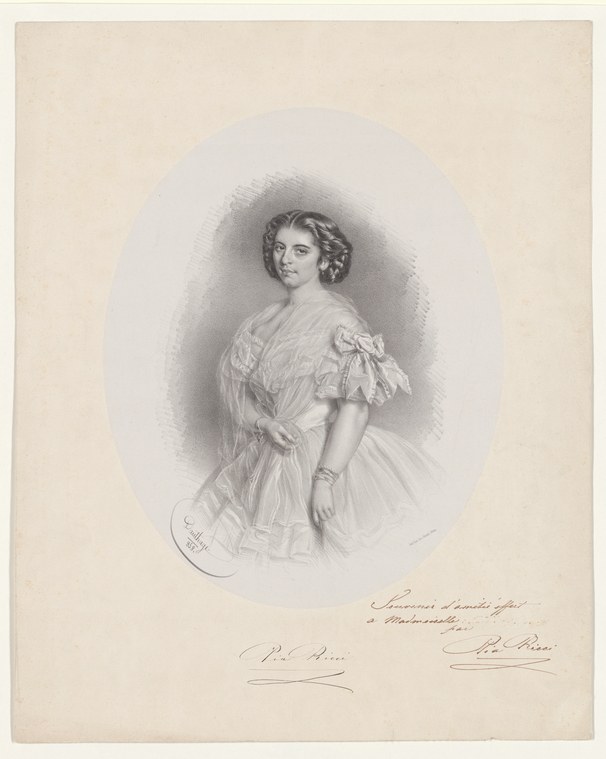
A single female figure in three-quarter view occupies the center of an oval composition, rendered in fine graphite or crayon on paper. She wears a voluminous white or pale silk dress with off-shoulder puffed sleeves and a fitted bodice, typical of early 19th-century evening wear. The dress flows to the ground in gathered folds; her posture is upright and composed, with one arm relaxed at her side and the other bent naturally before her. Her hair is arranged in the fashionable ringlets of the period, pulled back from her face. The figure is set within a soft oval vignette that fades into an unworked cream ground, suggesting atmospheric depth. The entire composition is a formal portrait study rather than a narrative scene — there is no setting, no other figures, no indication of movement or music.
The dancing
The woman stands in a relaxed contrapposto stance with weight evenly distributed; there is no sign of active dance posture or turned-out legs. Her arms hang naturally; there is no frame, hold, or arm position characteristic of any dance technique. Her body is presented frontally in the manner of a portrait rather than in the angled, engaged positions used to depict dancers in action. She is a single stationary figure.
The dance depicted
The image does not depict dance. The woman is posed as if for a portrait, in the formal stance appropriate to early 19th-century society portraiture. There is no choreography, no movement, no costume or setting identifying her with a particular dance or dance scene.
How it was made
This is a graphite or chalk drawing, likely a portrait study made from life or a preparatory work for an engraving. The soft tonal modeling of the face and the fine linear work describing the dress folds indicate skilled draftsmanship in the academic tradition. The oval vignette format is characteristic of printed portraits of the period — this may be a drawing intended as the basis for a reproductive engraving or lithograph for circulation, a common practice in early 19th-century portrait studios.
About this work
This is a formal portrait drawing of a woman in early 19th-century dress, rendered in the neoclassical style. The figure has been identified in the catalogue as Pia Ricci, though the artist remains unrecorded. It is a document of elite fashion and portraiture of its era rather than a representation of dance. The drawing's inclusion in a dance collection may reflect confusion with similar compositions, or may record that the subject was known as a performer or dancer of the period — but the image itself contains no dance content.
How to look at it
This is not an action portrait. The viewer should attend to the dress as historical evidence — the cut, the materials, the ornament — and to the portraitist's technique in rendering the fabric and the face. The oval vignette and the neutral ground are conventions of the period's portrait drawing, a format designed for reproductive printing. The stillness of the pose is itself the point: this is how a woman of standing presented herself.
The artist
The artist is not recorded in the catalogue. The drawing's quality and the professional finish of the vignette suggest a trained portraitist working in the academic tradition of the early 19th century, possibly preparing work for reproduction. Without inscription, signature, or documentation, the creator cannot be identified from the image alone.
The period
The dress and hairstyle place the work firmly in the 1820s–1840s. This was a period of flourishing theatrical and social dance — Romantic ballet was emerging, and social dancing in ballrooms and theaters was central to urban leisure. If Pia Ricci was a performer, she would have worked in this context. However, the formal portrait tradition of the period was equally strong, and most such drawings were made of respectable women regardless of their profession or celebrity.
Where it lives
The work is held in the New York Public Library's collection of prints depicting dance. It arrived there via an acquisition that grouped it with other dance-related imagery, but the catalogue record does not specify the circumstances of acquisition or the collection's original context. An inscription visible in the lower portion of the image appears to include a signature or attestation, but is not fully legible in the reproduction.
Questions about this work
Was Pia Ricci a dancer?
The catalogue does not confirm this. The name appears to be Italian, and women with that name are documented in Italian and European performance histories of the early 19th century, but the collection record does not establish her profession or whether she was a dancer, actress, or merely a society figure.
Why is this portrait in a dance collection?
The cataloguing decision is not explained. It may reflect a known connection between Pia Ricci and theatrical performance that is not noted in the basic record, or it may be an error in classification. The image itself contains no dance content.
Could this be a costume study for a theatrical role?
The dress is fashionable day or evening wear of the period, not a stage costume. If Ricci performed, this portrait appears to document her as a person rather than as a character or in a role.
More dance artwork





