49 works in this view — arrow keys or swipe to move between them.
Dance in Art
Folk and ethnic dancing in wood engravings
Unknown artist
- Collection:
- Prints depicting dance
- Source:
- New York Public Library
- Rights:
- Public domain — free to use, share and adapt.
- Recorded as:
- Public Domain
This work has no relevance to the history or study of dance. Its inclusion in a dance collection suggests either a cataloguing error or an unusual institutional definition of 'dance' that extends to animal movement or kinetic energy in general.
What you are looking at
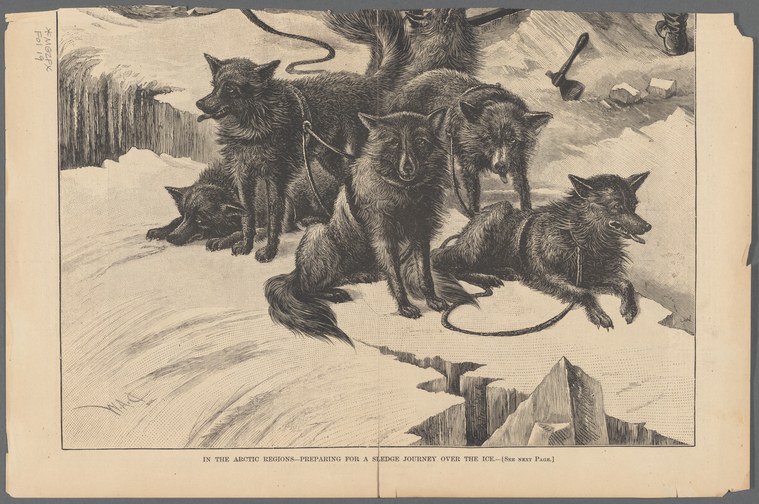
A wood engraving depicting a team of sled dogs in harness, positioned in a snowy Arctic landscape. Five dogs are shown in active pulling formation, their bodies leaning forward into their traces with visible muscular tension. The dogs wear harnesses connected by rope to what appears to be a laden sled (visible at lower right). The setting is spare and monochromatic—white snow dominates the composition, with dark hatching indicating shadows and terrain features. A wooden structure, possibly a cabin or cache, appears at left. The engraving's title indicates this depicts preparation for a sledge journey across ice, and the artist has captured the dogs in a moment of readiness or strain, their heads alert and bodies angled to suggest imminent or ongoing movement. The technique creates strong contrasts between the dogs' dark fur and the surrounding snow.
The dancing
The dogs display the characteristic posture of sled animals in harness—bodies extended, legs positioned to engage forward momentum, heads raised. The team's configuration suggests a multi-dog trace arrangement typical of Arctic travel. The artist has differentiated individual animals while maintaining compositional unity, and the rope work and harness details are rendered with precision. The nearest dog (foreground left) shows particular anatomical clarity. There is no human figure visible, leaving the focus entirely on the canine team.
The dance depicted
This is not a dance work. The image depicts working animals—sled dogs—not human dancers or choreographed movement. The catalogue assigns it to a dance collection, but the content is purely zoological and utilitarian. The 'dancing' or rhythmic quality some may perceive in the dogs' postures is incidental to their function as draft animals. This appears to be a significant cataloguing error.
How it was made
Wood engraving, a relief printing technique in which an image is carved into the end-grain surface of a hardwood block. The fine parallel lines (hatching) visible throughout create tone and shadow; the white of the paper forms the brightest areas. Wood engraving permits great detail and precise linework, as seen in the fur texture and harness elements here. This technique was widely used for book and periodical illustration in the 19th century, suggesting the work was created for serial publication rather than as a standalone print. The style and subject matter indicate a likely date in the mid-to-late 19th century, during the period of intensive Arctic exploration.
About this work
This is a wood engraving of Arctic sled dogs in harness, titled as preparation for a sledge journey over ice. It documents a utilitarian working scene rather than human dance or choreography. The work belongs to a long tradition of Arctic exploration imagery in European and North American print culture, and the technical precision of the wood engraving—the careful rendering of individual dogs, harness, and landscape—suggests it was created for illustrated periodicals or travel narratives popular in the Victorian era. The assignment of this work to a dance collection appears to be an error of cataloguing or collection policy.
How to look at it
Attend to the artist's rendering of animal musculature and posture—the extended bodies and forward-leaning stance convey the strain and force of pulling. The engraver has used fine parallel lines to suggest fur texture and to create tonal variation across the snow and landscape. Note how the composition directs the eye along the line of the dogs' bodies and traces, creating a sense of directional movement despite the static medium.
The period
The mid-to-late 19th century saw intense European and American interest in Arctic exploration, following the search for the Northwest Passage and the race to the poles. Illustrated periodicals and travel narratives generated demand for precise, detailed imagery of Arctic conditions, wildlife, and travel methods. Wood engraving was the dominant reproductive technology for such illustration before photomechanical processes became standard. The style and subject matter place this work squarely in that tradition.
Where it lives
The work is held as part of the New York Public Library's collection of prints depicting dance. The source attribution and the dance classification suggest it may have arrived as part of a broader collection donation or may reflect a cataloguing convention now outdated.
Questions about this work
Why is this in a dance collection?
The cataloguing record lists this as a folk and ethnic dance image, but the work depicts sled dogs, not human dancers. This appears to be a cataloguing error. It is possible the collection includes works on movement or kinetic subjects more broadly, or that the work was misfiled when the collection was organized.
What does the title mean?
The engraving is titled 'In the Arctic Regions—Preparing for a Sledge Journey over the Ice.' It documents the practical preparation of a dog team for travel across frozen Arctic terrain, likely in the context of polar exploration.
How old is this engraving?
The catalogue record gives no date. Based on the style of the engraving, the subject matter (Arctic exploration), and the printing technique (wood engraving), it was likely created in the mid-to-late 19th century, possibly 1850–1900, for publication in an illustrated periodical or travel narrative.
More dance artwork





