49 works in this view — arrow keys or swipe to move between them.
Dance in Art
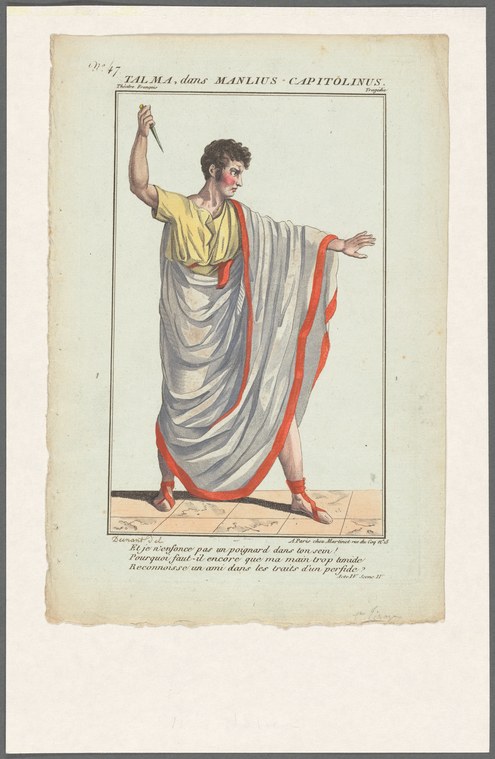
Talma, dans Manlius Capitolinus, no. 47, Théâtre Français, tragédie
Unknown artist
- Collection:
- Prints depicting dance
- Source:
- New York Public Library
- Rights:
- Public domain — free to use, share and adapt.
- Recorded as:
- Public Domain
Talma was one of the most influential tragic actors of his generation and a reformer of French classical acting; this image preserves a role and a style of performance that shaped European theatre. The pose and costume reveal how 'dance' and gesture functioned within classical tragedy as a unified language of the body—not entertainment but a fundamental tool of dramatic expression, worthy of the same artistic attention given to choreographed movement.
What you are looking at
A single male dancer in classical dress is captured mid-performance against a plain background. He wears a yellow tunic draped with a grey-white himation (classical cloak) edged in red, the fabric swept dramatically across his body and raised in his left hand. His right arm extends outward in an open, declarative gesture. His weight appears shifted, suggesting arrested motion—the pose suggests oratorical or heroic utterance rather than pure dance movement. The figure stands on a shallow tan floor line, rendered in a tinted engraving with hand-coloured detail. The composition is frontal and formal, the figure isolated and monumental, filling the frame. Text above identifies the performer and role; lines of French verse below remain partially legible.
The dancing
The dancer's body is upright and commanding, weight on one leg with the other subtly positioned. The left arm cradles the cloak material while simultaneously raising it to chest height in a rhetorical gesture; the right arm is extended sideways, open-palmed and outward-facing, as if addressing or appealing to an audience. The pose is fundamentally static and frontal, with emphasis on the arm and upper torso rather than footwork or travelling movement. This is a dancer frozen in a moment of expression or declamation rather than executing a step.
The dance depicted
This appears to document a performance by the celebrated actor-dancer François Talma in the tragic role of Manlius Capitolinus, a neoclassical tragedy likely by Plutarch or adapted for the Théâtre Français. The pose and costume suggest this is staged in the style of French classical theatre of the late 18th or early 19th century, where male roles combined oratory, mime, and stylised movement within an elevated dramatic idiom. The 'dance' here is more properly theatrical gesture and heroic stance—the language of classical tragedy as performed on the French stage—than vernacular or ballroom dance. Talma was known for reforming tragic acting through enhanced physicality and naturalism, and this image may capture that transitional moment.
How it was made
This is a hand-coloured engraving, characteristic of theatrical documentation from the revolutionary and Napoleonic periods in France. The print technique allowed rapid circulation of performance images among theatre-goers and the educated public, creating a record of celebrated actors and roles. The engraved line is fine and controlled; the hand-colouring—particularly the warm yellow of the tunic and the bright red of the cloak edge—is applied selectively to draw the eye toward the figure's costume and gesture. This combination of engraving and watercolour was standard for mid-range theatrical prints, affordable enough to reach subscribers and patrons without the cost of oil painting.
About this work
This is a record of a celebrated performer at the Théâtre Français, the state theatre of France, in a classical tragic role. It documents not dance in the modern sense but the heightened physicality and gestural language of late-18th-century French tragic theatre—a form that merged declamation, mime, and stylised movement into a unified dramatic performance. The work is part of a larger print culture that captured and circulated images of famous actors and moments, allowing audiences to study performances and actors to be remembered in signature roles. For a history of dance, it matters because it shows how the boundaries between theatre, dance, and oratory were understood and merged in the classical repertory, and because Talma himself was a figure of innovation who pushed beyond the stilted conventions of his time toward a more embodied and emotionally direct tragic style.
How to look at it
Notice the arrested moment: the dancer-actor is not in mid-step but rather in a rhetorical pause, the cloak held aloft as if offering an appeal to the gods or the people. This is the grammar of classical tragic gesture, where the body speaks as much as the voice. Look at how the engraving technique allows fine detail in the fabric and drapery—the folds and weight of the himation are precisely rendered, showing that classical costume itself was understood as an element of performance and beauty. The red-edged cloak is highlighted in colour precisely to catch the eye; in theatrical terms, this is where the audience's attention should be. This is not a dance step but a pose meant to be held, studied, and remembered—the theatrical equivalent of a portrait.
The artist
The artist is not named in the catalogue record. The engraving and colouring are consistent with the commercial theatrical print trade of Paris in the late 1700s and early 1800s, when prints of celebrated actors in famous roles were produced and sold in series for theatre enthusiasts. Such prints were often unsigned or credited only to the engraver or publisher, and the same designs might be reissued or copied across print houses. The quality and finish suggest a professional atelier, likely working for a theatre publisher or the Théâtre Français itself.
The period
This image belongs to the revolutionary and post-revolutionary period in France, when the Théâtre Français was at the centre of national cultural life and the classical repertory—particularly Greek and Roman tragedy adapted to French form—was the highest expression of dramatic art. The late 18th century saw intense debate about acting style: the old 'declamatory' school emphasised formal posture and rhetorical gesture, while reformers like Talma pushed toward greater naturalism and emotional intensity, though always within the frame of classical dignity. Theatre prints of this era served as both documentation and advertisement, allowing performances to reach beyond those who attended in person and creating a visual archive of celebrated interpreters. The neoclassical subject—a Roman hero—reflects the period's obsession with classical antiquity as a model for virtue, political action, and aesthetic excellence.
Where it lives
The New York Public Library holds this as part of its collection of prints depicting dance and theatre, classified under 'Prints depicting dance.' It is an eighteenth or early nineteenth-century engraving with hand colouring, likely produced in Paris for sale to theatre patrons and collectors.
Questions about this work
Who was François Talma?
Talma (1763–1826) was the leading tragic actor of his generation at the Comédie-Française and a reformer of French classical acting. He was celebrated across Europe and known for bringing greater naturalism and emotional power to roles in ancient tragedy while maintaining classical dignity. He performed for Napoleon and was influential in shaping Romantic-era theatre.
What is Manlius Capitolinus and why was it performed?
Manlius Capitolinus is a classical Roman hero—a legendary Roman general known for his defence of Rome. Several tragic plays on this subject exist; the role offered opportunities for grand declamatory acting and heroic gesture. The neoclassical repertory of the 18th century drew heavily on Roman history as a source of morally elevated drama.
Is this actually a dance?
Not in the modern sense. This is theatrical gesture within classical tragedy—a form that merged oratory, mime, and stylised movement. The pose is declamatory rather than choreographed, but it represents a mode of physical performance where the body's language was as important as words. For historians of dance, it documents how movement, gesture, and costume functioned as unified theatrical expression.
Why is the cloak so prominent?
The himation (classical cloak) was essential to the costume of ancient tragedy and a vehicle for expressive movement. Actors used the drape, folds, and sweeps of fabric to underscore emotion and meaning. The hand-colouring highlights the red edge, directing attention to this dramatic element of the performance.
More dance artwork





