49 works in this view — arrow keys or swipe to move between them.
Dance in Art
The Boleras dance
Unknown artist
- Collection:
- Prints depicting dance
- Source:
- New York Public Library
- Rights:
- Public domain — free to use, share and adapt.
- Recorded as:
- Public Domain
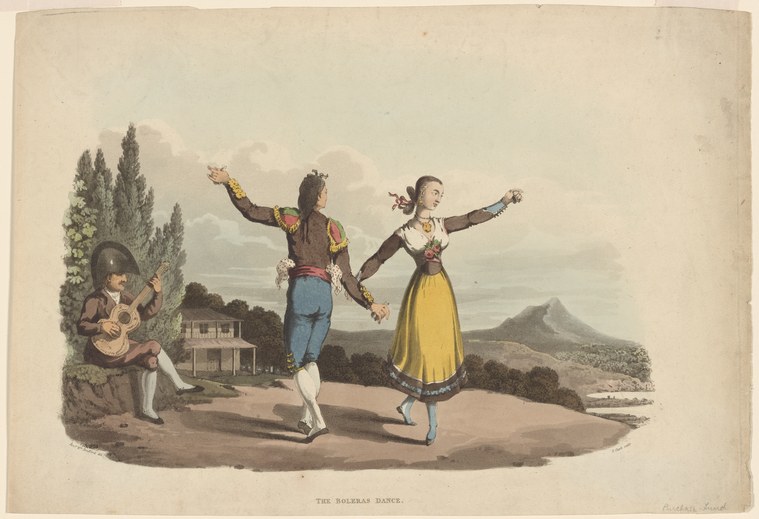
This print documents a crucial moment in the Europeanization of Spanish dance: the transformation of the bolero from a social form into a Romantic theatrical fantasy. For dance historians, it reveals the visual strategies by which regional and colonial dance forms were absorbed, simplified, and aestheticized to appeal to metropolitan audiences and to legitimize their performance on the concert stage.
What you are looking at
A hand-colored engraving depicting a couple dancing outdoors in a Romantic-era landscape. The male dancer, in a dark military-style jacket with gold trim and blue breeches, executes a dramatic leap or bound with his arms flung wide. His female partner, in a yellow Empire-waist dress with a dark corsage and headdress, mirrors his pose with arms extended in a complementary gesture. They occupy the center of a sunlit clearing, with a seated female musician playing a guitar in the left foreground, a simple cottage visible in the middle distance, and a distinctive peaked mountain rising beyond. Tall cypress trees frame the left side. The composition suggests a moment of culmination or climax in the dance, with both figures lifted from the ground in synchronized exuberance. The print's title, "The Boleras dance," is inscribed at the bottom.
The dancing
Both dancers are captured mid-leap, their bodies weightless and symmetrical, with arms raised to full extension and slightly turned outward. The male dancer's posture is more athletic and forceful, his torso bent slightly backward; the female dancer's frame is more upright and graceful. Neither figure shows closed-position contact; instead, they relate through mirrored spatial arrangement and synchronized lift. The pose is theatrical rather than socially intimate, suggesting performance rather than partner connection in the ballroom sense.
The dance depicted
The work is titled "The Boleras dance" and depicts what appears to be a stylized, theatrical interpretation of bolero rather than the Spanish flamenco form. The simultaneous lifting of both partners with outflung arms is consistent with Romantic-era theatrical renderings of Spanish and Spanish-inflected dances. The outdoor setting, the presence of a guitarist, and the mountainous landscape suggest Iberian or Mediterranean romance—a key theme in European theater and visual culture of the early 19th century. However, the synchronized, quasi-balletic leap is more characteristic of theatrical romance than of the actual social bolero, which typically featured less formal partnering.
How it was made
This is a hand-colored engraving, as evidenced by the fine parallel line-work for shadow and the delicate tinting applied by hand in transparent washes—particularly visible in the sky, costumes, and landscape. The technique allowed for wide distribution to a middle-class print-buying public interested in dance, theater, and fashionable entertainment. The hand-coloring makes each impression unique and indicates a work of some modest value, neither mass-produced in the manner of later chromolithographs nor as precious as an original drawing.
About this work
This engraving presents the bolero as a Romantic spectacle of Spanish passion and outdoor leisure. The image is not a document of actual dance practice but a theatrical fantasy: the symmetrical, acrobatic leap, the soulful guitarist, the picturesque landscape, and the radiant mountain all belong to the visual language of Romantic nationalism and exoticism that gripped European art in the early 19th century. The bolero itself—a Spanish and Latin American couple dance with strong hip and body movement—is reinterpreted here through the vocabulary of high Romantic ballet: verticality, symmetry, weightlessness, and the subordination of erotic or social complexity to an idealized moment of synchronized beauty.
For historians of dance imagery, the work illustrates how European printmakers of the period adapted Spanish and Spanish-American dances into forms legible to their own theatrical and balletic conventions. The coupling of the guitar with a Romantic landscape also reveals how the bolero was marketed to northern European audiences as a marker of sensibility, passion, and cultural otherness.
How to look at it
Attend to the symmetry of the pose: both dancers are lifted identically, arms equally extended, bodies at the same angle. This perfect mirroring is a signature of theatrical convention and would be nearly impossible in actual social dancing. Notice also what is not here—there is no lower-body action, no hip movement, no footwork detail. The bolero in actual practice involved complex rhythmic footwork and sinuous hip and torso movement; none of that is visible in this image. What the artist has chosen to emphasize is the moment of maximum verticality and lightness, the body's triumph over gravity. This is the vocabulary of Romantic ballet applied to a Spanish form.
The period
The Romantic era (approximately 1800–1850) saw an explosion of interest in folk, regional, and "exotic" dance forms across Europe. Spanish and Spanish-American dances—bolero, cachucha, tarantella—became fashionable subjects for composers, choreographers, and printmakers. The bolero, which originated in Spain in the late 18th century, was already familiar to Parisian and London audiences through the theater by the 1820s. Simultaneously, the rise of theatrical dance as a serious artistic form—led by figures like Marie Taglioni and the Romantic ballet—created a template for how all dances were visualized: as weightless, vertical, symmetrical, and often nonsexual. This engraving sits at the intersection of two trends: the vogue for Spanish dance and the dominance of Romantic ballet aesthetics in the representation of movement.
Where it lives
This print is held in the New York Public Library's collection of prints depicting dance. It is part of a broader archival record of how dance was represented and circulated through print media in the 19th century.
Dance in this work
Questions about this work
What is the bolero, and is this an accurate depiction?
The bolero is a Spanish couple dance that originated in the late 18th century and became popular across Europe and Latin America. This image is a romantic idealization rather than a faithful representation. Actual bolero emphasized hip and torso movement, rhythmic footwork, and a more intimate partnering than the symmetrical, balletic leap shown here. What we see is a theatrical transformation of the bolero for European concert and print audiences.
Why are both dancers lifted off the ground at once?
This pose reflects Romantic-era theatrical convention. The elevation (or 'jump') became a signature of Romantic ballet, especially after the rise of female dancers on pointe. By depicting both partners in perfect synchronization and weightlessness, the engraver renders the bolero legible to European audiences through the visual language of ballet, even though the bolero was never primarily a jumping or acrobatic dance.
What does the guitarist in the foreground tell us?
The guitar establishes the Iberian, specifically Spanish, context of the dance. The guitarist is a stock figure in European representations of Spanish and Spanish-American life. Her seated, subordinate position relative to the dancers also reveals the hierarchy of the image: the dance (and the dancers' bodies) is the subject; music and musician are supporting decoration.
Why does the engraver include a landscape with a mountain?
The romantic, distinctly non-urban setting—countryside, peaked mountain, simple cottage—is part of the visual mythology of Spain that circulated in northern European art. It suggests the bolero as an expression of authentic, rural, national character, closer to nature than to the artificial conventions of the city. This landscape conventions also elevate the dance from social entertainment to an expression of natural passion and national identity.
More dance artwork





