49 works in this view — arrow keys or swipe to move between them.
Dance in Art
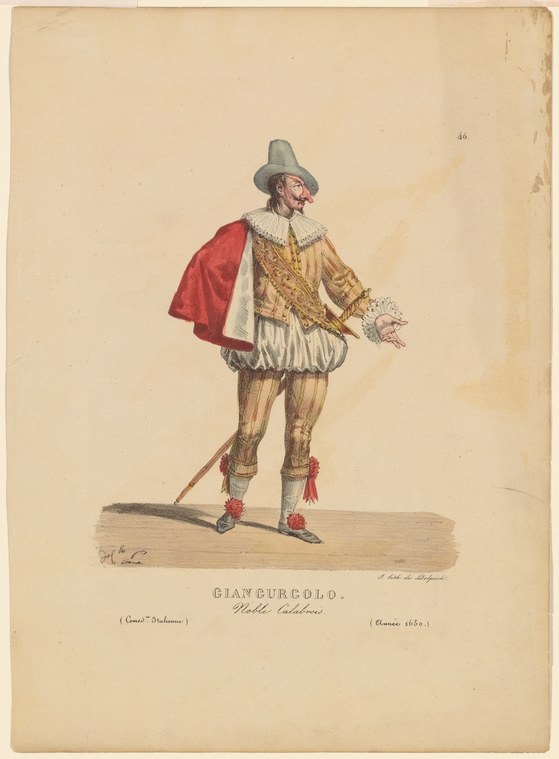
Giangurgolo, noble Calabrois
Unknown artist
- Collection:
- Prints depicting dance
- Source:
- New York Public Library
- Rights:
- Public domain — free to use, share and adapt.
- Recorded as:
- Public Domain
Commedia dell'arte was foundational to the development of gesture and comic physicality in European performance, influencing later dance and theater profoundly. This image documents the actual costume, proportions, and characteristic attitude of a specific stock character, preserving evidence of how these roles were embodied and presented on stage.
What you are looking at
A single male figure stands in three-quarter profile against a pale background, posed in a theatrical stance characteristic of commedia dell'arte performance. He wears a gold-and-yellow patterned doublet with prominent white puffed breeches, a white ruffled collar, and a red cape that drapes from one shoulder. A feathered hat sits atop his head at a jaunty angle. His right arm extends outward in an emphatic gesture—palm open, fingers spread—while his left arm hangs naturally. His posture is upright and commanding, with weight shifted slightly forward onto his front leg, the back leg extended. Red ornamental ribbons or bows accent the hose at his ankles. The figure occupies most of the composition, positioned slightly left of center, rendered in hand-colored engraving with fine detail in the costume and confident line work in the body.
The dancing
The single dancer (or performer) is captured mid-gesture rather than mid-step: his weight is engaged and mobile, leaning forward with a slight twist through the torso, but the primary action is manual—the open, expansive right-hand gesture that reads as exhortation, invitation, or rhetorical flourish. The arm position and the tilt of the head suggest an actor-dancer comfortable with pantomime and expressive rhetoric rather than balletic line. The stance is grounded and playful rather than ethereal.
The dance depicted
This is a portrait of a commedia dell'arte character, almost certainly Giangurgolo, a stock figure of Calabrian origin (the title specifies "noble Calabrois"). Commedia dell'arte incorporated stylized movement, comic gesture, and physical comedy alongside dialogue and song. The pose captures not a moment of choreographed dance but rather a characteristic theatrical attitude—the kind of commanding, rhetorical stance a character-actor would hold to command attention or deliver a quip. Giangurgolo was a servant or zanni figure known for physical expressiveness, wit, and acrobatic capability; this image fixes the moment of theatrical presence rather than active movement.
How it was made
This is a hand-colored engraving, recognizable from the fine parallel line work (hatching and cross-hatching) used to model form and shadow, and the precise contour lines that define edges. The coloring appears to be applied after printing—the yellow, gold, and red pigments sit on the surface with the quality of period watercolor or gouache. This technique allowed for fairly economical reproduction of theatrical costume designs and portrait studies; such prints were sold individually or in series to document performers, roles, and fashions, circulating among theater patrons and as souvenirs of celebrated actors.
About this work
This hand-colored engraving documents a commedia dell'arte character type—Giangurgolo, identified as a noble Calabrese servant or zanni—frozen in a moment of theatrical self-presentation rather than choreographed dance. Commedia dell'arte was a form of improvisational theater that blended dramatic speech, physical comedy, and stylized movement; while not dance per se, it shared the stage with dance and incorporated similar principles of exaggerated gesture, stock postures, and the body as a primary instrument of expression. The print belongs to a large tradition of theatrical portraiture that documented celebrated actors and iconic character types for a print-buying public fascinated by performance. Its inclusion in a collection of dance imagery reflects the historical proximity and overlap between theatrical movement, comedic physical performance, and formalized dance in the early modern period.
How to look at it
Observe the hand gesture first: it is not a ballet port de bras but a comic or rhetorical flourish, palm open and fingers spread, projecting outward and upward as if to address or invite the audience. Notice how the costume dominates the image—the puffed breeches, the red cape, the patterned doublet, the elaborate collar—each element designed to be readable from a distance and to contribute to the character's comic or boastful air. The stance is wide and grounded, not refined or closed. The expression and tilt of the head, though stylized, convey a sense of swagger and confidence suited to a servant character clever enough to navigate complex social situations.
The artist
The artist is not recorded. The print is consistent with the style and format of 18th-century theatrical costume and character prints produced in Italy and circulated across Europe; such series documented famous performers and stock characters for collectors and theater enthusiasts.
The period
Commedia dell'arte was at its height of popularity and international circulation in the 17th and 18th centuries, particularly in Italy, France, and Central Europe. In the same period, dance was becoming increasingly formalized and codified—court dances were being published in dance notation, and ballet was beginning to separate as a distinct theatrical art. The boundary between theater, dance, and physical entertainment was fluid; actors trained in both dance and dramatic movement, and the physical vocabulary of commedia dell'arte influenced choreographed dance. Theatrical prints like this one were popular commodities, documenting both the glamour of stage costume and the physical charisma of celebrated performers.
Where it lives
The print is held in the New York Public Library's collection of prints depicting dance. It is catalogued with minimal metadata, suggesting it may be part of a larger uncatalogued or loosely catalogued series of theatrical costume and character studies.
Questions about this work
Is this actually a dance?
Not in the modern sense of choreographed dance, but commedia dell'arte was a fully physical performance form that incorporated stylized movement, gesture, and comic physicality. Performers trained in both speech and movement, and the vocabulary of exaggerated, readable gesture that commedia dell'arte developed influenced later dance and theater significantly. This print documents the theatrical body and its expressive repertoire.
Who was Giangurgolo?
Giangurgolo was a stock character type in commedia dell'arte, typically a Calabrese servant or zanni (comic servant). The character was known for physical expressiveness, wit, and acrobatic or comic business. Different actors played the role with variations, but the costume and basic character type remained consistent across performances.
Why is this in a dance collection?
Commedia dell'arte shares historical and performative ground with early modern dance; the boundary between theatrical movement and dance was not sharp. The physical training, expressive gesture, and bodily control evident in commedia dell'arte directly influenced the development of ballet and theatrical dance. Prints documenting theatrical performance of this era are valuable evidence of how the body was understood and deployed on stage.
More dance artwork





