49 works in this view — arrow keys or swipe to move between them.
Dance in Art
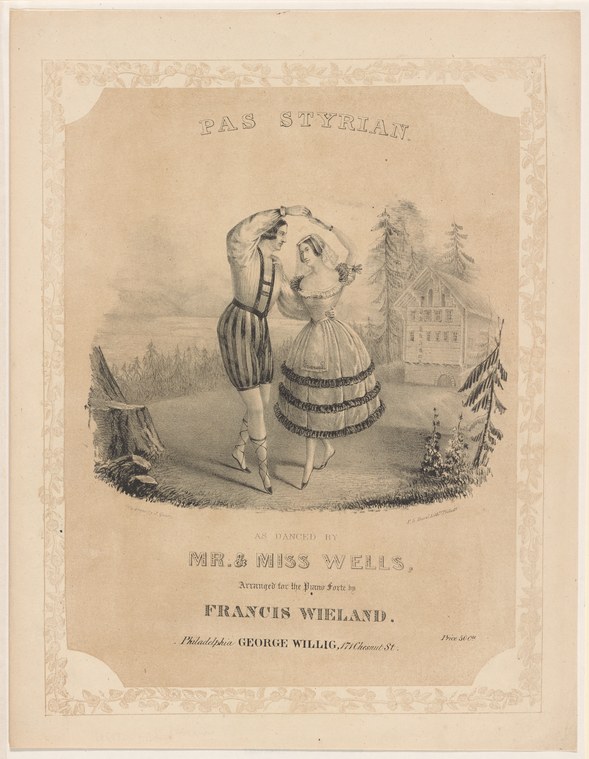
Pas styrian, as danced by Mr. & Miss Wells, arranged for the piano forte by Francis Wieland
Unknown artist
- Collection:
- Prints depicting dance
- Source:
- New York Public Library
- Rights:
- Public domain — free to use, share and adapt.
- Recorded as:
- Public Domain
The image is evidence of the Styrian's presence in American urban dance culture by the 1830s–1840s and documents the role of professional dance couples (Wells) in promoting and teaching fashionable dances to paying students. It shows how folk dances crossed national and class boundaries through publication and professional performance, and how the engraving industry enabled the rapid dissemination of choreography and technique.
What you are looking at
A young couple dances in a wooded alpine setting dominated by a tall chalet or inn in the background. The man, in striped trousers and a dark jacket, holds the woman's raised hand while looking up at her face; the woman wears a full-skirted dress with horizontal bands of trim or ribbon, her posture graceful and elongated. The composition is intimate despite the outdoor setting—the dancers occupy the foreground while evergreen trees and the architecture frame them loosely. The engraving technique renders the scene in fine gray tones with delicate crosshatching; the ornamental border suggests this is a published sheet music cover or dance instruction illustration. The lighting is soft and diffuse, emphasizing the leisurely, courtly nature of the moment rather than vigorous exertion.
The dancing
The couple stand in a three-quarter pose that allows the viewer to read both dancers' bodies simultaneously. The man's arm is raised and extended; the woman's arm mirrors his in a lifted, open frame. Both dancers appear upright and poised rather than flexed or grounded; their weight seems evenly distributed, suggesting a walk or glide rather than a bounce. The man gazes upward toward his partner's face while she looks somewhat to the side in the demure convention of the period. The relative height difference and the formality of their carriage suggest trained social dancers of the Romantic era.
The dance depicted
The title 'Pas Styrian' identifies this as a Styrian dance, a couple dance originating in Styria (then part of the Austrian Empire). The image shows a country dance or folk couple dance adapted and refined for ballroom society, likely during the 1830s–1840s when European folk dances were fashionable in upper-class drawing rooms. The pas (step or figure) format and the formal clothing indicate this is the ballroom version, taught and performed by professionals like Mr. and Miss Wells (named on the cover). The open arm position and upright carriage align with early Romantic-era ballroom technique, and the alpine setting references the dance's Tyrolean origin while maintaining the social fiction of refined urban performance.
How it was made
This is an engraving, identified from the fine linear hatching, the precise line work, and the decorative border typical of 19th-century printed sheet music covers. Engraving allowed for detailed reproduction and wide distribution to music teachers, dance halls, and the amateur market; the title and credits (composer Francis Wieland, publisher George Willig of Philadelphia) are clearly legible within the print. The technique's precision makes it well-suited to convey the exact postures and dress required for teaching the dance through illustration alongside the printed music. The ornamental border frames the scene like a window, a convention that emphasized the work's status as a published commodity and an object for framed display.
About this work
This is a music-cover engraving depicting the Pas Styrian as danced by professional performers Mr. and Miss Wells. The Styrian was a Central European couple dance that entered fashionable ballroom society during the early Romantic period, usually in polka-like or waltz-like rhythm. The engraving documents both the dance itself—through the precise rendering of posture and arm position—and its social circulation as a published musical work and instructional image. It represents the 19th-century trade in European folk-dance arrangements for middle-class ballroom use, a major pathway by which regional dances became cosmopolitan.
How to look at it
Notice the woman's elongated, lifted posture and the open arm frame between the dancers—these are markers of Romantic-era ballroom technique, far removed from the rigid, close hold of Regency-era dancing. Observe the moment the engraver chose: a pause in the step, with both dancers upright and facing the viewer, which makes the pose legible and teachable rather than capturing mid-motion. The alpine setting and the rustic styling of the woman's dress signal the dance's folk origin while the refined execution and fashionable tailoring of the man's coat signal its transformation into a society dance.
The artist
The artist is not recorded. The engraving was published by George Willig, a major Philadelphia music and dance publisher active from the 1810s through the 1850s, who was known for producing sheet music covers with dance illustration. The specific engraver may have been a studio hand working within Willig's shop; the refined technique and the standardized format suggest professional commercial production rather than individual artistic attribution.
The period
The 1830s–1840s were the height of the Romantic era in Europe and America, marked by enthusiasm for folk and national dances as expressions of regional character. Austrian and German dances—the waltz, the polka, the Styrian, the Tyrolienne—were intensely fashionable in ballrooms from Vienna to London to New York. The period saw the professionalization and codification of social dance through published instruction books, musical arrangements, and celebrity dance couples who performed and taught. Simultaneously, engraving and lithography had made dance and music publishing a major commercial enterprise, with sheet music covers doubling as advertisements for performers and as instructional aids.
Where it lives
The engraving is held in the New York Public Library's collection of prints depicting dance. It is a commercial sheet music cover published by George Willig of Philadelphia and was intended for both musical performance and dance instruction.
Dance in this work
Questions about this work
What is the Styrian dance?
The Styrian is a couple dance in moderate 2/4 time originating in Styria (now part of Austria). It resembles a polka or a slow waltz and was danced in folk contexts with vigorous turning and stamping. When it entered fashionable ballrooms in the 1830s–1840s, it was refined into a more elegant, controlled form, as shown here. The open arm position and upright carriage distinguish it from the closed-hold waltzes of the same period.
Who were Mr. and Miss Wells?
They were professional dance performers and teachers active in American cities in the early 19th century. Their names on sheet music covers like this one indicate they had taught and popularized specific dances, likely through performances and paid instruction. They were among the celebrities of the social dance world who shaped fashionable technique.
Why was this engraved and published as sheet music?
Sheet music covers with dance imagery served multiple purposes: they advertised the performers and composers, provided visual instruction in posture and frame for dancers learning from the music, and were collected and displayed in homes. Publishing dance music and imagery together was standard practice for making dances accessible to the amateur market and the professional dance world.
What does the alpine setting tell us?
The trees and chalet reference the Tyrolean or Alpine origins of the dance while maintaining a romanticized, picturesque view suited to fashionable taste. In reality, professional performers like Wells would have danced this in ballrooms and theaters, not outdoors. The pastoral setting is a convention that emphasizes the dance's 'authentic' folk roots while presenting it as an object of refined aesthetic appreciation.
More dance artwork





