49 works in this view — arrow keys or swipe to move between them.
Dance in Art
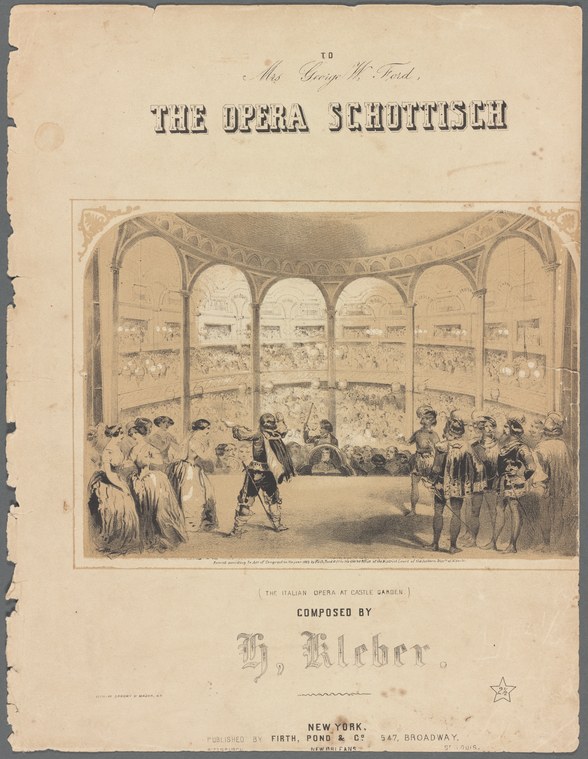
The opera schottisch: (the Italian opera at Castle Garden)
Unknown artist
- Collection:
- Prints depicting dance
- Source:
- New York Public Library
- Rights:
- Public domain — free to use, share and adapt.
- Recorded as:
- Public Domain
This print is one of the clearest visual documents of the schottische in its heyday, and it captures the specific American ballroom culture of the Civil War era. For dance historians, it establishes the posture, hold, and group formation of the dance in a real venue; for social historians, it evidences the popularity and respectability of commercial public dancing in antebellum New York.
What you are looking at
This is a hand-colored engraving depicting a ballroom scene at Castle Garden, a popular entertainment venue in nineteenth-century New York. The composition is framed by a theatrical proscenium arch with ornate ironwork and five large rounded windows above, packed with rows of spectators watching the dance floor below. The dance floor itself occupies the foreground and middle ground, where couples in formal dress execute a schottische. The women wear full-skirted gowns typical of the 1860s–70s; the men are in dark formal coats and trousers. The artist has captured several couples at different moments in the dance, some mid-turn, others in stepping patterns. The crowd in the background—partially visible through the architectural frame—suggests the scale and public nature of the event. The light is even and architectural, emphasizing the geometric structure of the venue and the orderly arrangement of dancers and spectators.
The dancing
The dancers are shown in couples maintaining closed or near-closed ballroom holds, typical of the schottische. The women's full skirts create strong visual arcs as they turn; several appear to be mid-rotation, their bodies leaning slightly into the turn. The men are upright and formally postured. The artist has rendered multiple couples at different phases of the step pattern, suggesting a circular or processional movement around the dance floor. The posture is upright and restrained—this is ballroom dance, not folk or theatrical performance. No extreme lift, extension, or dramatic gesture; the movement vocabulary is contained and social.
The dance depicted
The schottische was one of the most popular social dances of the mid-to-late nineteenth century, a round dance in 2/4 time combining hoplike steps with a turning motion. It originated in Northern Europe (possibly Bohemia) and spread rapidly through ballrooms across North America and Europe from the 1850s onward. This image documents its place in commercial public dance spaces in 1860s New York. The title's reference to 'the Italian opera at Castle Garden' may indicate a themed evening or simply mark the occasion; Castle Garden hosted a wide range of entertainments. The dancers' formal dress and restrained technique indicate a respectable, middle-class social setting, not a working-class dance hall.
How it was made
This is a hand-colored lithographic print, a reproductive medium that allowed mass distribution of images to a broad public audience. The composition is rendered in fine line work with subtle tonal variation, typical of mid-nineteenth-century commercial lithography. The hand coloring—visible in the women's gowns, the architectural detail, and the spectators—was applied after printing, often by workshop assistants. This technique was standard for popular prints of entertainment and social scenes, making such imagery widely affordable and circulated. The print's inclusion in a collection titled 'Prints depicting dance' suggests it was valued as a document of social practice as well as a picturesque scene.
About this work
This is a commercial lithographic print from the 1860s–70s documenting the schottische as danced in the major public ballrooms of New York. Castle Garden, located at the Battery at the southern tip of Manhattan, was one of the city's premier venues for public entertainment, and this image captures its formal ballroom culture at mid-century. The print serves as both a visual record of the dance itself—its hold, frame, and step patterns—and a document of the social and architectural context in which it was performed. The engraver has chosen to emphasize the theatrical scale of the venue, the orderly arrangement of spectators, and the formal comportment of the dancers, presenting ballroom dance as a respectable, organized, and visually spectacular form of public entertainment.
How to look at it
Attend to the posture and hold of the couples: notice how upright and controlled the dancers are, how the women's bodies follow their partners' lead without pronounced extension or turn-out. The schottische is not a ballet; it is a social dance executed with restraint and propriety. Look also at the frame of the room: the artist has chosen to show the dance from a vantage point that emphasizes the crowd and the architectural monumentality of the venue, not an intimate view of footwork. This compositional choice—framing the dance within the grand interior—reflects nineteenth-century attitudes toward public ballroom dancing as a social spectacle to be observed from a distance, not a participatory folk activity.
The artist
The composer D. Richer is credited on the print; this appears to be a musical publication with engraved illustration, likely released by the New York music publisher Firth, Pond & Co., whose imprint appears at the bottom. The artist of the engraving itself is not recorded. Firth, Pond & Co. (later Pond & Co.) was one of the leading music publishers of the mid-nineteenth century, specializing in popular dances, marches, and operatic arrangements for piano and voice. Such firms routinely commissioned engravings of ballroom scenes to illustrate their publications, both for aesthetic appeal and as implicit endorsement of the music as fashionable and socially current.
The period
The schottische enjoyed peak popularity in American ballrooms from roughly 1850 to 1880, overlapping with the waltz and preceding the quadrille's decline. The 1860s–70s, the likely date of this print, was a golden age of public ballroom dancing in American cities, even amid the Civil War. Castle Garden itself had opened in 1824 as a public entertainment venue and became especially famous for balls, concerts, and theatrical performances in the 1850s–60s. The print's publication by a major New York music house reflects the commercialization and democratization of ballroom culture in the nineteenth century: dances were no longer the exclusive property of aristocratic courts but had become objects of mass consumption, leisure, and public spectacle. The formal architectural frame—the proscenium—suggests the artist's awareness of dance as theater.
Where it lives
This is a hand-colored lithographic print from the New York Public Library's 'Prints depicting dance' collection. The printed attribution at the bottom identifies the publisher as Firth, Pond & Co. of 247 Broadway, New York, and credits the composer as D. Richer. The print appears to be the illustrated cover or interior page of a published schottische dance composition.
Dance in this work
Questions about this work
What is a schottische?
The schottische is a nineteenth-century ballroom dance in 2/4 time, resembling a slow polka with hopping steps and turns. It was danced by couples in a closed ballroom hold and was one of the most popular social dances of the 1850s–80s. Originating in Northern Europe, it spread rapidly to America and remained fashionable throughout the Victorian era.
What was Castle Garden?
Castle Garden was a major public entertainment venue located at the Battery in lower Manhattan, opened in 1824. It hosted concerts, theatrical performances, public balls, and other amusements and was one of New York's premier ballroom spaces in the mid-nineteenth century.
How do I know this is a schottische and not another dance?
The title explicitly identifies it as 'The opera schottisch,' and the posture and hold of the couples—the closed ballroom frame, the restrained upright carriage, and the visible stepping patterns—are consistent with ballroom schottische technique. The formal dress and venue also confirm this as a respectable social dance, not a theatrical or folk performance.
Who danced at Castle Garden?
Castle Garden hosted public balls and entertainments open to middle- and upper-class New Yorkers. Admission was paid, making it a commercial venue rather than an exclusive private club. This print documents the ballroom culture of that public, respectable audience.
More dance artwork





