49 works in this view — arrow keys or swipe to move between them.
Dance in Art
Dance on music covers
Unknown artist
- Collection:
- Prints depicting dance
- Source:
- New York Public Library
- Rights:
- Public domain — free to use, share and adapt.
- Recorded as:
- Public Domain
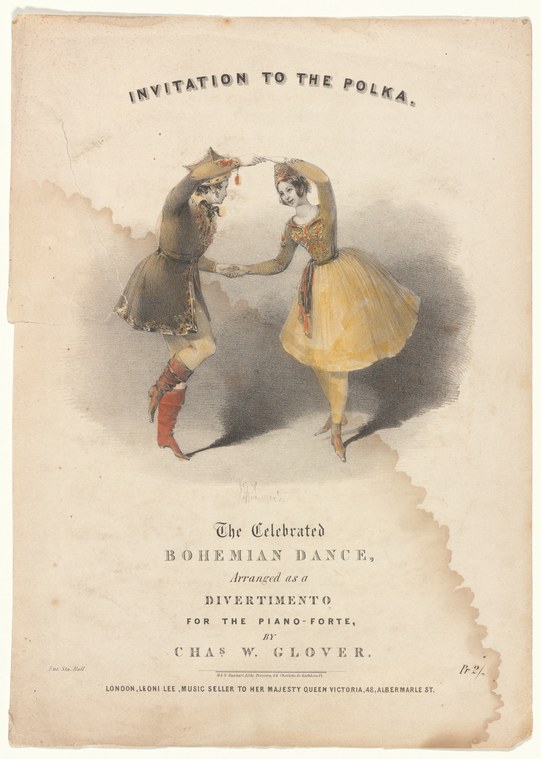
This image is evidence of how polka was commercialized and domesticated for middle-class consumption in the Victorian era. For historians of social dance, it documents the posture, dress, and physical relationship expected of polka dancers in a formal setting, preserving how the dance was supposed to be performed and understood. The survival of numerous such covers tells us which dances mattered to which audiences at which moments in history.
What you are looking at
Two figures in an elegant interior space face each other in a moment of dance instruction or invitation. The figure on the left wears dark clothing with what appears to be a military or formal jacket, red boots or stockings, and holds one hand extended toward the partner. The figure on the right wears a pale yellow skirt that balloons outward, suggesting movement or the swirl of a turn, with a fitted dark bodice. Both have their faces turned toward each other in an attitude of engagement. The composition is intimate and formal, set against a plain ground with subtle shading that suggests an interior without defining it precisely. The overall tone is one of courtship or social dancing instruction in a refined setting.
The dancing
Both dancers are positioned in a gentle diagonal relationship, neither in a closed ballroom hold nor completely apart. The left figure's arm extends in an invitational gesture, while both dancers appear light on their feet. The right figure's full skirt is caught in motion, suggesting a turn or pivot. Their postures are upright and controlled, consistent with formal social dance of the 19th century. The physical relationship suggests instruction, flirtation, or the opening moment of a dance sequence.
The dance depicted
The image depicts the polka, a social dance of the 19th century that was performed by couples in a sprightly, turning manner. The title and the evidence in the image—the light, animated poses, the fashionable dress, the intimate scale—all confirm this is a representation of polka dancing. The polka was enormously popular in ballrooms and dance halls across Europe and North America from the 1840s onward, and appeared frequently on sheet music covers as a sign of fashionable entertainment. The turning posture and the woman's full skirt in motion are characteristic of how the polka was depicted.
How it was made
This is a hand-coloured engraving or lithograph, evident from the linear work visible in the background and the careful tonal shading created through line work rather than continuous tone. The technique allowed for relatively rapid reproduction and wide distribution of popular dance imagery. The hand-colouring—particularly the yellow of the skirt and the red of the boots—was applied after printing, a common practice for sheet music covers and popular prints of the period. This method of production suggests the work was intended for a mass market rather than as a unique artwork.
About this work
This is a music cover for a piano arrangement of 'The Celebrated Bohemian Dance,' presented as a divertimento for piano-forte, composed by Chas. W. Glover. The engraving depicts two dancers performing the polka, a fashionable couple dance that swept through European and American society in the mid-19th century. The image serves dual purposes: it announces the contents of the musical publication and presents an idealized image of the dance as it was performed in polite society. Music covers were a primary medium through which images of dance reached the public, making them documentary evidence of how dances were understood and represented in their moment. The work belongs in a gallery of dance in art because it captures not only the visual spectacle of a popular dance but also the commercial and social infrastructure through which dance was circulated and consumed.
How to look at it
Notice the precise moment the artist chose: not a full turn but the instant of invitation or the opening of a step, with the dancers' bodies still displaying the initial attitude of courtesy. The woman's skirt is caught billowing, a convention of dance imagery used to indicate motion and lightness. The formal dress and refined interior setting communicate that this is ballroom polka—respectable, fashionable, and performed by people of means—rather than folk or working-class dancing. The hand-colouring technique creates a slightly artificial, poster-like quality that emphasizes the idealized nature of what is shown.
The artist
The composer is identified as Chas. W. Glover, a musician active in Victorian London. The engraver is not credited in the visible catalogue record. Sheet music publishers of the period—here, Lionel Lee Music Seller to Her Majesty Queen Victoria of Albermarle St—employed staff engravers and colourists, making the image a collective product rather than the work of an identifiable individual artist. The publisher's royal warrant suggests an establishment of considerable standing.
The period
The polka originated in Bohemia in the 1830s and became a craze across Europe by the 1840s and 1850s. In Victorian England, it was one of the principal couple dances of the ballroom, performed alongside the waltz and quadrille. The 1850s and 1860s saw an explosion of polka-themed sheet music, with hundreds of compositions published for amateur musicians to play at home or in ballrooms. The dance represented modernity, continental sophistication, and a degree of physical ease between dancers that was considered daring by some and progressive by others. Visual representations of the polka in prints and on sheet music covers became a standard way to advertise and disseminate both the music and the dance itself.
Where it lives
This engraving is part of the NYPL's prints collection documenting dance. It is held as a music cover and print, not as a unique manuscript or one-of-a-kind artwork. Such covers were mass-produced and widely distributed, making the survival of individual examples valuable primarily as historical documentation rather than as precious objects.
Dance in this work
Questions about this work
What is a polka and why is it on a sheet music cover?
The polka is a couple dance in moderate duple metre, originating in Bohemia in the 1830s and becoming fashionable across Europe and America by the 1840s. Sheet music publishers added dance imagery to covers because music and dance were complementary entertainments; amateur musicians bought the music to play at home while dancers performed the steps, and the visual of the dance on the cover made the music more appealing and helped convey the character of the piece.
How were these prints made and coloured?
The image was engraved or lithographed in black and white, then hand-coloured after printing. This allowed publishers to produce thousands of copies rapidly while still offering colour imagery, which was expensive to achieve through mechanical means in the 19th century. The visible brushwork and slight variation in the coloured areas shows the hand-finishing.
What does this tell us about how the polka was performed?
The upright posture, the formal dress, the intimate but not tightly joined hold, and the ballroom setting all confirm that this is ballroom polka as performed by the middle and upper classes. The woman's full skirt and the turning posture indicate the characteristic spinning motion of the dance. The refinement and restraint of the depiction shows that polka was considered a respectable, fashionable dance by the 1850s, not a vulgar or transgressive one.
Who was Chas. W. Glover?
Glover was a Victorian-era composer active in London. Little is recorded about his individual biography in standard references, but his publication by a royal-warrant holder indicates he was part of the established music publishing world. Many composers of the period wrote polka arrangements and variations as popular commercial products.
More dance artwork





